




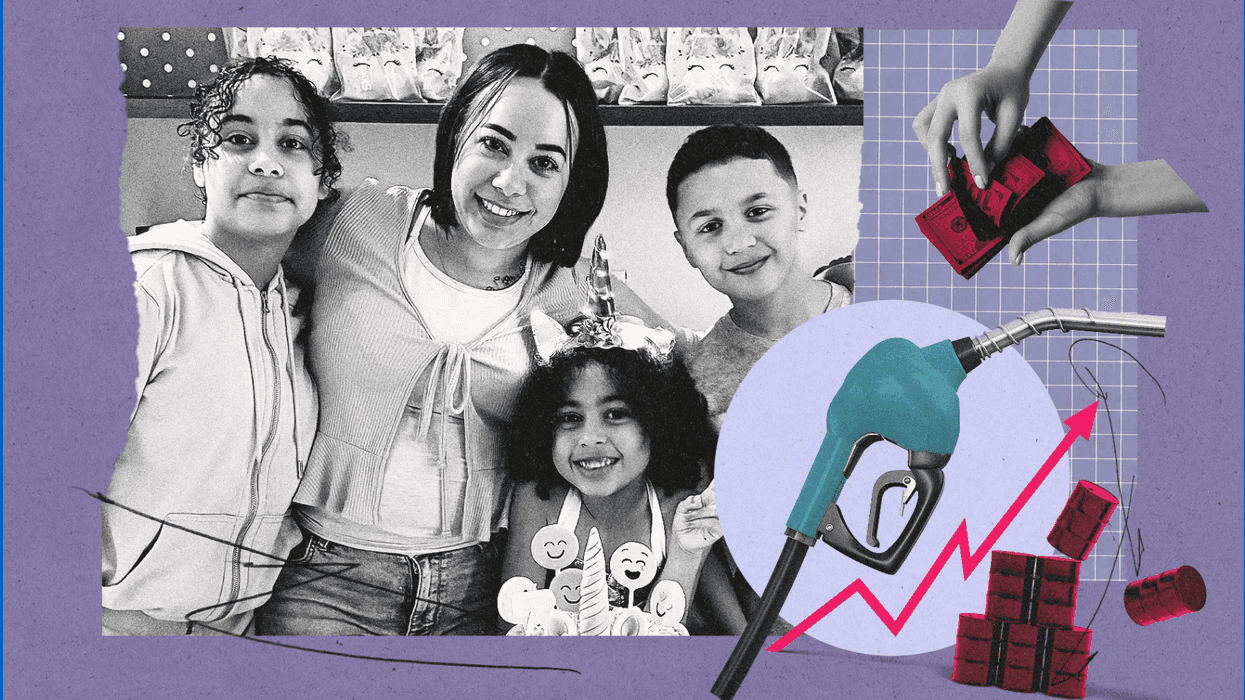

The rise in gas prices happened so quickly, single mom Luna Rosado has barely had time to adjust.
Rosado fills her tank twice a week to commute to her two health care jobs and shuttle her three kids to school, basketball and soccer practice.
This month, as costs have risen 30 percent after the start of war in Iran, she’s been paying about $40 more a week on gas. That’s $160 less a month for groceries and everything else they need. Rosado has since had to calculate and recalculate her budget, seeing where she can find the room to absorb the changes.
“It felt almost impossible in the beginning because I didn’t know how to approach the situation. Everything’s just getting more expensive,” said Rosado, who lives with her three kids, ages 11, 9 and 7, in Plainville, Connecticut. “I’m like, ‘I can’t keep up.’”
The impact of gas prices is so broad it could sway the midterm elections. After the United States and Israel attacked Iran at the end of February, leading Iran to close the Strait of Hormuz and cut off a quarter of the world’s oil supply, single moms are one group that feels it all the more acutely as they balance rising costs on one income.
Chastity Lord, the president and CEO of the Jeremiah Program, which works with low-income single mothers, hears stories like Rosado’s nearly daily, she said — the single mom and teacher who is crashing on a friend’s couch to save on gas, or the single moms who are gig workers cutting back their Uber or DoorDash driving hours.
As of this week, the average price of a regular, unleaded gallon of gas is just over $3.97 — more than $1 higher than what it was a month ago, according to AAA. In some states, like New Mexico, prices are up as much as 40 percent, according to a New York Times analysis of data from GasBuddy, a gas price finder app.
“Gas cuts through everything,” Lord said. As a single mom, “you’re already underwater, and it’s almost like the gas puts weights on your feet.”
More than 4 in 5 single parents are women, and the majority of those are Black women and Latinas. Their median income is also about $17,000 less than single fathers. And though single moms work at higher rates than married mothers, they are also more likely to be paying more to fuel their commute — and spending a larger share of their income at the pump.
The families spending the highest percentage of their income on gas — about 4.3 percent — are those earning $40,000 to $49,999 a year, according to consumer expenditure data from 2024. That’s the exact bracket where many single moms are concentrated; the median income for single mothers working full-time is about $40,000.
Single moms “are going to be the first ones to feel any economic problem going on,” said Sara Estep, an economist with the Center for American Progress, a liberal think tank.
“Because there is only one person earning money for the family, that creates a lot of sensitivity to these prices. There is very little room left to pivot at that point,” she said.
Low-income people, Lord said, are also rarely filling up their tanks the whole way, but rather putting in what they can as they go. They have increased visibility into the price jumps because they’re watching them closely day to day. “This is something that is poking you daily as you go put the gas in your car,” she said.
It becomes about tradeoffs — what can you live without? For moms, it means cutting back on going out with their kids to just focus on the basics.
Rosado, the mom in Connecticut, has started shopping at cheaper grocery stores and stopped driving for Uber and Lyft on the weekends because the increased gas prices would cut into her profits too much to make the time worth her while. That means losing supplemental money that was helping pay for her phone bill, child care and groceries.
“I’m a strong person so I roll with the punches, but I’ve had sleepless nights because of this — insomnia,” Rosado said. “It shouldn’t feel this way but it does.”
As a single mom of three teenagers, Heidi Dragneff has felt that weight much of this year. Dragneff said it now costs $60 to fill up her tank, by her calculation an increase of about 80 cents per gallon over the past two weeks, and she’s “terrified of what it’s going to look like” every time she goes to the pump. Her car recently broke down, too, so she’s debating the repair costs and the possibility of having to buy a new vehicle altogether.
I end up trying to make lists of budgets, like, where is all of my money going?”
Heidi Dragneff
On top of that, Dragneff’s rent increased $600 a month last year, her energy bills doubled this month and soon she’s going to lose child support in June for her eldest daughter who just turned 18, which means a cut of $400 a month. Moving is out of the question because she doesn’t have enough in savings to cover first and last months’ rent and security deposits. Recently, she stopped contributing to her 401K to cut back.
“I end up trying to make lists of budgets, like, where is all of my money going? How is it disappearing so quickly? And you go over these numbers over and over and over again, and nothing changes,” said Dragneff, who is a Navy veteran now doing organizing work for other veterans in Virginia Beach.
Single moms, she said, have to figure it out alone.
“From the outside it looks like we are these super strong women that have it all together when we are struggling just as much as anybody else, if not more,” she said. “Our kids are looking to us. It’s our responsibility, [on] our shoulders, to not lose our job, to make sure that we are able to make ends meet, keep the lights on and pay the rent.”
What’s also been challenging over the past few years, single moms told The 19th, is the unpredictability of where the price changes are occuring. A few years ago, the story was all about rising grocery prices. Now it’s gas, too.
“We don’t even know what’s going to happen day to day just watching the news,” said Taylour Grant, a single mom of four — ages 2, 7, 9 and 14 — in Tampa, Florida.

Taylour Grant, a single mom of four in Tampa, Florida, said recent cuts to her food stamps have left her with less wiggle room as gas prices climb. (Courtesy of Taylour Grant)
Grant’s food stamps were cut by nearly $200 a month recently after changes to the eligibility requirements for the Supplemental Nutrition Assistance Program went into effect in Florida last month. That means she has even less wiggle room to cut back on other things, like groceries, as gas prices climb.
She blamed the Trump administration for the instability.
“They don’t have the everyday worries that we have. They don’t have to worry about feeding their kids. They don’t have to worry about getting gas,” Grant said. “I’m pretty sure they don’t know how much a gallon of milk costs, so it’s just them not being mindful of us down here.”
With the midterm elections approaching in November, Democrats and Republican strategists have agreed that affordability will top the list of voter concerns this cycle. It’s a topic that has been highly motivational for mothers, who are often the ones managing household purchases and budgets. Women, more than men, report more concern about paying their bills in every area, according to a 19th News/SurveyMonkey poll taken in September.
Sondra Goldschein, the executive director of the Campaign for a Family Friendly Economy, which backs candidates that support issues like paid parental leave and affordable child care, is knocking on doors this election cycle talking to mothers about cost of living issues. In the organization’s conversations with voters, Goldschein said, they “are seeing people really step forward to voice their strong concerns and looking for various outlets to help make changes, whether it’s who they’re going to vote for or whether they’re going to run for office themselves.”
 Samantha Shepherd, a child care director in Savannah, Georgia, and a single mom of two girls, said rising gas prices are affecting families at her center, including one mother who may not be able to take her children to school. (Courtesy of Samantha Shepherd)
The Campaign for a Family Friendly Economy PAC this year is supporting Democrats in Senate races in North Carolina, Georgia, Michigan, Maine and Ohio and in House races in Iowa and Pennsylvania.
Lord is also hearing that the affordability crisis is mobilizing moms. At an early March conference of 600 single mothers, Lord said there was one session that was absolutely packed: “Why Women Don’t Run & Why They Should.”
“Moms are interested in being involved in campaigns, doing door knocking … There’s a deep desire to be involved in reimagining what’s possible for themselves, their family, but also their community,” Lord said. “Yes, there’s incredible stress, there’s incredible fatigue, alarm, vulnerability, but … people are like, ‘What do I need to do? Who do I need to hold accountable? What role do I play in changing what is happening in my local community?’”
“It is political,” said Samantha Shepherd, a child care director in Savannah, Georgia, and a single mom of two girls ages 6 and 7. Recently, one single mother whose children attend her center said she might not be able to take the kids to school because of the gas prices.
“We’re suffering for the drastic decisions that are being made by those who sit in the White House or those who are our legislators,” she said. “It’s important that people understand their voices need to be heard as well. Collectively, we can make a lasting sound, but if we don’t make no noise about it, they’re not even going to hear us.”
‘I Can’t Keep Up’: Many Single Moms Were Struggling To Get By. Then Gas Prices Shot Up. was originally published by the 19th and is republished with permission.
Chabeli Carrazana is an economy and child care reporter for the 19th.













The President Invited Iran to Bomb My Home