


Skip to content
Search

Latest Stories

Follow Us:
Top Stories

Voting Rights Groups Challenge Texas’ Removal of Potential Noncitizens From the Voter Roll

The plaintiffs argue Texas did not crosscheck its own records before flagging people on the voter roll as potential noncitizens.

News

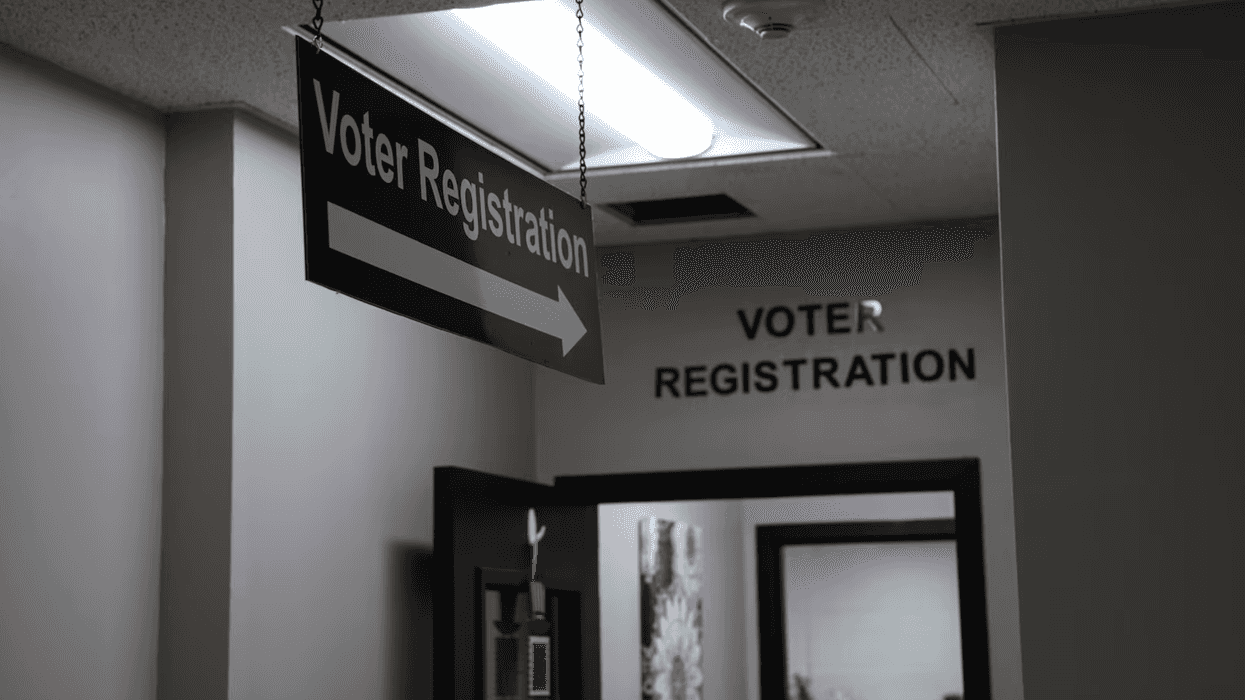
A sign that reads, "Voter Registration," hanging from the cieling, pointing to an office with the words, "Voter registration," above its doorway.

The voter registration office at the Nueces County Courthouse in Corpus Christi, Texas on Sept. 11, 2024. Voting rights groups are challenging the state's use of a federal database to check the citizenship status of people on the state's voter roll.

Gabriel Cárdenas for Votebeat

What happened?

Voting rights groups are suing the Texas Secretary of State’s Office and some county election officials to prevent the removal of voters from the state’s voter roll based on use of a federal database to verify citizenship. They also claim the state failed to crosscheck its own records for proof of citizenship it already possessed before seeking to remove voters.


What’s the dispute?

Last fall, the Texas Secretary of State’s Office announced it had used a federal database newly overhauled by the Trump administration — a tool from the Department of Homeland Security previously used for years to verify the immigration status of individuals seeking benefits — to verify the citizenship of more than 18 million Texans on the state’s voter roll. The office said at the time it had identified 2,724 “potential noncitizens,” and had directed counties to investigate.

Votebeat subsequently exclusively reported that some voters included in that figure may have already provided proof of citizenship to the state while obtaining a driver’s license or state ID at the Texas Department of Public Safety. At least one county later confirmed that some of the flagged voters there had done so.

In the lawsuit, filed in a federal district court in Austin Thursday, the plaintiffs said the database, known as SAVE, is unreliable, and that Texas’ use of it to remove people from the rolls, including some who are naturalized U.S. citizens, is a violation of the National Voter Registration Act.

The plaintiffs said in the filing, which cited reporting by Votebeat and other news outlets, that the Secretary of State’s Office “did not consult Department of Public Safety data—a known source that could confirm citizenship for many registered voters—before placing the burden on the voter to provide documentary proof.”

Who are the plaintiffs?

The nonprofit watchdog Campaign Legal Center filed the lawsuit on behalf of multiple voting rights and advocacy organizations, including the League of Latin American Citizens (LULAC), Texas LULAC, LULAC Council 102, and nonpartisan advocacy group Common Cause and its members.

What are the plaintiffs asking for?

The plaintiffs want the court to declare that the state’s removal of voters from the rolls using the SAVE database violates the National Voter Registration Act, and want the court to prohibit the Texas Secretary of State’s Office from sending lists of potential noncitizens to the counties without “further, uniform investigation,” the lawsuit says.

They also asked the court to prohibit the state and county election officials from removing people from the voter roll “solely because they have been flagged as noncitizens by the SAVE system” and to order that anyone who was removed be placed back on the voter roll until “it can be conclusively proved that such voters are not currently U.S. citizens”.

What happens now?

The state and county defendants have yet to file a response to the complaint. The Texas Secretary of State’s Office declined to comment Friday. At least one other lawsuit filed in federal court challenging the Department of Homeland Security’s use of the SAVE database is also still pending.

Read more Votebeat coverage of the state’s use of the SAVE database:


Natalia Contreras is a reporter for Votebeat in partnership with the Texas Tribune. Contact Natalia at ncontreras@votebeat.org.

Voting Rights Groups Challenge Texas’ Removal of Potential Noncitizens From the Voter Roll was originally published by VoteBeat Texas and is republished with permission.



Read More

People at voting booths, casing their votes in front of a mural depicting the American flag, a bald eagle flying, and children holding hands in the foreground.

Virginia voters cast their ballots at Robius Elementary School November 4, 2025 in Midlothian, Virginia.

Getty Images, Win McNamee

Fixing Broken Systems: America’s Path Beyond Polarization

"A bad system will beat a good person every time" is a famous quote by Dr. W. Edwards Deming, the American statistician most often credited with the Japanese economic miracle after WWII. Even talented, hardworking people cannot overcome a flawed, dysfunctional, or unfair system, making system improvement more crucial than solely blaming individuals for failures.

Fixing “bad systems” is viewed by political scientists and reform organizations as the primary path to reducing America’s political dysfunction. Current systemic structures often create "misaligned incentives" that reward extreme partisanship and obstruction rather than governance. The most prominent electoral system reforms proposed by experts include:

Keep Reading Show less
Voters lining up to vote.

Voters line up at the Oak Lawn Branch Library voting center on Primary Election Day in Dallas on March 3, 2026. Republicans' decision to hold a split primary from the Democrats and to eliminate countywide voting forced Dallas County voters to cast ballots at assigned neighborhood precincts, leading to confusion. Republicans have now decided to use countywide polling locations for the May 26 runoff election.

Shelby Tauber for The Texas Tribune

Dallas County GOP Will Agree To Use Countywide Voting Sites for May 26 Runoff Election

Dallas County Republicans will agree to allow voters to cast ballots at countywide voting sites for the May 26 runoff election after a switch to precinct-based voting sites caused chaos, the county party chair said Tuesday.

Dallas County Republican Chairman Allen West supported the use of precinct-based sites earlier this month, but said using precincts again for the runoff would expose the county party to “increased risk and voter confusion” because the county is planning to use countywide sites for upcoming municipal elections and early voting.

Keep Reading Show less
People at voting booths.

A clear breakdown of voter ID laws under the Constitution, federal statutes, and court rulings—plus analysis of new Trump administration proposals to impose nationwide voter identification requirements.

Getty Images, LPETTET

Just the Facts: Voter ID, States’ Powers, and Federal Limits

The Fulcrum approaches news stories with an open mind and skepticism, presenting our readers with a broad spectrum of viewpoints through diligent research and critical thinking. As best we can, remove personal bias from our reporting and seek a variety of perspectives in both our news gathering and selection of opinion pieces. However, before our readers can analyze varying viewpoints, they must have the facts.


Few issues generate more heat and are less understood than voter ID.

Keep Reading Show less
A person signing a piece of paper with other people around them.

Javon Jackson, center, was able to register to vote following passage of a 2019 Nevada law that restored voting rights to formerly incarcerated individuals.

The Nation Is Missing Millions of Voters Due to Lack of Rights for Former Felons

If you gathered every American with a prison record into one contiguous territory and admitted it to the union, you would create the 12th-largest state. It would be home to at least 7 million to 8 million people and hold a dozen votes in the Electoral College.

In a close presidential race, this hypothetical state of the formerly incarcerated could decide who wins the White House.

Keep Reading Show less