



Most Americans, Democrats as well as Republicans—many following the lead of President Trump—feel that it is not right for trans females to participate in women's sports. But the trans community, supported by those on the left wing of the Democratic Party, insists that this is part of ensuring the rights of trans people. The issue has been divisive among Democrats.
This is a complex issue. On the one hand, boys are boys, and girls are girls. That's the basic fact behind male and female sports, other than some intramural school sports that have boys and girls on the same team. Because boys are biologically stronger and faster than girls, separate leagues have been developed for both. This has nothing to do with gender identity; it is just a reflection of biological fact.
Into this history comes the relatively new fact of trans athletes, in particular, male athletes who transition to women. They want to continue playing, just now on women's teams.
I think the problem arises in part (the other part is transphobia) because most people don't really understand what it means to be a trans female. These are not just men who are cross-dressing, who are living their lives as females, or who are even taking shots to develop breasts. Trans women are mostly men who are changing their biological status from male to female through what's known as feminizing hormone therapy,
Since the late 70s, trans females have had access to medical therapies that alter their hormonal profile from male to female. What is the impact of such therapy? Among many physical and emotional changes, it results in a decrease in muscle mass and strength.
All studies show that, after one to three years, males receiving such therapy do not have the strength of cisgender males. However, whether their upper and lower body strength is comparable to cisgender females or somewhat higher is not clear. I found two reports that are based on multiple studies of the issue. In the one published in the British Journal of Sports Medicine, based on 52 studies, they find that trans and cisgender female body strength is comparable. In the other, based on 24 studies, they find that trans females have a slight advantage in most sports, with a significant advantage only in baseball pitching and field hockey drag flick. I found no data on the percentage of trans females who undergo hormone therapy, but a large number do.
Given the impact of feminizing hormonal therapy, I would argue that if a trans female has had the type of hormone therapy that reduces muscle mass and strength, that they should be allowed to play on female sports teams, whether in school, college, or professional. There is no "biological" basis for excluding them.
However, if they have not had such therapy, then I—as a liberal Democrat, as evidenced by my articles on Fulcrum, my blog: Preserving American Values, and my book: "We Still Hold These Truths: An American Manifesto"—would argue that they not be allowed to participate. The reason is based on the fact that biological males are stronger than females. To allow trans females who have not undergone hormone therapy to be on female teams would create an unfair advantage for such teams. This is not an issue of gender identity but one of biological sex.
Given the politically heightened public feeling against trans female athletes playing on female teams, especially in schools, it is critically important that the government, educational institutions, and other groups undertake the public education necessary to make the public aware that trans females are not just cross-dressers living their lives as women, but are people who have chosen to change their biological identity from male to female, resulting in many physical and emotional changes, among them a loss of muscle mass and strength.
Ronald L. Hirsch is a teacher, legal aid lawyer, survey researcher, nonprofit executive, consultant, composer, author, and volunteer. He is a graduate of Brown University and the University of Chicago Law School and the author of We Still Hold These Truths. Read more of his writing at www.PreservingAmericanValues.com











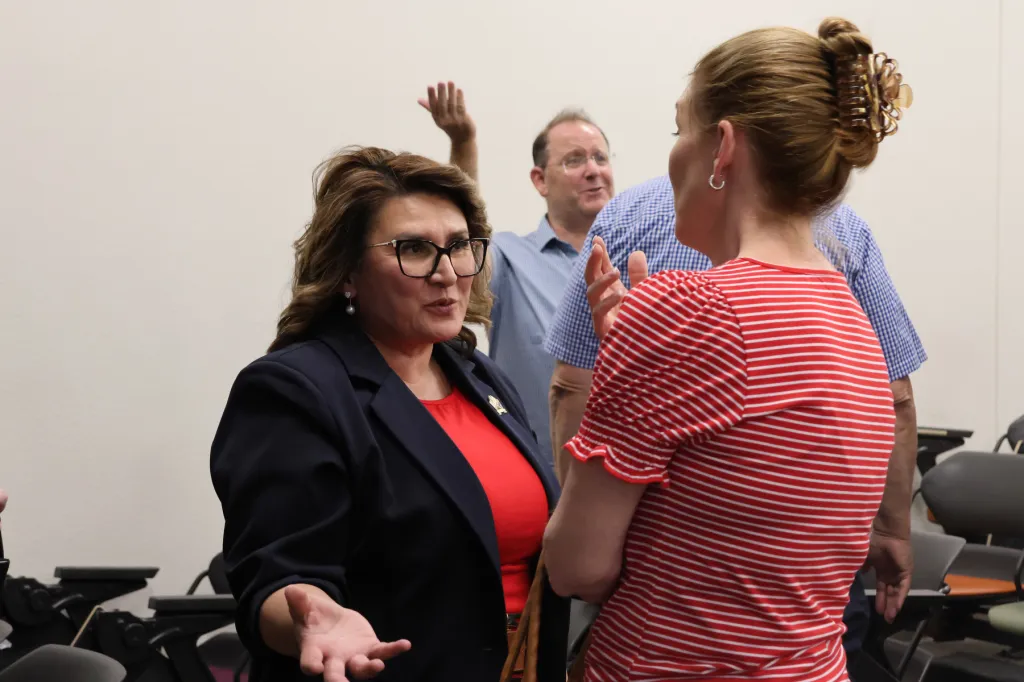 Congressional candidate JoAnna Mendoza has leaned into her working class background as she runs for a seat in the U.S. House to represent Arizona’s 6th congressional district. (Courtesy JoAnna Mendoza campaign)
 Politicians who come from working class backgrounds, like Minnesota Lt. Gov. Peggy Flanagan (center) and Minnesota state Sen. Omar Fateh (right), are resonating with voters during a particularly challenging economic period. (Stephen Maturen/Getty Images)