




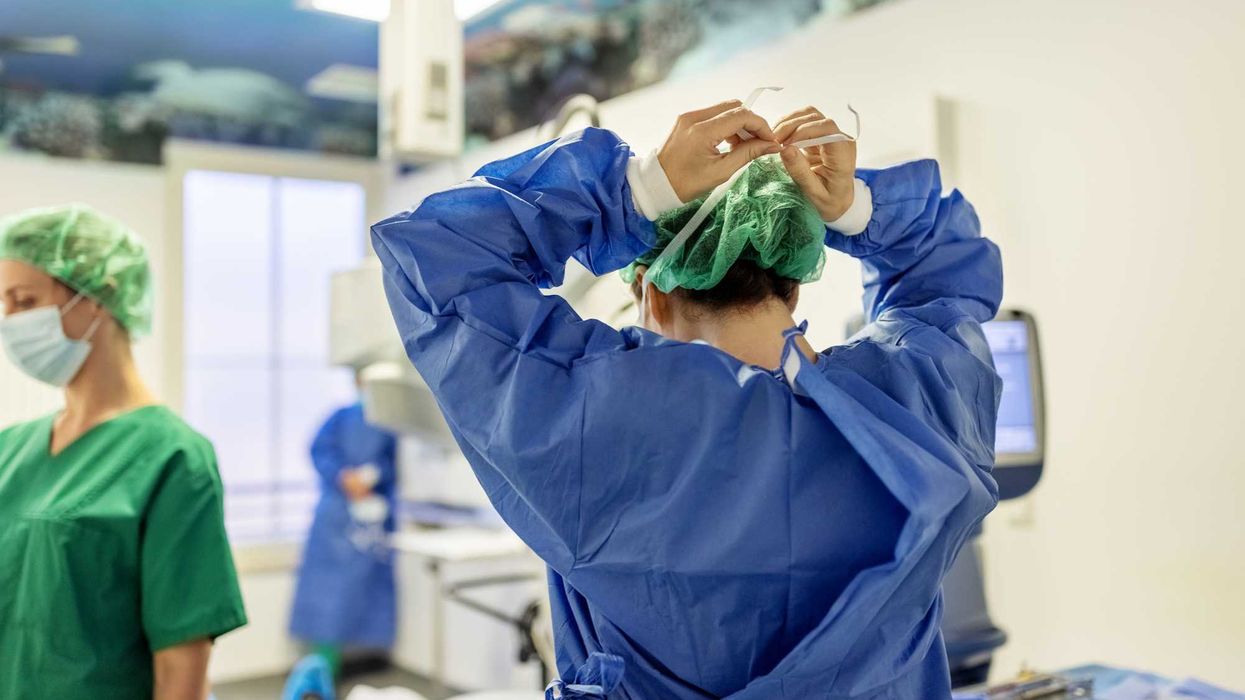

In medicine’s history, the best technologies didn’t just improve clinical practice. They turned traditional medicine on its head.
For example, advances like CT, MRI, and ultrasound machines did more than merely improve diagnostic accuracy. They diminished the importance of the physical exam and the physicians who excelled at it.
Now, an even more radical upheaval is headed for the operating room. Generative AI and surgical robotics are advancing so quickly that procedures once done solely by surgeons may soon be performed autonomously by robots. How soon this happens depends on the willingness of (a) clinicians to support the transition, (b) regulators to approve the applications, and (c) patients to trust a machine with the scalpel.
How Generative AI Plus Robotics Would Perform Surgery
The idea of a robot performing autonomous surgery (that is, completing an operation without a human guiding the controls) sounds like science fiction. But the rapid rise of generative AI since ChatGPT’s debut in 2022 has made it possible.
Hundreds of millions of people use tools like ChatGPT, Gemini, and Claude, yet most have only a vague sense of how large language models work. Contrary to popular assumptions, these large language models do far more than “predict the next word.” If that were all they did, then GenAI tools would routinely produce incoherent paragraphs and nonsensical explanations. Instead, they consistently provide sophisticated reasoning, detailed plans, and expert-level summaries.
They accomplish this through imitation. In medicine, generative AI systems are trained on a massive corpora of medical textbooks, scientific journals, surgical videos, and clinical conversations. With billions of internal parameters, the model learns to mimic how humans solve diagnostic problems, interpret images, and execute procedural tasks. With more training, its responses increasingly resemble those of expert clinicians.
Today’s models can already describe the precise steps required to remove a gallbladder. But executing those steps requires two additional capabilities:
- Training on thousands of real surgical cases to learn how expert surgeons perform operative procedures.
- A physical mechanism capable of translating surgical steps into precise movements.
That’s where existing surgical robots come in.
Modern Surgical Robotics: The Missing Link
Over the past two decades, operative robots have allowed doctors to work through smaller incisions with enhanced visualization, increased precision, and tremor-free control.
A typical robotic procedure involves the surgeon sitting at a console, watching a high-definition video feed of the operative field. Then, using hand controls, the physician directs the robot’s arms. The robot carries out movements inside the patient with sub-millimeter accuracy.
For generative AI to operate autonomously, developers would provide information and video from tens of thousands of recorded procedures. The large language model would analyze the data coming from the operative cameras inside the patient and match it to the precise hand movements surgeons make at the console in response. Over time, the model would learn to reproduce the same stimulus-response patterns that expert surgeons use — just as it currently learns to generate accurate answers or create videos following verbal or written prompts.
This approach parallels how self-driving cars are trained. But unlike the chaos of city streets (where vehicles, cyclists, and pedestrians constantly move in unpredictable ways) an operating room is a controlled space, and human anatomy is more predictable than the external environment. Generative AI will have an easier time distinguishing anatomical structures than a self-driving car has when deciding whether an object leaving the curb is a scrap of paper, a rolling ball, or a child running into the street.
In the meantime, progress in robotics continues to accelerate. Elon Musk recently predicted that Tesla’s humanoid robot project Optimus would soon be able to perform “sophisticated medical procedures — perhaps things that humans can’t even do.”
Putting The Robotic Pieces Together
The building blocks for autonomous robotic surgery already exist. Whether it becomes reality in five years or 10 will depend less on technological progress and more on how quickly and effectively hospitals, surgeons, and technology companies collaborate to train these systems.
Three changes are needed now to prepare for that future.
A. Payment models must be updated
U.S. healthcare’s fee-for-service reimbursement system rewards higher volume, not superior clinical outcomes. Hospitals earn more when operations take longer. And when reimbursement is tied to each inpatient day, there is little financial incentive to schedule procedures after hours or on weekends.
Shifting to bundled payments (a single rate for an entire surgical episode) will financially reward hospitals that perform safe, efficient surgical procedures at night and on weekends when surgeons aren’t available. By eliminating clinical delays, patients will recover sooner, reducing the demand for inpatient beds while lowering costs.
B. Regulators will need to apply different approval standards
The FDA’s current evaluation framework for AI-enabled devices focuses on the specific data sets used to train an algorithm and the consistency of its outputs. That approach works for narrow AI tools (like those that read mammograms or flag suspicious skin lesions) that are trained on specific datasets.
It does not work for generative AI, which is trained on vast, multimodal information sources and personalized inputs. A more appropriate method would evaluate actual clinical performance. For AI-directed robotic surgery, expert surgeons would review anonymized operative recordings — some performed by humans, others by the AI — without knowing which is which. Approval would be granted only when the generative AI consistently matches the quality, safety, and outcomes achieved by expert clinicians.
C. Medical culture will have to evolve
Clinicians have long resisted technologies that threaten professional autonomy, judgment, or income. Autonomous robotic surgery will be no exception.
But rising economic pressure from the growing unaffordability of care, combined with the promise of safer and more consistent outcomes, will ultimately drive adoption.
Patients will hesitate at first. Technologies that take over tasks once performed exclusively by humans always generate concern. When ATMs were first introduced, many Americans worried their deposits might disappear. But as people gained experience and the systems proved reliable, trust grew, and the technology became routine.
Generative-AI-enabled surgical robots will follow a similar trajectory.
Robert Pearl, the author of “ChatGPT, MD,” teaches at both the Stanford University School of Medicine and the Stanford Graduate School of Business. He is a former CEO of The Permanente Medical Group.















The President Invited Iran to Bomb My Home