The principle is simple. Just like politicians are not supposed to pick their voters, government officials don’t get to pick the reporters who cover them.
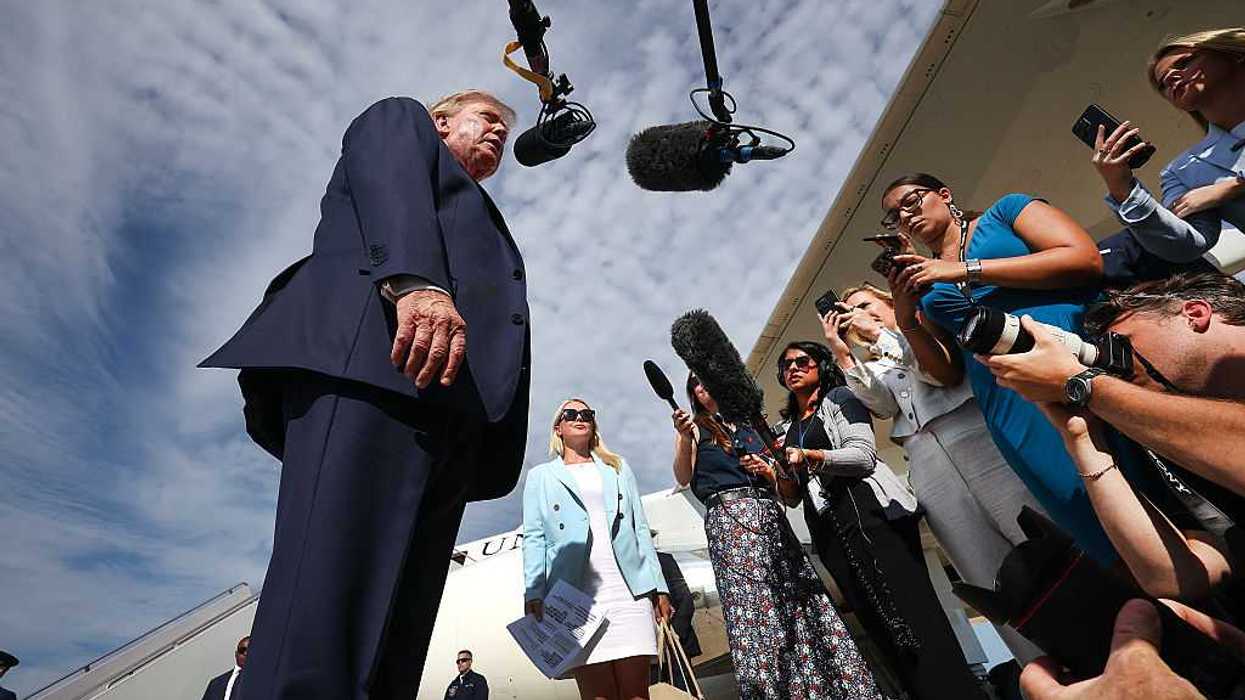
If they did, the First Amendment would be meaningless. and we would no longer live in anything resembling a constitutional republic. That is why President Trump’s September 18 announcement that he is banning reporters from CNN, MSNow, and Politico from the White House is so dangerous.
Whatever one thinks of the quality of their news coverage, all of us have a stake in resisting the president’s brazen attempt to silence and punish news outlets who refuse to bend a knee to him. Because it is a form of viewpoint discrimination, the ban violates the First Amendment, and I expect that the courts will soon say so.
But whatever the courts do, other members of the Whiter House Press Corps should pack their bags and reuse to give President Trump the coverage he so clearly craves.
The American public learned of the president’s intention from a post on Truth Social. “I am proud to announce that, effective immediately, I am banning Fake News CNN, MSNOW (who recently changed their name from MSNBC due to lack of viewership and credibility!), and Politico (The recipients of an illegal and ridiculous $8 Million Dollar subscription, an All Time Record, directly from the United States Government, under Crooked Joe Biden, in order to keep them “alive.” Seems like corruption to me!), from the White House as a result of their constant “reporting” FAKE NEWS!”
“Media Outlets,’ he continued, “shouldn’t be able to constantly write or report FICTION and LIES when they’re covering the President of the United States, the Trump Administration, or the United States of America. Other Fake News Media Outlets to follow.”
Actually, the First Amendment gives broad scope to the press to publish false information so long as they don’t do it with “actual malice.” In its 1964 decision in New York Times v. Sullivan a unanimous Supreme Court held that “When a statement concerns a public figure… it is not enough to show that it is false for the press to be liable for libel. Instead, the target of the statement must show that it was made with knowledge of or reckless disregard for its falsity.”
The president hates that decision and would love to see it overturned
As Justice William Brennan noted, “In the effort to persuade others to his own point of view, the pleader, as we know, at times resorts to exaggeration, to vilification of men who have been, or are, prominent in church or state, and even to false statement. But the people of this nation have ordained, in the light of history, that, in spite of the probability of excesses and abuses, these liberties are, in the long view, essential to enlightened opinion and right conduct on the part of the citizens of a democracy."
“That erroneous statement,” Brennan observed, “is inevitable in free debate, and that it must be protected if the freedoms of expression are to have the ‘breathing space’ that they ‘need . . . to survive.’"
The president hates that decision and would love to see it overturned.
And, in an Oval Office meeting with reporters after his Truth Social Post, the president made clear that what irked him about reporters from CNN, MsNow and Politico was that they are “people to write purposely negative stories….”
While the welcome mat is out for reporters who write positive stories about him and his administration. If a reporter does not toe the line, then “that’s fine, but I don’t have to let them into my — into the people’s house.”
Put aside the telling slip of the tongue and what remains is a boldfaced assertion of a presidential prerogative to punish news outlets because of what they say and the viewpoint they express. There is nothing more central to the First Amendment than that.
Indicators of viewpoint discrimination include official action that “singles out particular speakers may be aimed at restricting certain content or certain viewpoints… (or that) restricts only a particular form of expression may be aimed at suppressing a particular viewpoint.” Excluding three news outlets because of their “negative coverage” is about as clear an indication of viewpoint discrimination as one could get.
As the famous Judge Learned Hand once explained “The First Amendment presupposes that right conclusions are more likely to be gathered out of a multitude of tongues than through any kind of authoritative selection. To many, this is, and always will be, folly, but we have staked upon it our all."
The president and others in his administration have made it abundant clear that they have no interest in hearing a “multitude of tongues.”
And this is not the first time the president has tried to exclude a reporter whose coverage he did not like. In November 2018, closed to the halfway point of his first term his White House suspended the press credentials of CNN’s Jim Acosta after Acosta “challenged the president on his characterization of the migrant caravan moving through Mexico as an ‘invasion.’"
CNN sued and Federal District Judge Timothy Kelly ordered the White House to restore Acosta’s credentials on the ground that it hard deprived him of due process by taking it away in a summary fashion.
He based his ruling on a 1977 decision by the Court of Appeals for the D.C. Circuit. As that court explained, “denial of a White House press pass to a bona fide journalist violates the first amendment unless it furthers a compelling governmental interest identified by narrowly and specifically drawn standards…(and) that denial of a White House press pass constitutes a deprivation of "liberty" without due process of law within the meaning of the fifth amendment because it interferes with the free exercise of the profession of journalism.”
It added, “notice, opportunity to rebut, and a written decision are required because the denial of a pass potentially infringes upon first amendment guarantees. Such impairment of this interest cannot be permitted to occur in the absence of adequate procedural due process.”
Apparently, the president has not learned his lesson. Or maybe he thinks that when he took the oath of office, he became the decider who could do whatever he wants to whoever he wants.
It looks like he will again have to be disabused of that notion in a court of law and hopefully by the solidarity of the White House Press Corps. But ultimately it will be up to voters to send the message that he is the president in a constitutional republic, not a monarch.
In the meantime, all of us should remember, even if the president does not, Thomas Jefferson’s admonition that "(O)ur liberty depends on the freedom of the press, and that cannot be limited without being lost… (and that) were it left to me to decide whether we should have a government without newspapers or newspapers without a government, I should not hesitate a moment to prefer the latter.”
Austin Sarat is the William Nelson Cromwell professor of jurisprudence and political science at Amherst College.