





Who is a hero? More importantly: what is a hero? What attributes are universally admired, inspiring glorious stories, ballads and songs, memorials and movies, all chronicling the hero’s bold adventures?
The Odyssey, a new release written and directed by Christopher Nolan, attempts to answer that question. Based on the ancient tales The Iliad and The Odyssey, written by Homer around 800 BC, the film stars Matt Damon as Odysseus and Anne Hathaway as Penelope, his loyal wife.
Historians have puzzled over the “Homeric question,” that is, who was Homer? We know very little about him, not even when or where he was born; seven Greek cities lay claim to him as their native son. Yet, he is considered the “godfather” of national Greek culture, and his stories are among the earliest masterpieces of literature.
Homer is sometimes romanticized as a blind poet who wandered from town to town reciting his stories. But he, who could express so poignantly the tribulations of Odysseus, was not blind to human nature. He keenly wrote of the attributes as well as the paltriness in his characters and the flaws of his great hero, Odysseus.
The Iliad is the story of the final years of the Trojan War, sparked when Helen, the beautiful wife of Sparta’s King Menelaus, was kidnapped by Paris of Troy. Because the kings had initiated a pact to defend one another, Odysseus was drawn into the fray.
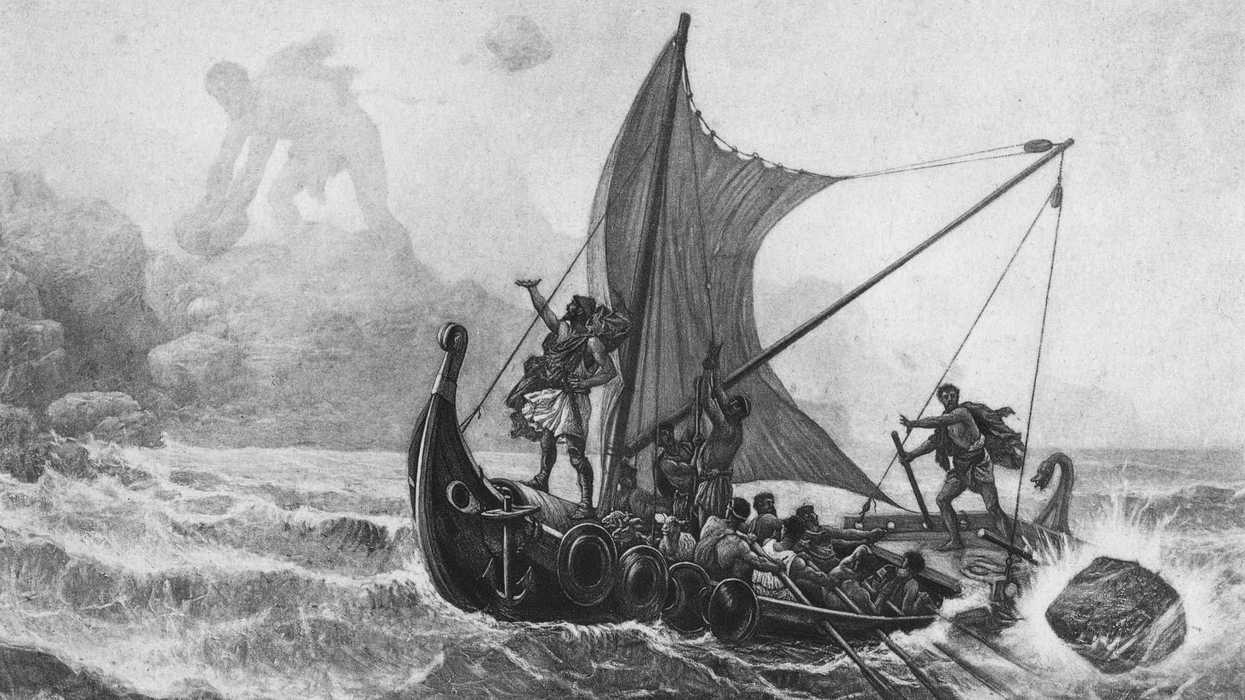
After spending ten years fighting the Trojan War and finally achieving victory, The Odyssey tells of Odysseus’s struggle to return to his kingdom, Ithaca. On his way home, he encounters many dangers and delays. He is pursued by the sea-god Poseidon, must surmount Circe’s spell, and overcome the seductive charms of the enchantress Calypso, and his journey takes him another ten years.
Odysseus’s desires and struggles are universal: his longing for home, yearning for an end to his troubles, for rest after a long and difficult journey. His difficulties reflect the immemorial questions of what it means to be loyal, to belong, what it means “to be” at all. Despite his hubris, which manifests in his propensity to court catastrophe without regard for consequences, Odysseus is an authentic hero, noble and admirable, brave and dedicated.
According to the Greek ideal, a true hero must possess physical excellence and moral virtue. He must, as well, embrace his civic duty. Achieving such status requires “paideia,” a good education; “sophrosyne,” moderation in maintaining physical and emotional balance; and “arete,” an allegiance to the state.
Fictional or real, heroes’ deeds resonate through the centuries and shine a light on what is best in humanity, what matters, what will live on despite our mortality.
Is our digital age really so different from Homer’s Bronze Age? Physical beauty is still adulated, as it was then with Helen of Troy, “the face that launched a thousand ships.” (Marlowe) Power is still king, and wealth is still power.
The years of the Trojan War were harsh and violent. But were they more brutal than the times we live in? Although millenniums have passed and we now have different battlefields, Palestine, Ukraine, Iran, etc., the ravages and the wages of war remain the same: death and suffering. Humanity’s currency is the same, and so, too, is our quest for heroes.
Social scientists claim that after three generations most people are forgotten by even their direct progeny, and after four, remembered only by historical records. So, what then does last? What makes a difference? What is truly beautiful and worthwhile in life?
The universal themes embodied and emboldened by our heroes throughout the ages, the faithfulness of their hearts and the courage of their deeds, these last.
The essential qualities of a hero are manifested in Homer’s Odysseus. Steadfast integrity: “Hateful to me as the gates of Hades is that man who hides one thing in his heart and speaks another.” His deep compassion: “Yet, taught by time, my heart has learned to glow for others’ good, and to melt at others’ woes.” (Both quotes from The Odyssey.)
Nolan’s movie may have created a more virtuous hero than Homer’s works, but the core of the nearly 3,000-year-old-story is intact and as crucially relevant today as it was then. It is the stuff of life: trauma, survival, relationships with others, finding oneself, deciding what is right, choosing a path forward, sometimes, ultimately leading to the honing of a hero.
Just as Odysseus braved storms, temptations, and trials in search of home, we too face a modern sea of civic turbulence, polarization, mistrust, and the fraying of our shared story.
As we live, we too will write our defining stories. How then might we become modern heroes?
By instigating the third Greek ideal of “arete”; embracing our civic duty. By becoming citizens who are open to reflection and debate, who are willing to act with purpose for the betterment of our nation.
In this journey, the work of renewing our democracy can be its own Odyssey, a voyage calling for integrity, courage, and steadfast commitment. Not to return home as Odysseus so desired, but to preserve our home, for the grand and worthwhile purpose of working toward an ever-better future for our country.
With others, we can shape the next chapter of our nation’s collective story.
Amy Lockard is an Iowa resident who regularly contributes to regional newspapers and periodicals. She is working on the second of a four-book fictional series based on Jane Austen’s “Pride and Prejudice."














Odysseus Reimagined: Nolan’s Epic Explores What Makes a True Hero
A modern retelling of Homer’s epic asking what courage and integrity mean today.
Opinion