Site Navigation
Latest Stories
Join a growing community committed to civic renewal.
Latest news
Read More

As new voting restrictions spread nationwide, When We All Vote's 'Party at the Polls' brings 5,000 community events to turn out voters ahead of November.
Community is Our Best Bet Against Intimidation and Fear at the Ballot Box
It’s no secret that 2026 has tested our democracy. This year alone, the Supreme Court has continued to dismantle the Voting Rights Act, state legislators are rushing to execute a generational gerrymander in the South to undermine Black and Latino voters, and state houses across the country are considering more than 330 laws that make it harder for everyone to vote. At the same time, the administration continues its attempts to consolidate federal power over elections, including a push for Congress to pass the SAVE America Act. These nationwide efforts to ensure voters are confused, tired, and apathetic are not a coincidence — they are voter suppression.
But here’s the hope: the one thing we’ve learned despite the many challenges we’ve seen in 2026? We need each other now more than ever.
The voter suppression tactics being used today are not new. But neither is the way we fight back — together. People in this country used to build our lives around gathering together in faith groups, labor unions, PTAs, neighborhood associations, community centers, fraternities and sororities, local NAACP chapters, and more. The result? The Voting Rights Act. The Fair Housing Act. The Equal Pay Act. These wins have proven that communities coming together in hope can be a powerful antidote to intimidation and fear.
How we show up in this moment will determine our future — and we need to be as organized and as energized as those who push anti-democratic policies and agendas. And as we go, we need to hold on to hope, to joy, and to celebration.
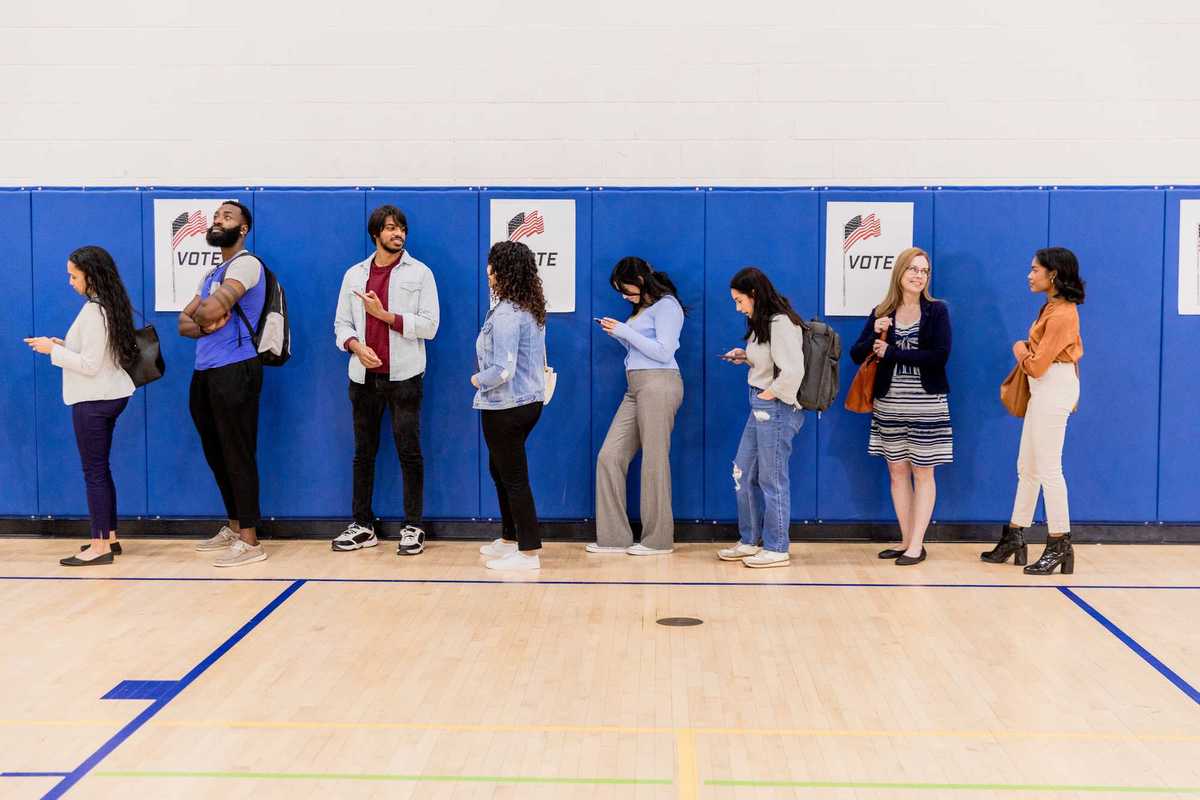
That’s why When We All Vote is launching our largest-ever Party at the Polls program with more than 5,000 community events across the country as we head toward November’s election. Making voting a celebration can look like a Ride to the Polls in Navajo Nation with Protect the Sacred, line dancing and games with AME churches in Savannah, a Quince to the Polls with Harness in Texas, or events on community college campuses nationwide in partnership with the ALL IN Campus Democracy Challenge.
These events are joyful by design — but they’re also strategic. Research shows Party at the Polls can increase voter turnout by up to 4 percentage points. And just as importantly, the program is a powerful way to combat intimidation tactics and threats of violence at the ballot box. But no one organization can do this alone. As history shows, protecting democracy has always required coalitions, and we’ll be joined by organizations — like Divine Nine fraternities and sororities, the ACLU, and State Voices — that have led this work for decades.
As we bet on the power of community, we must also commit to protecting voters’ safety and right to cast a ballot. Lawyers looking to protect free and fair elections and safeguard the rule of law can join groups like We The Action and the Election Protection Hotline, observe the official canvass in states across the country, support election officials, restore voting rights to people with past convictions through organizations like the Florida Rights Restoration Coalition, and more.
As a Black woman — a Black mother — living in Mobile, Alabama, the work to build a system that works for us all, and for the generations ahead of us, is deeply personal to me. Even as every day seems to bring another alarming headline, I’ve witnessed something even more powerful. Looking at history, at my neighbors supporting each other, and at the people leading this work across the country, I know the power of the people is still greater than the people in power. And with 80,000 elections across all 50 states this fall, we the people have 80,000 chances to show up in ways that are impossible to ignore — together.
Kalisha Dessources Figures is the When We All Vote Senior Advisor.
Recommended

A rose stands on the 9/11 Memorial for the North Tower in front of 3 and 4 World Trade Center on September 7, 2026, in New York City.
The 9/11 Town Hall That Helped Rebuild Ground Zero—and Democracy
As the nation and the world pause this week to honor and reflect on the 25th Anniversary of the terrorist attack that brought down the twin towers of the World Trade Center and killed more than 3,000 people, I am moved to share a very personal reflection.
After serving as Chief of Staff to Governor Celeste of Ohio and in the Clinton-Gore Administration, where I experienced firsthand how the major institutions in our country interact to favor the powerful over we the people, I became deeply concerned about the health of our democracy. It was clear to me that, beyond voting and national polling, the American people were not at the table to influence the decisions that most affect their lives.
In March, 1995, I left my office in the White House and founded AmericaSpeaks, whose mission was to bring We the People back into the foundational role envisioned in our founding documents. I created the 21st Century Town Meeting based on the New England Town Meetings, which, to this day, mean that citizens determine their town and school budgets. By adding technology – computers and voting devices – we could scale this work and bring thousands of Americans together to weigh in on important decisions.
By 2001, the AmericaSpeaks 21st Century Town Meeting had been successfully used to influence Social Security policy nationally, determine city budgets, and foster regional cooperation among counties. So, when the Lower Manhattan Development Corporation invited us to demonstrate its efficacy to ensure citizen voices would impact the rebuilding of Ground Zero, we were honored and ready to serve
A documentary film, “9/11: Reclaiming Ground Zero,” premieres this week on September 10th at the Brooklyn Public Library. 5,000 citizens, representative of the demographics of New York City, came together on July 20, 2002, to review the conceptual plans for rebuilding. The film tells the story of what happened leading up to that day and what followed. What you see today on the 16 acres that comprise Ground Zero was forever changed by the collective voice of those 5,000 citizens and the decision-makers' commitment to respect them.
To this day, I am humbled and honored that the AmericaSpeaks team and the hundreds of volunteers that came together to make that day possible were able to serve in this way.
But for me, having worked in the field of deliberative democracy for more than 30 years, the film's message is as much about our future as it is about what happened during the rebuilding of Ground Zero.
Today our democracy is under severe attack from forces within. Given the failure of our branches of government to play their rightful roles in the balance of power to ensure that our republic stays grounded in the core values of our founding documents, it is We the People who must act to ensure that our democratic republic can celebrate another 250 years.
The vast majority of Americans know that where we are today is wrong and want to do something about it. Our national narrative – by both traditional and social media – constantly feeds us negative storylines that we are too divided and polarized to come together. And yet in thousands of communities across the country we are already coming together and solving problems. We just do not know about it unless we live in a community that is already doing it.
Citizen Assemblies – a more recently developed method for creating the collective voice of representative citizens to solve problems -- first proliferated across Europe and Canada and now are finding fertile ground here at home. Citizen assemblies are currently happening statewide: on property taxes in Connecticut; on education policy in Maine; and on water policy in Nevada. In communities across the country, cities and counties are using Assemblies to deal with tough issues that the political process has not been able to solve: Petaluma, California; Fort Collins, Colorado; Akron, Ohio; Snohomish County, Washington – just to name a few.
Given the current profound political dysfunction at the federal level, it would not be possible to do this kind of work nationally. But we are building the necessary infrastructure and civic muscles all across the country, which means our capacity to bring the wisdom of the American public into our national institutions is growing rapidly.
I am honored and delighted that this documentary film captures the legacy of AmericaSpeaks' contribution to the field of deliberative democracy, but I am even more pleased that it shows what We the People can do to impact public policy currently.
Today, 16 acres in Lower Manhattan are vibrant and full of life while simultaneously deeply honoring and respecting the loss of life that occurred there on September 11, 2001.
Today, our country is shaken by forces of destruction that do not respect our founding values, but We the People have the power to right our ship.
To explore organizations helping citizens strengthen our democracy, visit the Healthy Democracy Map:
healthydemocracymap.org
To learn more about the story behind the 2002 town hall and its impact, watch the documentary “9/11: Reclaiming Ground Zero”:
https://www.amazon.com/gp/video/detail/B0H967H5TV?ref_=atv_dp_share_cu_r
Carolyn J. Lukensmeyer was the first Executive Director of the National Institute for Civil Discourse, an organization that woks to reduce political dysfunction and incivility in our political system. As a leader in the field of deliberative democracy, she works to restore our democracy to reflect the intended vision of our founding fathers.

Bruce Springsteen performs the song “Streets of Minneapolis” after receiving the ACLU Ralph Ellison Award for Defenders of Civil Rights and Civil Liberties in the Arts, Business, Science and Sports at the ACLU Awards Ceremony at Washington Hilton on July 24, 2026 in Washington, DC.
Springsteen, Morello Ignite ‘Music and Resistance’ Festival’
When I first wrote in early July about Bruce Springsteen and the upcoming Power to the People Festival, the event was still taking shape as a hopeful but not yet fully defined effort to confront the growing tensions in our democracy through music.
A great deal has occurred since then.
The festival has now been officially announced, clearly presented to the public, and left with no doubt as being one of the most deliberate cultural interventions of the 2026 election season; Springsteen's own way of describing it as a night of "music and resistance" shows that this will not be just another concert.
It became clear in late May when Springsteen previewed the festival live from the stage at Nationals Park. "Tom Morello and I will be back in D.C. on Oct. 3 for another night of music and resistance," he told the crowd, asking fans to "make a goddamned ruckus with us." That was not the kind of thing you would expect from a normal Springsteen concert announcement. It clearly signaled that the festival would align with Springsteen's long-standing view that democracy is defended not only in voting booths but also in public squares where citizens gather, speak, and refuse to be quiet.
Since my July writing, the festival’s contours have sharpened. Morello released the full lineup, and it reads like a modern map of protest music: Foo Fighters, Dave Matthews, Joan Baez, Brittany Howard, Cypress Hill, Killer Mike, Dropkick Murphys, Serj Tankian, Jack Black, The Linda Lindas, and others. Shepard Fairey — whose artwork has become a visual emblem for political conscience — will contribute both design and a DJ set. The organizers describe the event as a celebration of “freedom, justice, equality, and rock and roll.” Still, the underlying message is unmistakably civic: ordinary people have extraordinary power when they come together through art and collective action.
That message fits Springsteen’s recent posture. In my earlier writing, I argued that democratic erosion rarely arrives with dramatic ruptures; it arrives quietly, through resignation and silence. Springsteen has spent the past year trying to shake audiences out of that silence. His criticism of the current administration has been blunt, and his insistence that citizens must speak up when democratic norms weaken has stayed resolute. Morello’s framing of the festival fits squarely within that tradition. This is not about left or right. It is about whether Americans still believe they share a democratic inheritance worth defending.
The festival’s infrastructure reinforces that ambition. Freedom Village, a separate gathering place at the concert, lets attendees meet with nonprofits, advocacy groups, artists, community partners, and organizations working on voting access, grassroots organizing, mutual aid, and civic learning. VoteRiders will receive a portion of ticket proceeds, and HeadCount will be on-site registering voters. These are not symbolic movements. These are operational commitments to strengthening democratic participation at a moment when confusion about voting rules and ID requirements threatens turnout nationwide.
Of course, the political tension about the event is impossible to ignore. In today’s hyper‑polarized climate, even a call for unity can be interpreted as provocation. Springsteen’s criticism of President Trump routinely rockets to the top of news cycles, often followed by immediate condemnation on Truth Social. That dynamic will almost certainly intensify as October approaches.
This tension is exactly what makes the festival worthwhile. The festival is trying to achieve something rare by securing the kind of cultural and media exposure designed to encourage Americans to do more than just vote—such as volunteering, organizing, turning up, and taking responsibility for the country's future. It is not certain whether such momentum can emerge in a divided political environment. Nevertheless, the initiative reflects a belief that music can still inspire public involvement when traditional politics fails.
American democracy has never relied solely on ballots and campaigns; it has always needed cultural traditions that reinforce a shared future, such as abolitionist hymns, Dust Bowl ballads, and civil-rights anthems. Music has served that function in the past, and Springsteen believes it can be done again by deliberately positioning itself in that tradition.
A festival held one month before the midterms, featuring artists known for their political voices, certainly will not escape partisan interpretation and inevitably will be read through a partisan lens, regardless of the organizers’ stated intent.
In fact, it may even deepen the tension between culture and politics. But it also expresses a broader truth: democracy is not only something we vote in—it is something we live in, and sometimes the best way to achieve that is to gather at a festival, listen to music, and let music remind us all what we still hope to be. As Marvin Gaye pleaded more than half a century ago, “You know we’ve got to find a way.” That line still echoes today—a signal that the work of keeping a nation together belongs to all of us.
David L. Nevins is the publisher of The Fulcrum and co-founder and board chairman of the Bridge Alliance Education Fund.
College Athletes Are Becoming a New Civic Power — And The Team Is Showing How
WASHINGTON, D.C. — A growing movement is reshaping how student‑athletes engage with democracy, and at its center is The Team, a nonprofit that integrates civic responsibility directly into college sports. Its mission — developing “teammates, leaders, and citizens” — is resonating across campuses nationwide as athletes step into roles that extend far beyond competition.
Elizabeth Ford, the team's program manager, noted that student‑athletes are uniquely positioned to influence civic culture because “they already have a platform, and people listen to them.” Ford highlighted how The Team is channeling that influence into structured, nonpartisan civic leadership.
The organization’s Engaged Athlete Fellowship has become one of the country’s fastest‑growing civic leadership programs for student‑athletes. Applications surged from 59 to 396 between the first and third cycles — an increase reflecting rising interest in civic engagement across NCAA divisions. Fellows receive leadership training, mentorship, and support to design civic projects tailored to their campuses and communities.
Projects have ranged from voter‑engagement campaigns and legislative workshops to mental‑health initiatives, community sports camps, and resource drives. At Howard University, fellows tackled truancy and organized athletic‑gear donations for youth in Africa. At Northwestern, athletes are developing civic‑education programming and spotlighting racial inequities in women’s distance running.
In a Fulcrum interview, Elisee Byun, program coordinator for The Team and a former varsity gymnast at UC Berkeley, emphasized why athletes are embracing civic work: “Athletes know how to show up for their communities. They just need the tools to do it intentionally.” Byun said the fellowship helps athletes connect their discipline and teamwork to civic responsibility.
This year, I met the 2025–2026 Engaged Athlete Fellows in Washington, D.C., where athletes connected with professionals across fields — from tech to sports — who showed how civic engagement strengthens their industries and careers. The gathering offered a firsthand look at how young leaders are translating visibility, discipline, and collaboration into civic impact.
- YouTube youtu.be
One fellow, Katherine Helms, a women’s swimmer at North Carolina State University, underscored why athletes are stepping into civic leadership. “I think first of all I believe as athletes we have a platform that can help better our communities and we're also role models,” Helms said. “People look up to us — kids, but also adults.” She described her project, “Swim for Life,” a free, beginner swim and water safety clinic serving children from low-income families in Raleigh. It brought local youth onto a college campus and into a college pool for the first time. “I thought that the impact would be measured on how many kids learned how to swim. But it was more than that. It was confidence-building, seeing themselves differently, and learning a new skill they didn’t think they could do.”
“Swim for Life” is run in partnership with Neighbor to Neighbor (N2N), a nonprofit dedicated to reversing the effects of poverty through mentoring, education, and community development. N2N assists with participant recruitment and family outreach to ensure the program reaches children who lack access to swim education.
Another fellow, Jasmine Jackson, a women’s basketball player at Elizabeth City State University, said the fellowship pushed her to rethink what meaningful community engagement looks like. Her project centered on listening first — not assuming what a neighborhood needed, but building trust through conversation and collaboration. “The biggest takeaway from that project was the impact that it left on the community,” said Jackson. “Literally, from everything from the kids to the principals—just being able to go into a community and not go in with tunnel vision and ‘Hey, we know how you need help,’ but asking them and being intentional and seeing what they need and how you can support that.” Through mentorship, hands-on engagement, and immersive experiences, her goal is to empower future minds by showing them what’s possible and helping them envision their own journey as scholars, athletes, and changemakers.
Jackson’s emphasis on listening and community‑driven work reflects a broader theme emerging across the fellowship: athletes are recognizing that their influence extends well beyond the court, track, or pool. For many, that sense of responsibility is shaped not only by their civic projects but by their own journeys through college athletics — journeys that opened doors to education, mentorship, and long‑term opportunity.
That perspective is especially clear among Division I athletes, who understand firsthand how powerful that pipeline can be. For many, competing at the D1 level isn’t just about sports — it’s a gateway to education, opportunity, and career pathways that will outlast their athletic careers. Only a small percentage ever make it to the professional level, so the college experience becomes the foundation they carry forward. That’s why building a pipeline matters: ensuring that talented young people, especially those who may not know how to navigate the system, can access the same doors athletics opened for them.
David Davitt of the University of Pennsylvania Men’s Track and Field & Cross Country developed new pathways for student-athletes to pursue careers in financial services. His project focuses on building a structured talent pipeline that expands access to professional opportunities by addressing real obstacles athletes face — including rigid recruiting timelines, demanding practice schedules, and limited flexibility for traditional internships.
“When you understand that you have that platform through being there, it's like you want to create that for the next generation,” Davitt said. “I think just experiencing that myself, I really want to make sure that other people have the same opportunity, especially for the ones who don't necessarily know the pathway to get that opportunity, but are well capable of getting in.”
The Team operates as a fiscally sponsored project of the Bridge Alliance Education Fund, the parent organization of The Fulcrum. The partnership reflects a shared commitment to expanding civic infrastructure and empowering new generations of democratic leaders. The Team is already evaluating candidates for the 2026–2027 Engaged Athlete Fellowship — a sign of the program’s continued momentum and the growing national interest in student‑athlete civic leadership.
As student‑athletes continue to rise as influential voices in American culture, The Team is proving that sports can be a powerful entry point into civic life — helping young people build not only stronger teams, but a stronger democracy.
Hugo Balta is the executive editor of The Fulcrum and the publisher of the Latino News Network