
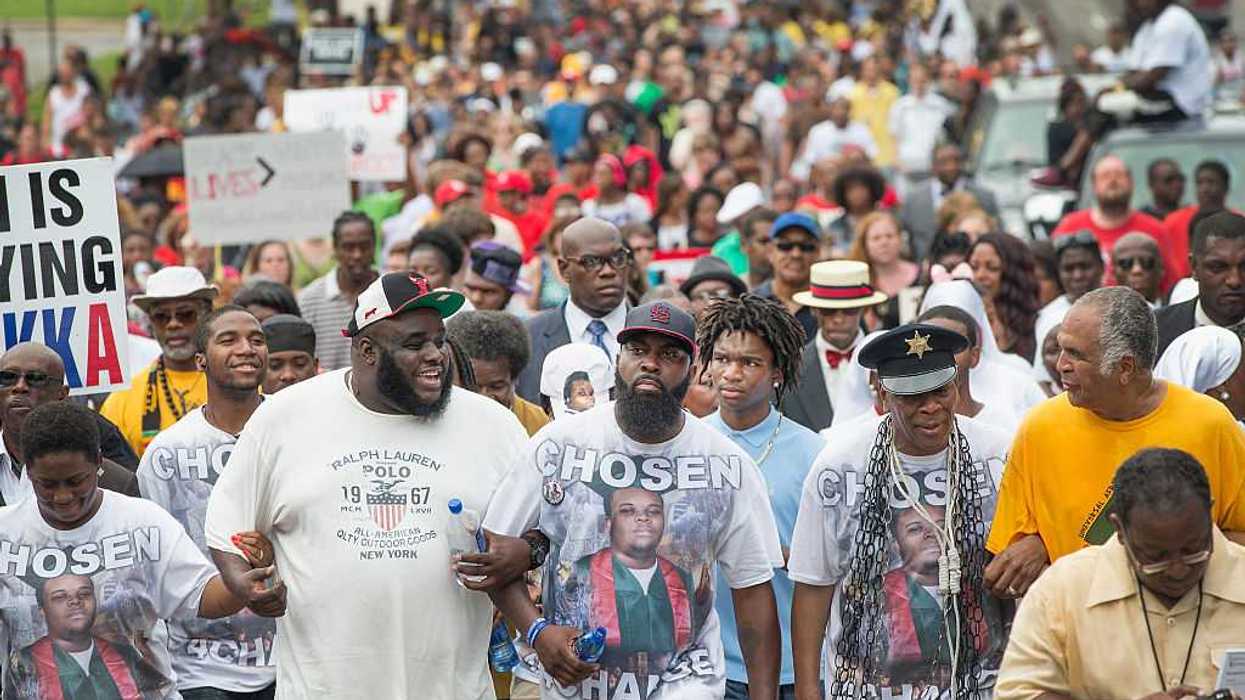

Every August comes heavy and hot, and every year it brings me back to Ferguson. To a particular patch of Canfield Drive, where asphalt still seems to pulse with memory, and to the faces—some familiar, some gone—who gathered under a bruised sky after Michael Brown Jr. was killed. It has been twelve years, and I have learned that time does not heal all wounds. It teaches us the difficult choreography of living with them.
I am no longer the pastor of Wellspring Church nor a resident of Ferguson, but that moment, that street, and that season are stitched into the lining of my soul. Like many who stood in the breach that August and beyond, I am forever changed. Yet the anniversary still stalks me. It waits in the marrow. I have come to see this not only as trauma’s residue, but as a call to hold pain and faith, memory and movement together.
The Spiral, Not the Line
We are a nation that likes its narratives linear: wound, struggle, triumph, and then, cleanly, “moving on.” But Dr. William Bridges' seminal book, Transitions, explains that change does not follow an arrow-straight path. Healing, especially collective healing, moves in spirals. We return to the site of pain not because we are stuck, but because reclamation becomes possible there.
Grief, in this sense, is not an obstacle to overcome but a companion to acknowledge. Each August, I walk through the memories with new eyes: the anguish of a mother’s cry, the rage that spilled into streets, the prayers whispered in the darkness, the negotiations—holy and human—between justice and survival. These memories do not fade. They evolve. As Dr. Edward Wimberly’s communal-contextual model suggests, healing is as communal as it is internal. We do not grieve alone. We do not heal alone.
Anniversaries That Haunt—and Heal
Anniversaries are tricky things. For those of us who love or lead, who protest or pastor, they can be both holy days and haunted ones. The calendar’s return to August 9th is not just a date; it’s a collision of past and present. And yet, there is something righteous—something necessary—about returning. I appreciate Dr. J. Scott Butler’s work with African American families and faith communities. He notes that our rituals of remembrance are not simply about not forgetting; they are about turning toward justice, healing, and persistence. We mark the pain so we can measure the progress and the promise it demanded.
Recalibration is not about erasing the hard memories. It is about finding a healthy rhythm—acknowledging the wound without letting it define the whole. I have seen what happens to those who try to outrun their pain: it speeds up, nipping at their heels, bleeding into their relationships and rest. But those who pause, who turn and face it, who remember communally, find a different kind of strength. They reclaim not only their narrative but also their agency.
Living Into Promise
I have been asked, more times than I care to count, what it means to “move forward” from Ferguson. The question itself is a misunderstanding. We do not move forward as if leaving a place behind. We spiral—returning, reflecting, reclaiming, and then stepping into the world again, a little more whole and a little more resolved.
Dr. Stephanie Crumpton, in her womanist pastoral theology, frames this as the sacred work of reclamation. There are points, periods, and places of pain that must be revisited, not to wallow, but to witness. To name what happened, to honor those who suffered, and to insist that the story is not finished. This is righteous recalibration. It is the refusal to let trauma have the last word.
For me, Wellspring was never just a sanctuary for Sunday worship. It was a field hospital, a strategy room, a place where the rawness of grief and the audacity of hope could mingle. Twelve years later, I see that the real work was not about “fixing” the community but about empowering it to claim and transform its wounds. This is what gives anniversaries their sacred power: they force us to reckon with what remains undone, and they invite us to remember what has been survived.
Empowering the Struggle
If you are reading this and carrying your own anniversaries—of loss, of violence, of moments that split your life into before and after—hear me: the spiral does not mean you are failing. It means you are human. It means you are, perhaps, doing the most courageous kind of living. The recalibration of grief is not a denial of pain but a disciplined, even holy, engagement with it.
For some, this engagement might mean returning to the page each year, journaling the surge and echo of anniversary memories. Others may find comfort in creating space for quiet prayer or lighting a candle in remembrance. Some may choose meditation in the mornings of those significant days, or gathering trusted companions to reminisce and bear witness together. These personal practices, humble as they may seem, offer gentle scaffolding as we walk through the spiral, making meaning of the pain and shaping hope from memory.
We show up to the hard places, year after year, so that our communities and we are not defined solely by what broke us. This is both psychological and theological truth. Scholarship reminds us that faith is not the absence of suffering, but the willingness to integrate it into our stories. Likewise, healing is a shared responsibility, and power exists in naming and narrating our pain, especially for those whose suffering has too often been silenced.
Twelve Augusts have come and gone. I have left Ferguson, but Ferguson has never left me. Each anniversary is both an ache and an altar—a place to lay down burdens, gather lessons, remember names, and recalibrate the soul.
We spiral, yes. But we spiral upward, carrying not only pain, but promise—and the call to keep remembering, reclaiming, and becoming, with a steadier and more resolved soul.
Rev. Dr. F. Willis Johnson is a spiritual entrepreneur, author, and scholar-practitioner whose leadership and strategies around social and racial justice issues are nationally recognized and applied.