

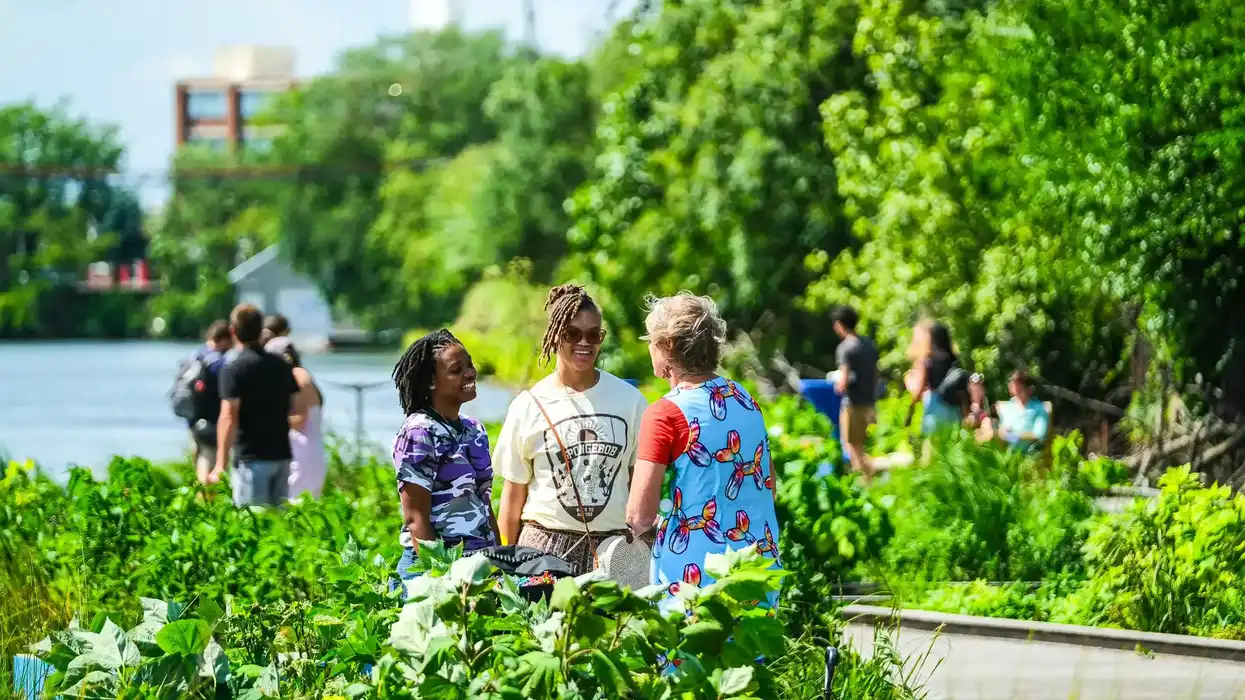
If you were to walk next to the Chicago River on North Ave, you’d find a ramp tucked away between venues and restaurants, seemingly leading down to river itself. Walking down it, you wouldn’t just find the river, but a sprawling park full of lush wildlife—the Wild Mile, a planned 17-acre floating eco-park along the North Branch Canal of the Chicago River.
Collin Quinn comes to the Wild Mile a few times a year to canoe along the river with his friends. “We go other places, but this is a real easy, convenient place for us,” he said. “Occasionally, we’ll see ducks or fish or animals in there. I like seeing it grow every year.”
But the Wild Mile isn’t just a public park, it’s a developing piece of environmental infrastructure dedicated to rehabilitating the wildlife in the Chicago river.
During Chicago's early days, its rivers were dredged, straightened, and dammed to facilitate the city’s industrialization, ensuring easy transportation along the waterways. Since then, the City of Chicago has spent years and several trillions on improving the water chemistry of the Chicago River, particularly to deal with sewage contamination through the Tunnel and Reservoir plan, which is designed to store up to 67.76 billion liters of untreated storm- and wastewater during heavy rain to prevent combined sewer overflows. Years of industrialization and urban development have made it impossible for ecosystems typically found in rivers to grow.
“All of the fish and birds and other wildlife that live in the river naturally still don't have habitat for themselves,” said Nick Wesley, who directs and co-founded Urban Rivers, the company behind the Wild Mile.
The project traces back to 2016, when Urban Rivers and SOM installed a 1,500-square-foot floating garden pilot; the first 400 feet of public boardwalk opened in 2022, with an additional 300 feet added in 2024. In 2022, Nick and his team started the Wild Mile, a floating eco-park in the Chicago river that uses the existing industrial infrastructure to create an artificial habitat to emulate the natural processes you would find in a normal river. Their efforts aim to reverse habitat degradation in the Chicago River over the years and rebuild wildlife populations that have been missing from the ecosystem.
The Wild Mile develops a system of floating wetlands the team plants native wetland species on. Today the installation spans more than 11,000 square feet of floating habitat, though that's only about 10 percent of Urban Rivers' eventual goal of a full mile-long park, a reminder of how much of the river remains unreclaimed.
The plants’ roots continue to grow downward, into the river, to get nutrition and, in turn, create a network of roots that serves as a natural habitat for aquatic organisms. Algae and microbes grow, fish hide from predators and lay their eggs, At the same time, the plants that grow on the surface are useful for pollinators, birds, and small mammals.
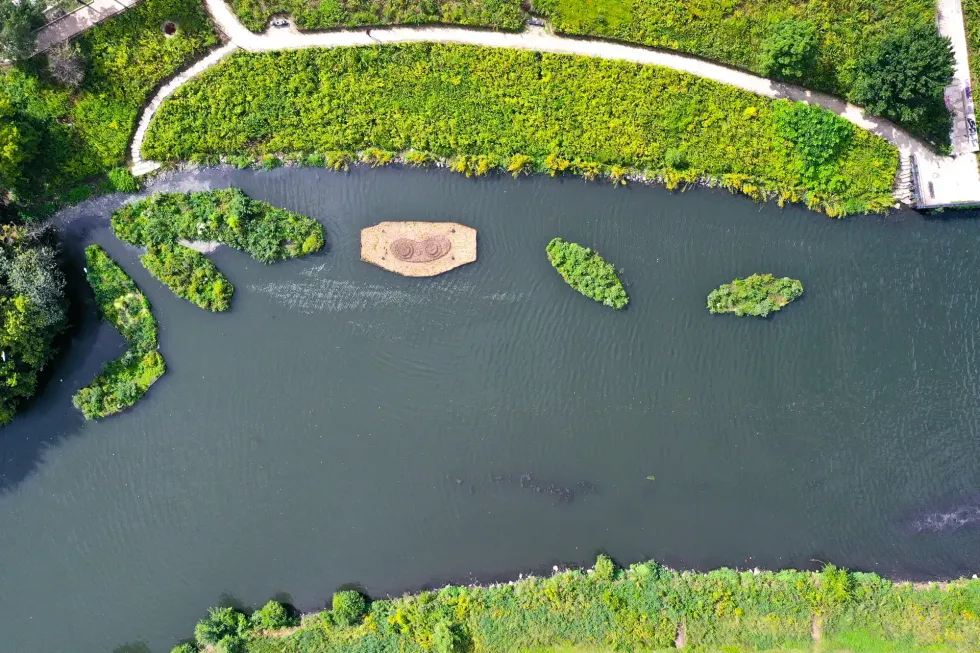 Bubbly Creek - New Garden Nick Wesley, Urban Rivers
The biggest challenge in realizing the Wild Mile was getting the city on board and granting the team the proper permits. But as challenging as it was to vet their research and plans, it was difficult to get across a vision for the Chicago river that was optimistic and attainable.
“Everyone was like, ‘Oh, this is really cool, but it's never going to happen,’” Wesley said. “It was a little hard to get people's heads wrapped around exactly what we were doing and that it's feasible and it's not just some sketch.”
The Wild Mile is the first-ever fully floating eco-park in the world, currently standing at about 700 linear feet with an eventual goal of a full mile, and the experimental nature of the project is one of the things that made it difficult to get the plans approved. “There wasn't a framework for, you know, how to do a project like this,” Wesley said. It made permitting difficult, as half the battle was figuring out what the appropriate agencies were to get such a unique project off the ground.
But permitting was only the first hurdle. Researchers who have studied the Wild Mile point out that a floating installation, however successful, has hard physical limits. It occupies only one side of the canal, so it can't treat or influence the entire cross-section of river flow — the water that passes under the far bank never interacts with the wetland at all. And because the canal is open and continuously mixed with the rest of the river, any local improvement in water quality or fish abundance can be diluted or offset by conditions upstream and downstream. In other words, the Wild Mile can create a pocket of healthier habitat, but it can't singlehandedly clean up the North Branch.
The species data reflect that nuance, too. Researchers found the wetland was linked to more native minnows and fewer invasive common carp compared to reference sites, but not every outcome was as clear-cut. Zooplankton counts, for instance, actually dropped near the floating wetland in a companion study of similar installations in other cities, even as their average body size grew — a pattern researchers say may reflect predation dynamics rather than a straightforward win, and one that only showed up during brief windows each summer.
Scientists studying the Wild Mile have been careful to note that some of these fish and invertebrate trends are correlational, not proven cause-and-effect, and that further monitoring is needed to confirm the wetland — rather than broader, decades-long improvements in Chicago River water quality — is truly driving them.
As the Wild Mile annexes new installations, its research and development team continues to collaborate on experimental ways to support and monitor the growing habitat, which are added to installations.
“Everything is about diversifying the habitat within this big empty box that you've got,” said Phil Nicodemus, Research Director at Urban Rivers. “It just requires creativity and trying a lot of things for the first time in ways that maybe are not going to work out.
“So you got to do them, but you also got to study them well enough to be able to explain to somebody why you should do it, or why it's going to work, or why it's not going to work in this scenario or that scenario.”
One of the newer aspects of the Wild Mile are the new underwater cameras that the team uses to monitor the fish and bring a hidden aspect of the park to people’s attention.
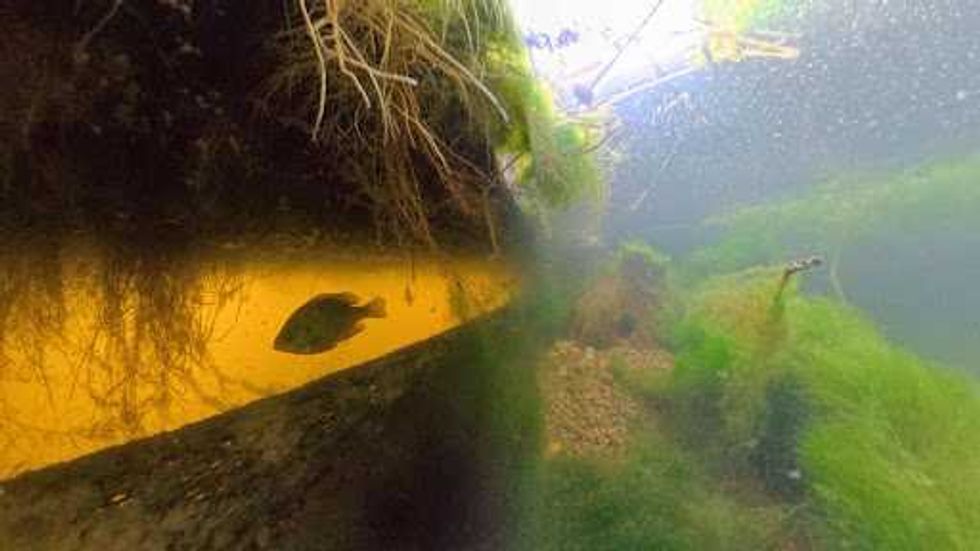
“They all have their own little personalities and like these internal politics that happen around mating season and stuff,” Sage Rossman, Urban Rivers’ Communication Manager, said. “Being able to get a glimpse into that whole entire world is super duper cool.”
As installations are added and interventions brainstormed, the data reflects incremental but significant change in the Chicago river’s make up. The Urban Rivers team regularly tests and studies the water to investigate how the Wild Mile is impacting nitrogen and phosphorus levels. A five-year peer-reviewed study (2018–2023) found statistically significant reductions in nitrate (down an average of 1.31 mg/L at the surface) and phosphate (down 0.64 mg/L) in water passing under the floating wetland, with consistent removal performance year-round, not just during the growing season.
That said, the same body of research found the wetland's effect on dissolved oxygen and water temperature was not statistically significant — meaning the plants clean the water of certain nutrients without measurably changing some other basic conditions fish and other organisms depend on.
There has also been quantitative increases in the presence of minnows and smaller bait fish in the river, which indicates that other, bigger fish are reproducing. Electrofishing surveys between 2016 and 2019 found the average catch of small prey fish near the Wild Mile grew from just one golden shiner across three hauls in 2016 to an average of 17 small prey fish per haul by 2019, alongside a significant, corresponding drop in invasive common carp.
Even that finding comes with a caveat researchers are careful to flag: when the Wild Mile site was compared against individual reference locations rather than the pooled average, the difference in small-fish abundance wasn't always statistically significant — a distinction that matters for anyone trying to judge exactly how much credit the wetland deserves versus the river's broader, decades-long recovery.
But besides rebuilding the wildlife of the Chicago river, the Wild Mile contributes significantly as a piece of social infrastructure, providing an open air park that’s free to the public and often used as an events venue. To date, the park has served more than 20,000 visitors, students, kayakers, and volunteers, and its annual Block Party has drawn crowds of over 850 people.
“Chicago’s one of the few cities that actually takes [wildlife preservation] super seriously,” said Jay Levesque, who found the park by volunteering with Chicago Adventure Therapy, one of the many organizations that has programming on the Wild Mile. He I think it could be a really nice third space for folks, especially in the warm weather.”
Priorities for Urban Rivers lie in new installations and in exporting their ideas to other cities in the United States. After the Wild Mile’s success, inquiries began to come in from across the country to diversify wildlife in industrial infrastructure.
What the Wild Mile ultimately offers other cities isn't a finished blueprint, but a proof of concept: that urban revitalization doesn't require tearing out the seawalls, dams, and industrial channels that already define a waterway. Instead, as Nicodemus put it, it means building new habitat directly onto that existing infrastructure and studying, patiently and rigorously, what actually takes root.
“I mean, its main purpose is for the wildlife,” Rossman said. “But, you know, humans are wildlife too. We need to be in contact with plants and water and clean air.”
Isabel Papp is a summer fellow with The Fulcrum and a student at Northwestern University, double‑majoring in Journalism and Political Science. A bilingual journalist, she is a proactive, equity‑centered storyteller committed to elevating underrepresented voices.