
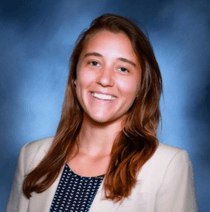
Friday was my last day working for the New York State Assembly. While finishing my Master of Laws at Columbia, only a month after leaving the military following ten years as a Naval Aviator, I saw on LinkedIn that an Assembly member was looking for a District Director. I applied for the job, got it, and, with a semester to go, took it. It was my first job out of the military, and it was absolutely wonderful. At a time when trust in government is lower than it's been in almost seventy years, I was part of a team that made me believe, more than ever, that government can be a force for good. I want you to believe it, too.
My boss was the kind of politician one dreams of: hardworking, earnest, and incredibly smart. He was an absolute model of public service and neighborliness, who grounded us in the mission that anyone who ever came into contact with our office should walk away with more faith in government. He did his best to show up everywhere and for everyone; I watched him give every ounce of himself to serving his constituents in Manhattan and representing them in Albany. Sometimes they called and complained anyway. Most who observed his effort became enamored. I can say confidently that New York is better for having had him in the state legislature.
His Chief of Staff was one of the savviest managers I have ever met. She had come from tech and quickly became a political force; we should be glad she chose public service when it is clear she could do anything–she would have made a formidable military officer because she is such a natural mission commander. She optimized the entire office, reminding us to set boundaries to prevent burnout, but calling us out if she knew we could do better. She brought out the best in us. We never wanted to disappoint her.
The legislative team was composed of two policy savants. One of them entered the office as an expert in computer science and artificial intelligence, while the other quickly became one. Together, they were behind an incredibly impressive legislative agenda that included the most progressive AI safety law in the country. These two will shape the future of AI regulation–if we're lucky. They are also funny.
Our director of constituent services is perhaps the most empathetic person I have ever met. She took call after call from neighbors on their worst days and worked tirelessly to help them solve their problems. On top of that, she managed a schedule that was busier than the governor’s, according to a staffer who would know. She also made sure we were all taken care of emotionally and that the office was stocked with snacks. On my last week of work, she gifted me a tote bag she had hand-embroidered with colorful hearts and the words ‘HATE HAS NO HOME HERE.’
We did not agree with each other on everything. Our office was not an echo chamber, but we addressed tension with compassion and curiosity to move things forward. We trusted each other, and recognized that ultimately we won and lost as a team. I can’t help but think that such an office mindset played a role in the Center for Effective Lawmaking giving our boss the highest freshman effectiveness score of any New York City legislator, and the second highest in the entire state. Teamwork is useful for more than just morale.
By the way, every single bill my boss passed had at least one partner across the aisle. I think this must be thanks in part to legislating with that same collaborative mentality, allowing for bipartisan cooperation. It turns out, lawmakers who build coalitions across party lines are simply more effective at passing legislation than those who don't, regardless of which party controls the chamber. In fact, political scientists at the University of Arkansas found that “the states where legislators were the most civil towards each other passed roughly twice the number of bills that the most uncivil legislatures passed.” To illustrate the point, in 2023, Congress passed only 27 bills total. In only four years, my boss passed 35 himself (and they’re good ones).
Moved by the effort of everyone on the team to ensure we were operating at maximum efficiency, and blown away by the efficiency itself, I have tried to internalize what made it possible. It does feel relevant that the oldest person in our office was 43. Younger generations may be better equipped to address many important issues of our time, and not just because of their vitality. It was the 23 year old in the office, after all, who taught me how to use and optimize Claude. More Gen Z adults report owning crypto than any other generation–that fluency could be an asset. The legislative duo I described are geniuses, so who cares that even the older one was born only three weeks before September 11th? While elder knowledge is critical and intergenerational exchanges are important, it's hard not to think our youth was a factor in that efficiency.
Unfortunately, young people are strikingly scarce in government. Of the 2 million people in the federal government, roughly only 7% are early-career individuals, while that demographic makes up 20% of the broader American workforce. Millennials made up more than a quarter of the voting-age population but only about 7% of the 117th Congress. Now, they’ve increased to 15%, but Gen Z still sits at .2%. We should identify and remove the hurdles keeping young people out of public service. It’s the right thing to do, and it might even lead to significant improvements in government effectiveness.
Our government has a lot to fix before it can earn back the people’s trust. It will be more important than ever to elect the right people to represent us. Before you exercise your civic duty of voting, consider asking yourself: how much energy do these candidates have? And what kinds of coalitions do they build? If we want to elect leaders capable of meeting the moment, a capacity to work hard and an ability to work with others should count at least as much as a good resume or simply incumbency.
I want to live in a world where a high functioning government doesn’t feel like the stuff of fantasies or The West Wing. After getting a year’s worth of eyewitness evidence, however, I leave New York affirmed that this is achievable, that good people are among us, and that progress is not just possible but within reach. Our office wasn’t perfect, but we gave it our all every day, and we have a lot to show for it. I know we’re not the only ones. If you feel called to serve, go find your team.
Julie Roland was a Naval Officer for ten years, deploying to both the South China Sea and the Persian Gulf as a helicopter pilot before separating in June 2025 as a Lieutenant Commander. She has a law degree from the University of San Diego, a Master of Laws from Columbia University, and is a member of the Truman National Security Project.



 Following our HWF Civic Futures kickoff last week with Eric Liu, our design partners at Public/Official have created a unique visual to capture the “civic scaffolding” spirit of this conversation.
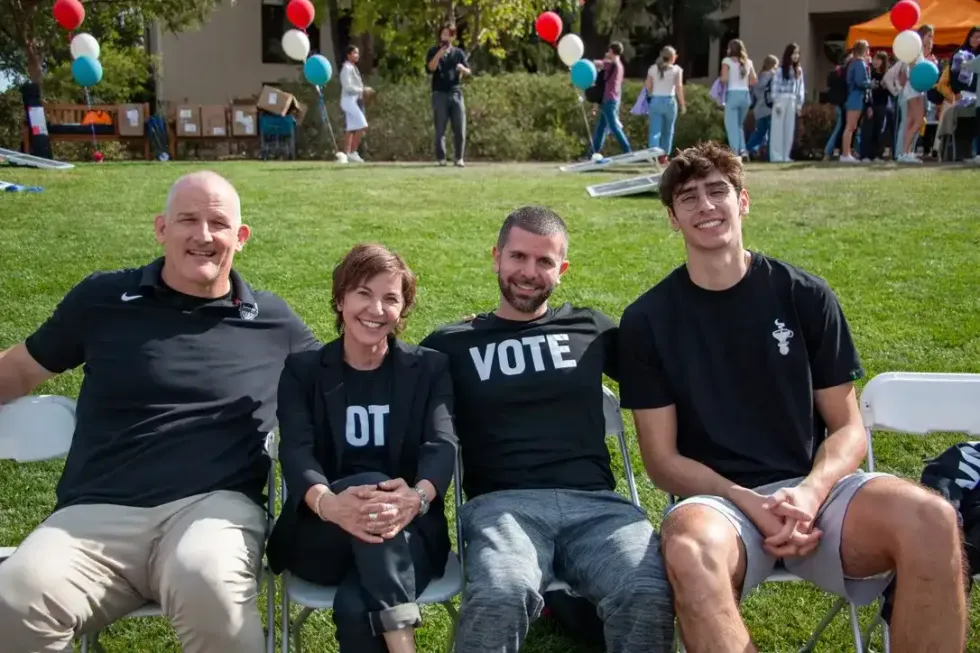 Lisa, Coaches Rev and Matt Elkin, and former Stanford Men’s Basketball star Maxime Raynaud at Stanford’s “All Vote No Play” Democracy Day, 2025