


It seemed like an ordinary day in Olga Adamowska’s life as a 12-year-old Catholic, until one question changed how she understood her family and her own identity.
Holocaust books, a Hasidic figurine or a collectible sculpture depicting a Hasidic or Orthodox Jewish Man, an Israeli flag family, synagogue visits, and a trip to Auschwitz-Birkenau at 5 years old had surrounded her. Curious about her mother, Dorota Adamowska, and her unusual fascination with Judaism, she asked her mother.
Dorota told her that the family had Jewish roots and that Olga was Jewish according to Halakha, or Jewish law.
Olga recalled feeling as though a weight had been lifted off her shoulders.
Years later, Olga recalls sitting at her family home kitchen table, where she asked her mother why she never revealed this information sooner.
“Realistically, I thought that you knew,” replied Dorota.
Olga was stunned by her mother’s response and asked, “How [was I supposed to know]?”
“I was pretty sure that you knew,” reiterated Dorota.
For Olga, the discovery was more than an explanation of family traditions. It opened the door to understanding a history that was shaped by generations of fear, silence, and the lasting consequences of the Holocaust.
After World War II, many Jewish families lived in fear and distanced themselves from practices that could identify them as Jewish. Olga felt this reluctance in her own family: some traditions survived, but openly embracing them was difficult and discouraged.
Olga became the first in her immediate family to break that cycle, choosing to explore her heritage and reconnect with Jewish traditions.
But uncovering her identity meant confronting the stories and emotions that previous generations struggled to share and understand.
One of the most significant moments in Olga’s journey came when she approached her great-aunt about their family’s past. Two months before her great-aunt died in 2018, Olga finally asked her to share her story.
“I was waiting.” Adamwoska recalls her great-aunt saying, “I am happy that you are making this step and you came back to [discuss this with me].”
Despite her willingness to share, her great-aunt remained hesitant to discuss their Jewish background outside the family. Her great-aunt was willing to speak privately but feared being overheard, making Olga turn up the television to prevent the neighbors from overhearing the conversation and identifying them as Jewish.
Her reluctance illustrated how deeply fear of being identified as Jewish had become embedded in the family, even decades after the Holocaust.
Her great-aunt’s death later that year nearly caused Olga to abandon all efforts. She questioned whether she had the strength to keep embracing her Jewish identity while navigating the tensions within her family.
However, her search for answers eventually led her to relatives and family records Olga never knew existed.
While attempting to repair her great-grandfather’s grave, Olga reached out to family members through Facebook and connected with a distant cousin. Their conversation opened a new path to recovering stories of relatives whose lives had largely been absent from her understanding of family history.
As they exchanged photographs and documents, Olga began piecing together a family tree that revealed relatives who had experienced the Holocaust and others who had fought in the Polish resistance.
Olga discovered that one of her great-uncles had been deported to Auschwitz, while another, Jozef Adamowski, had been captured and murdered by German soldiers for participating in the Polish resistance.
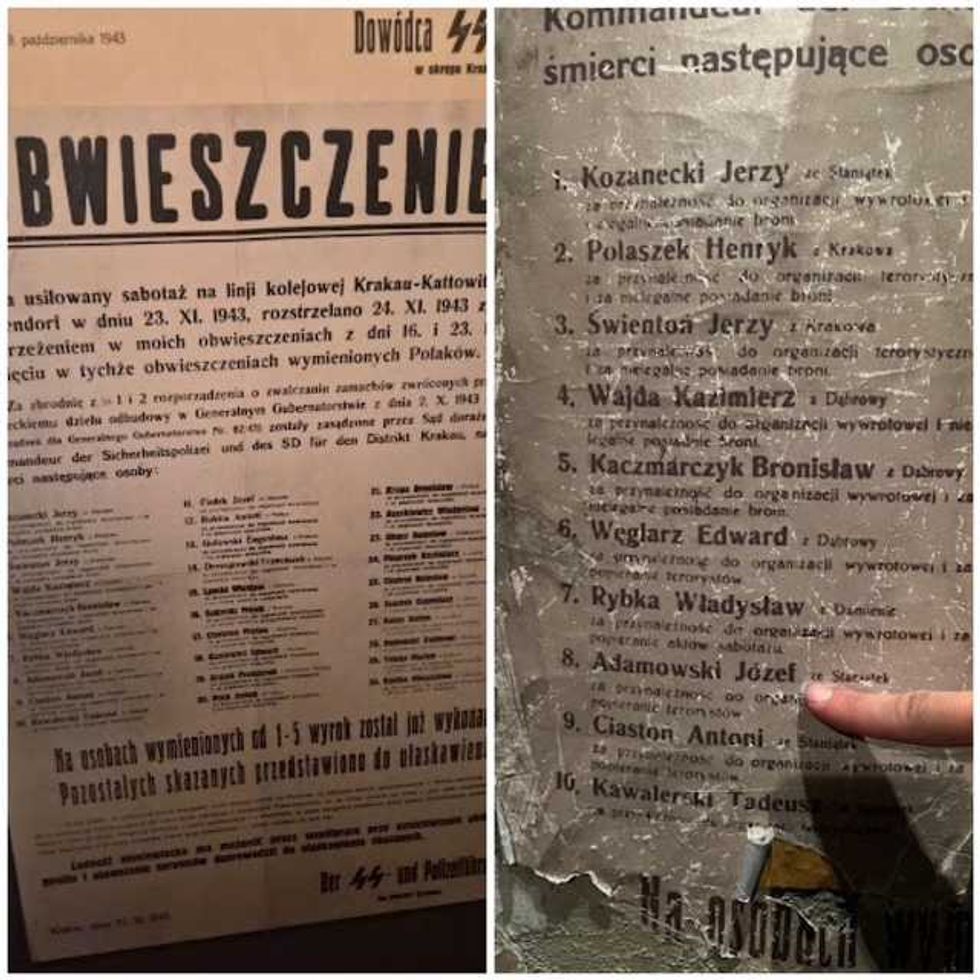 His name, Jozef Adamowaski, can be found next to the number 8, on the second floor, right after the Underground Uprising in Poland and right before entering Schindler’s office throughout the Oskar Schindler's Enamel Factory Museum. Credit: Jessica A. Valencia
The discoveries reinforced her determination to recover the names and stories of relatives who might otherwise have remained forgotten.
“When I started learning more about my great-grandparents, [I wrote] their names on a piece of paper, [which I brought] with me all the time,” Adamowska recalled, “I [joked] that I am collecting all my dead Jewish [ancestors], [But now I realize] that they are alive [and live on] because I remember them.”
For Olga, remembering became a way to restore the identities of family members whose stories persecution and generations of silence had interrupted.
But preserving those memories would eventually become something larger than a personal responsibility.
Olga recognizes that her experience is not unique. Many people may be unaware of their Jewish ancestry or may have grown up in families where embracing their heritage was discouraged.
She believes that reclaiming an identity does not always begin with knowing one’s history, but with deciding to learn about it and accept it.
“It is not about being born Jewish; it is about deciding to be Jewish,” said Olga, referring to individuals who choose to embrace their heritage despite the fears carried by previous generations.
That understanding has shaped how she approaches educating others about Jewish history and culture.
Today, Olga works at the Jewish Community Centre of Krakow (JCC), where she continues to find ways to make Jewish history accessible to audiences who may not otherwise engage with it.
As the number of Holocaust survivors able to share firsthand stories declines, she believes educators must find new ways to reach younger generations and ensure that the lessons of the Holocaust remain relevant.
For Olga, that means adapting education to the interests and learning habits of today’s youth rather than relying exclusively on traditional teaching methods.
As a comic book enthusiast, she helped create an educational comic focused on Sarah Schenirer a jewish educator whose story was intended to inspire Jewish girls.
The research and development process presented challenges, particularly because resources about Schenirer in Polish were limited. Although the comic was never printed, it was published online as an educational resource.
During a visit to a local school, Olga discovered that the teacher planned to use her comic as part of a classroom discussion about Jewish history.
"After the lecture, we will have a discussion about Jews, and we will use this book which I found," the teacher told the class.
For Olga, the moment demonstrated how educational resources can extend beyond their original audience and create opportunities for younger generations to engage with histories that may feel distant.
Her approach reflects a broader responsibility to preserve historical memory as firsthand testimonies become less accessible. By introducing students to Jewish history through creative storytelling, Olga helps create opportunities for young people to ask questions, challenge assumptions, and understand experiences beyond their own.
Engaging with history is not just about remembering what happened. It also requires recognizing how fear, persecution, and the erasure of cultural identities can affect generations long after the events themselves.
Through her educational work, Olga encourages younger audiences to approach history with curiosity rather than avoidance. Preserving these stories helps students understand others' experiences and recognize the importance of ensuring those histories are neither forgotten nor dismissed.
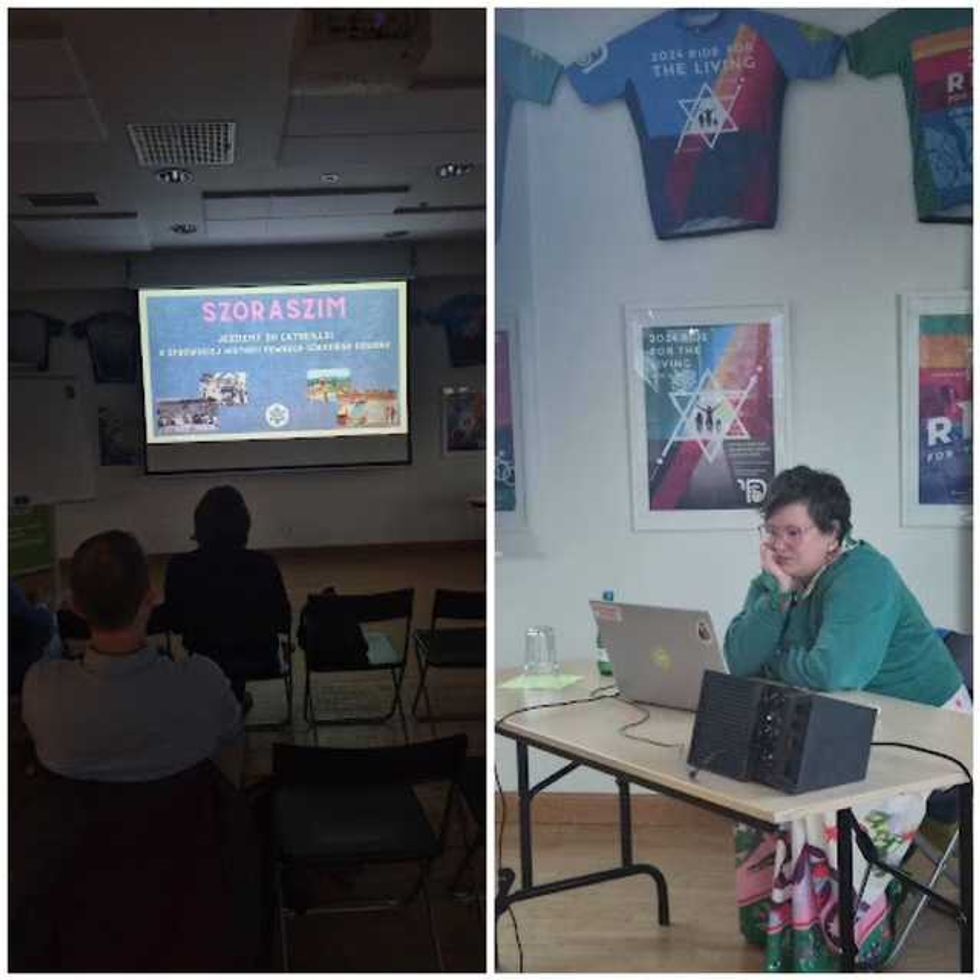 Olga’s lectures on transporting the audience to the Catskill Mountains, which for much of the 20th century were one of the most important destinations for Jewish leisure and social life in the United States. Credit: Jessica A. Valencia
Olga looks forward to the day her nephew approaches her with questions about their family’s past.
“[I am waiting] for the day my nephew comes to me,” Adamowska states, “ [and asks me about the past] so I [share] with him everything that I have collected.”
What began with a question from her 12-year-old self to her mother has since become a lifelong commitment to recovering history and ensuring it reaches the next generation.
Olga once inherited a family history shaped by silence. Today, through education and remembrance, she is working to ensure that younger generations inherit the knowledge to understand it, question it, and keep its stories alive.
Jessica A. Valencia is a recent graduate from California State University.
Jessica was a fellow with Fuente Latina, an organization that sponsors journalists and students to visit Poland and learn about the Holocaust and Jewish history in the region.