
Many Americans think that all US citizens aged 18 or older are entitled to vote. In fact, that has never really been the case in the USA. It has been a tremendously long, hard road to get to where we are today.
The easy part is that the Twenty-Sixth Amendment to the US Constitution lowered the voting age from 21 to 18 in 1971, in response to the Vietnam War. It was considered unjust to draft men to war who were denied the right to vote. In several states felons are denied the right to vote for life.
There was no right to vote specified in the US Constitution when it was adopted in 1789. Voting regulations were determined by the states, not the federal government, and most states restricted voting to white male Christian landowners. At the time, they comprised only 6%of the population.
African Americans were not entitled to vote in most states. (Free Blacks petitioned Massachusetts in 1780). In 1807, New Jersey which previously permitted women and free Black people to vote reversed itself and restricted voting:
to free, white male citizens of the state, of the age of twenty-one
years, worth fifty pounds proclamation money”
When Vermont was admitted to the USA in 1791, it gave the vote to all men regardless of color or property ownership. Kentucky, when admitted in 1792, permitted free men to vote. In 1792, New Hampshire became the first state to eliminate property requirements for voting.
In 1818, a bill known as the “Jew Bill” was introduced and later passed in 1826 and formally re-entitled “Act for the relief of Jews in Maryland”. It eliminated the requirement that candidates for office declare their belief in the Christian Faith. In 1828, Maryland became the last state to deny eligible voters based upon religion.
In 1857, North Carolina passed a state constitutional amendment removing the property ownership requirement, permitting all white men, rich and poor, to vote.
It was sometime around 1856/7 before all white men were permitted to vote in the USA.
In July 1848, a major convention was held in Seneca Falls, New York to discuss the social, civil, and religious rights and conditions of women. At that convention the attendees issued the Declaration of Sentiments. The document mirrored the style of the Declaration of Independence. This reflected a growing women’s movement which included amongst many other concerns, a clearly articulated demand for women’s suffrage.
After many long, tedious struggles, the ability of women to vote was only secured by the 19th Amendment in 1920.
Native Americans were not considered citizens until 1924 and accordingly were largely unable to vote. They also suffered the same indignities as African Americans with literacy tests, poll taxes, redlining, intimidation, violence and gerrymandering and their many further ordeals will require a separate discussion entirely.
Under the Constitution, the Compromise that led to the Three-Fifths Clause counted slaves for the purpose of taxes and their states’ congressional seat allocation (but they themselves were not entitled to vote). It took a Civil War to emancipate the slaves. What is less well understood is that from 1830 onward free and emancipated people of color gathered at conventions on both state and national levels on more than 250 occasions to address issues related to access to education, labor, legal justice and of course enfranchisement.
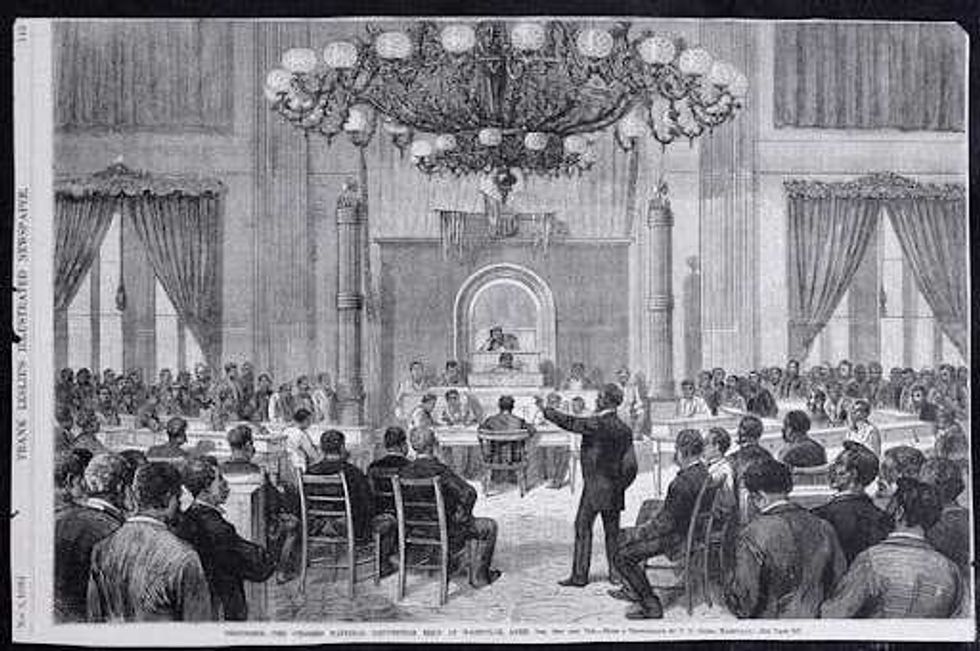 Colored Conventions, a Rallying point for Black Americans Before the Civil War. An engraving of a “colored national convention” in Nashville in 1876, printed in Frank Leslie’s Illustrated Newspaper.Frank Leslie's Illustrated Newspaper NYTimes.com.
It is significantly a result of these efforts that the Thirteenth, Fourteenth and Fifteenth Amendments arose. The Fifteenth Amendment held:
The Right of Citizens of the United States to vote shall not be
denied or abridged by the United States or by any state on
account of race, color, or previous condition of servitude.
Despite the passage of the 13th Amendment which abolishes slavery; and the 14th Amendment which holds in section 1 that:
All persons born or naturalized in the United States, and subject to the
jurisdiction thereof, are citizens of the United States ... No state
shall make or enforce any law which shall abridge the privileges
or immunities of citizens of the United States; nor shall any state
deprive any person of life, liberty, or property, without due process
of law; nor deny to any person within its jurisdiction the
equal protection of the laws.
These were not rights that were easily realized, the amendments were attained as a result of more than a century of efforts by abolitionists, free and enslaved people of color, 150 years of litigation, not to mention the Civil War. From 1877 after the passage of the Amendments, Black Americans and other people of color experienced the Jim Crow years when poll taxes, literary tests, redlining, intimidation, violence and gerrymandering were all utilized to suppress the Black vote. After 90 years of voter suppression and backlash, the Voting Rights Act was passed in 1965. The Voting Rights act was one of the most transformative pieces of legislation in US history. The Act was relatively stable for 15 years. In 1981 there were three challenges to the act in 1988 there were 175.
In 2009 in NW Municipality Utility District v. Holder Chief Justice Roberts and Justice Thomas suggested racism in voting was no longer an issue and hinted that federal oversight was no longer necessary.
“Voter turnout and registration rates now approach parity,” Chief Justice Roberts
wrote. “Blatantly discriminatory evasions of federal decrees are rare. And minority
candidates hold office at unprecedented levels…
Two later decisions addressing the act, Shelby County v. Holder in 2013 and Louisiana v. Callais (2025) gutted the Voting Rights Act reopening the doors for extreme gerrymandering specifically intended to undermine the effect of the black vote, virtually eliminating access to Black representation in congress.
The Constitution has evolved. When it refers to all men, it now means all citizen persons (excepting convicted felons). However, the Citizens United decision which tilts campaign funding to benefit oligarchs (mostly white & male e.g. the equivalent of landholders in the 1700s) is unconscionable and demonstrably unjust. The United States of America consists of citizens of most religions, all races, a wide range of ethnicities, a multitude of languages, a diverse range of gender identities, and we should all be entitled to the full rights and privileges of being citizens of the United States. The current efforts to preserve rights for the few and to deny or diminish rights for the many must neither be tolerated nor justified. The United States must continue to seek to be a more perfect union striving to achieve equal rights for all.
This series from Lawyers Defending American Democracy connects the words of the Declaration of Independence and the Constitution to current events that threaten democracy and the justice system. Each piece highlights the unique responsibility lawyers carry—through their oath, professional obligations, and roles in their communities—to help the public understand what’s at risk and to speak out when democratic principles are under threat. LDAD’s call to action is straightforward: as the Founders once did, we must recognize threats to constitutional values, demand accountability, and act to defend them.
Walter H. White, Jr. is a member of the board of Lawyers Defending American Democracy a co-founder and past chair of the ABA Center on Human Rights, and an American lawyer living in London, U.K.