
Skip to content
Search

Latest Stories

Follow Us:
Top Stories

The worst deal in the history of deals

Opinion

The worst deal in the history of deals

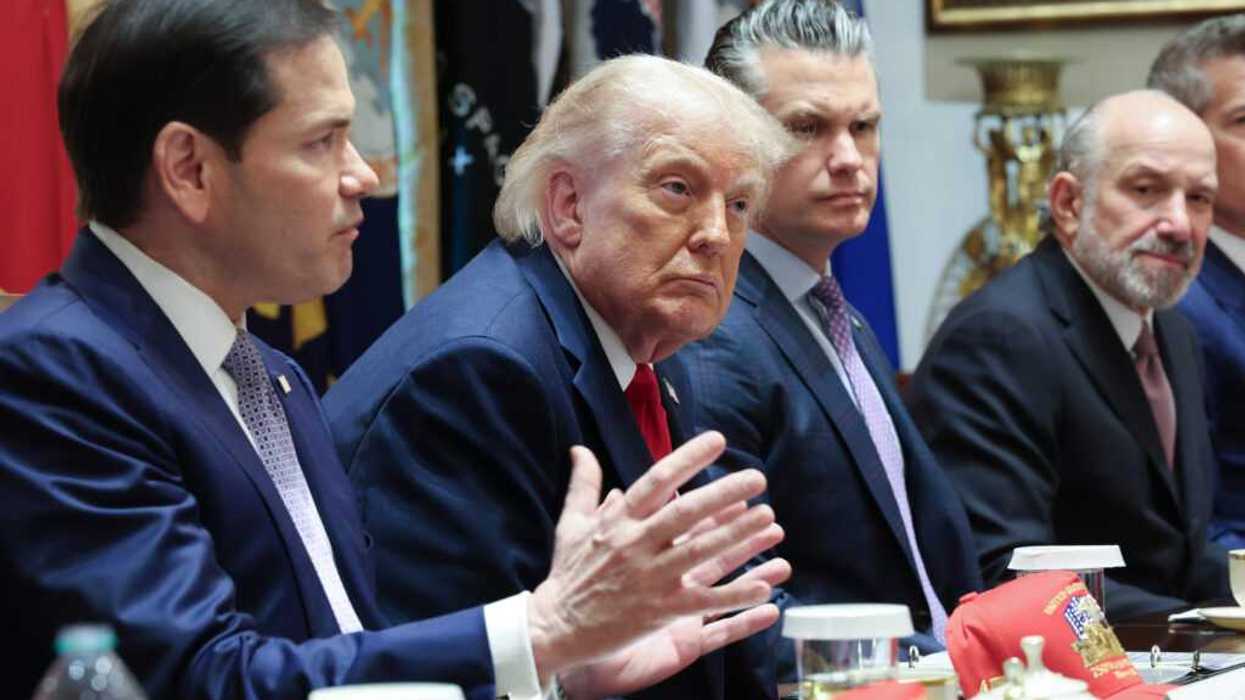
U.S. Secretary of State Marco Rubio speaks with U.S. President Donald Trump during a Cabinet meeting in the Cabinet Room of the White House on May 27, 2026 in Washington, D.C. Trump met with his Cabinet days after saying a peace deal with Iran was“ largely negotiated” amid expectations around the re-opening the Strait of Hormuz.

(Getty Images)

As a former Republican, sometimes it’s fun to look back on the things we — I was part of a “we” at one time — criticized Democrats for, and not all that long ago.

Remember, if you will, when Republicans condemned former President Bill Clinton for pardoning his brother and his corrupt donor friend Marc Rich?


Or, remember when Republicans wagged their fingers at former President Barack Obama’s golf outings? Or his executive orders? Or his Syrian “red line”?

Or all the times Republicans went after former President Joe Biden’s gaffes?

While those criticisms may have been justified at the time, they look patently ridiculous next to our current president’s cartoonish and downright dangerous offenses.

Offenses like pardoning Jan. 6 insurrectionists — nearly 100 of whom have gone on to be arrested for, charged with, or convicted of crimes separate from the events of that day.

Or wreaking havoc on the global economy by instituting reckless tariffs on friends, neighbors, and enemies alike?

Or taking a proverbial sledge hammer to countless government agencies that have put every American in danger, whether on airplanes, in hospitals, at job sites, or in natural disasters.

That’s just a few, but nothing looks worse next to his predecessors than Donald Trump’s supposed Iran deal, at least as it’s outlined in the Memorandum of Understanding, the details of which Trump was loath to share.

And for good reason — they are shockingly bad and humiliating for the U.S.

I remember Obama’s Joint Comprehensive Plan of Action or JCPOA from 2015 very well. I, along with many Republicans as well as a cadre of foreign policy experts, criticized that deal for its obvious and problematic concessions to a very bad actor who we’ve long known could not be trusted. But trust was what we gave the Iranian regime, as well as sudden access to a boatload of cash — $100 billion, to be exact.

All of Obama’s provisions were temporary, which would allow Iran to restart enriching uranium upon their sunset; the deal didn’t address Iran’s ballistic missiles, or its funding of terrorist proxies like Hezbollah and Hamas; the supposed “anytime, anywhere” inspections came with a 24-day delay, if Iran so chose, giving them ample time to hide any suspect materials; and it didn’t require any congressional authority.

In short, I’d argue it wasn’t a great deal. But as bad as it was, it looks like the Magna Carta next to Trump’s.

Trump’s deal would give Iran immediate sanction relief and access to $300 billion, presumably to use to fund terror proxies; it doesn’t secure any upfront limits on uranium enrichment or missile development; it allows Iran to charge for safe passage through the Strait of Hormuz in the future; and it calls for Israel to stop its attacks on Hezbollah, another win for Iran.

Neither Americans nor the Middle East are safer than we were 100-plus days ago when Trump decided to pursue this folly. And in fact, our economy is weaker for it. But Iran is unquestionably stronger and more emboldened.

They’ve seen Trump’s weakness, unseriousness, and frighteningly limited appreciation for history. They’ve seen him retreat on most of his core threats to the regime, from bombing their cultural sites to ending a civilization overnight. And they’ve taken notice as he’s abandoned the promises that were supposedly central to his justification for war in the first place — regime change, liberating the Iranian people, and removing Iran’s nuclear materials.

What a waste of blood and treasure, not to mention American might and power, only so that our enemies can watch us limp desperately toward a conclusion that’s being described — by the right — as “unthinkable,” “appeasement,” and “the worst foreign policy blunder in decades.”

S.E. Cupp is the host of "S.E. Cupp Unfiltered" on CNN.


Read More

NATO Has an Article 5. It Doesn't Have an Iran Policy

(L-R) Recep Tayyip Erdoğan, President of Turkey, Mark Rutte, Secretary General of NATO, Donald Trump, President of United States and Keir Starmer, Prime Minister of United Kingdom during a “family photo” at Beştepe Presidential Compound during a welcome ceremony for the NATO Summit on July 08, 2026 in Ankara, Turkey.

(Photo by Win McNamee/Getty Images)

NATO Has an Article 5. It Doesn't Have an Iran Policy

It seems just yesterday I was writing up a piece regarding the G7 summit taking place in southern France. In truth, it was a few weeks ago, but now that the NATO summit has wrapped up, I can’t be the only one with deja vu; world leaders meeting amid the continuing US-led war with Iran. I think I’ve seen this film before.

Welcome to Faultline. Last week, heads of NATO member states convened in Turkey for their yearly summit. Many issues were on the table for the summit, and the one expected to take center stage was the ongoing Russian invasion of Ukraine, considering that the Iran war was supposed to be done, as had been announced weeks ago. However, less than 30 days into the alleged 60-day ceasefire, President Trump has announced that negotiations with Iran are over, and not because they reached an agreement.

Keep ReadingShow less
2026 Democracy Awards Honor Excellence Across Congressional Offices
white concrete building during daytime

2026 Democracy Awards Honor Excellence Across Congressional Offices

The Congressional Management Foundation's Democracy Awards recognize congressional offices that demonstrate excellence in public service. While the headlines often focus on conflict, this year's winners remind us that strong leadership, thoughtful management, and a commitment to continuous improvement strengthen both Congress and the constituents it serves

Constituent service remains one of Congress's core functions, and this year's winners of the Best of Constituent Service Award demonstrate that excellence requires exceptional organizations and internal infrastructure. For example, Senator Adam Schiff's office (D-CA) streamlined processes by creating online forms for casework authorization and privacy releases. This system allows constituents to submit requests in minutes, streamlining a process that traditionally required extensive time and resources, resulting in more efficient casework intake

Keep ReadingShow less
Graham’s legacy & his failure over Trump

U.S. Senator Lindsey Graham, Republican of South Carolina, listens to President Donald Trump unveiling the Kennedy Center Honors nominees on Aug. 13, 2025, at the Kennedy Center in Washington, D.C.

(Mandel Ngan/AFP via Getty Images/TCA)

Graham’s legacy & his failure over Trump

I met the late Sen. Lindsey Graham about 20 years ago, when I was coming up in conservative politics.

I had been part of the neoconservative wing that believed in the “benevolent hegemon” version of America, and the idea that “history can be pushed along with the right application of power and will,” as Francis Fukuyama once described it.

Keep ReadingShow less
Trump’s Defense of ICE Traffic Stops Shows a President Willing to Risk Lives for Politics

U.S. President Donald Trump in the Oval Office of the White House on July 14, 2026 in Washington, DC.

(Photo by Andrew Harnik/Getty Images)

Trump’s Defense of ICE Traffic Stops Shows a President Willing to Risk Lives for Politics

President Donald Trump blasted ICE’s decision to suspend most vehicle stops after agents fatally shot two men just six days apart in Texas and Maine, declaring on his social media site: “We CANNOT give up one of ICE’s most important and effective Crime Fighting tools, THE TRAFFIC STOP!” His response made the stakes unmistakably clear. Instead of acknowledging the loss of life or the urgent need for accountability, Trump rushed to defend the very tactic that produced these deadly encounters. Once again, he signaled that the wellbeing of people — immigrants or citizens — matters far less to him than protecting his political agenda.

Trump’s posture toward ICE has always been rooted in escalation. He has framed undocumented immigrants as threats, encouraged aggressive enforcement, and rewarded secrecy over transparency. The consequences of that approach are now visible in a series of fatal encounters that reveal an agency operating without meaningful oversight.

Keep ReadingShow less