Skip to content
Search

Latest Stories

Follow Us:
Top Stories

‘Trumpapalooza’ is a sad, unnecessary spectacle that achieves nothing

Opinion

Donald Trump dancing

Republican presidential candidate and former President Donald Trump dances off stage at the end of a campaign rally at the Grappone Convention Center on Friday, Jan. 19, 2024, in Concord, New Hampshire.

(Chip Somodevilla/Getty Images/TNS)

Republican National Committee Chairman Joe Gruters says the GOP midterm election “convention” will be a “Trumpapalooza.” It’d be better if everyone called it that.

American political conventions are one of the best examples — among way too many — of American institutional decay.


In the 19th century and much of the 20th century, the quadrennial party conventions were indispensable pieces of political technology. I mean that literally. Traditionally, conventions were where party stakeholders — elected officials, party bosses, etc. — chose the nominee. Factions representing regions, interests, even ideas (how quaint!) would debate and horse-trade with each other, sometimes over days of voting, to name someone the party could get behind.

That system started to atrophy in the 1930s, as Michael Barone, the great political analyst, has argued, because of the telephone. The kind of negotiating required for a nominee to win support was impossible to do by letter. It took too long, and besides, putting things in writing risked exposing deals and other favor-trading for which savvy politicians would never want a paper trail. You had to do it face-to-face.

“The conventions were thus communication devices,” Barone writes, “in which campaign managers assessed candidates’ strength — and responded. Votes would be held back, so as to show momentum on later ballots. Favorite-son candidacies would be launched, in the hopes that they could be withdrawn later for reward or parlayed into a dark-horse nomination. No one had an accurate idea of how many delegates candidates had.”

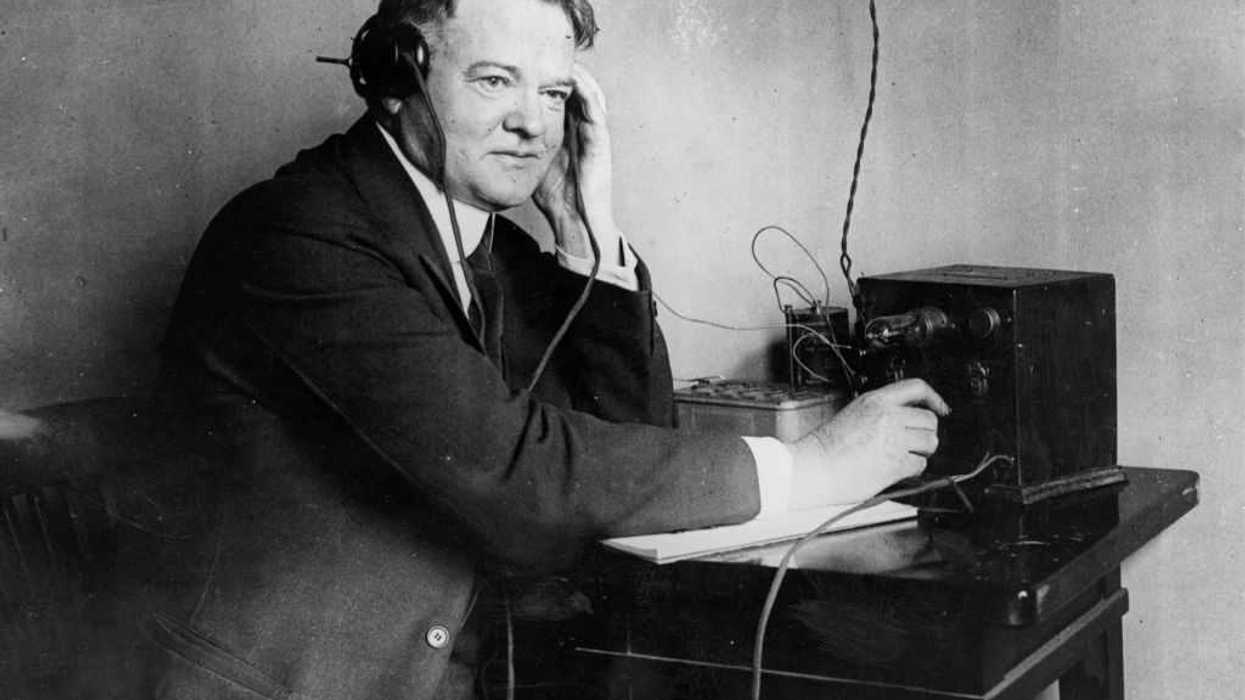
The telephone changed that. In 1936, President Roosevelt used the new technology of long-distance calling to organize support well in advance of the convention.

Polling, and then television, further sapped away the function of conventions. Who needs party bosses to tell you the mood of the rank and file, when polling can deliver a much richer picture? Why put floor fights and other fodder for opponents on TV? Better to offer a picture of solidarity and excitement.

But the real death knell came in 1972 with the “reforms” promulgated by Democrat George McGovern, which were quickly adopted by the GOP. These reforms — which I think were deformations of our democratic system — took the power to nominate a candidate away from the stakeholders and gave it to rank-and-file voters. We thus became the first and one of the only advanced democracies where parties can no longer choose their own candidates.

I think that was a disaster, but that’s a column for another time. One of the consequences of that disaster was that party conventions essentially became infomercials ratifying a fait accompli. The brokered convention — even the prospect for one — is gone now, replaced by a coronation.

But at least the coronation still serves a purpose. It’s still a necessary function of our electoral system. A boring, intelligence-insulting, performative function, but a function all the same.

This midterm “convention” isn’t even that. No one will be formally nominated. It’s just an opportunity for President Trump to put on a show — about himself.

Defenders might say there’s precedent for this, but their argument proves my point about decay. Democrats in 1974, 1978 and 1982 had midterm conventions. But those conventions involved various committee meetings in which party rules and resolutions were proposed and debated.

In 1978, President Carter defended the midterm convention.

“I believe it is very important for me, as a president, and also as head of the Democratic Party, to have my success and failures assessed objectively and openly by Democrats representing the grassroots of our party around the nation,” Carter said. “I think that was done in a very forthcoming way.”

The Washington Post reported that John C. White, the Democratic Party chairman, was worried that delegate disputes could “turn the convention into a public relations failure.”

“Of course we have a broad range of opinions on some issues within our party,” White said. “But if we get foolish, if we go beyond proper political division and look quarrelsome, these are things that could hurt the Democratic Party and the Democratic president.”

If you think the Dallas Trumpalooza is going to include an open and objective discussion of Trump’s failures, or feature even the slightest political division, I want to congratulate you for having just emerged from a decade-long coma.

This is a commercial with a live studio audience and nothing more. Indeed, the rot of our political institutions on display is not confined to the GOP. One of the featured keynote speakers is Attorney General Todd Blanche. Whether the already ethically compromised AG’s appearance at an expressly partisan event is a violation of the Hatch Act is something for the lawyers to debate. But the spirit of it is grotesque, and a sign that our parties aren’t the only institutions that have lost their way.

Jonah Goldberg is editor-in-chief of The Dispatch and the host of The Remnant podcast. His Twitter handle is @JonahDispatch.


Read More

Fire Pete Hegseth to help GOP in midterms

Secretary of Defense Pete Hegseth speaks during a meeting with Australia's Deputy Prime Minister and Minister for Defense Richard Marles at the Pentagon in Washington, D.C., on Sept. 2, 2026.

(Kent Nishimura/AFP via Getty Images/TCA)

Fire Pete Hegseth to help GOP in midterms

“Muscles, dudes in dresses, testosterone.”

That’s how one European defense official described the priorities of Defense Secretary Pete Hegseth, according to a bombshell new report from CNN on the growing concern inside the U.S. military over Hegseth’s leadership.

Keep ReadingShow less
THE POLITICS OF EXCLUSION: When Abuse of Power Pushes Communities Out of the American Story

An opinion essay traces America's cycle of welcoming immigrants and communities of color for labor, then excluding them once they gain power.

Westend61/Getty Images

THE POLITICS OF EXCLUSION: When Abuse of Power Pushes Communities Out of the American Story

The politics of exclusion is the deliberate use of power to push certain communities out of the American story through fear, cruelty, erasure, and unequal treatment. It is what happens when leaders abandon constitutional ideals and replace them with grievance, retaliation, and division.

The late John McCain warned that we weaken our greatness when we confuse patriotism with tribalism. Liz Cheney cautioned that no one should support a leader who uses fear and division to hold onto power. Adam Kinzinger called it authoritarianism. Mitt Romney said plainly, “He has caused fear and division.” Alexandria Ocasio-Cortez observed that “the cruelty is the point,” and the late John Lewis reminded us that “democracy is not a state; it is an act.” Together, these voices describe the elephant in the room. America is confronting a pattern bigger than corruption and bigger than authoritarian drift. It is the social, racial, and moral dimension of democratic erosion — lying, cheating, cruelty, intimidation, erasure, and exclusion masquerading as patriotism.

Keep ReadingShow less
Trump and Carney standing next to American flag

U.S. President Donald Trump welcomes Canadian Prime Minister Mark Carney to the White House on Oct. 7, 2025 in Washington, D.C.

(Chip Somodevilla/Getty Images/TCA)

Trump’s war on Canada a pitiful own goal

This summer, America played host to one of the biggest international events on the planet, the World Cup, drawing millions of foreigners to our cities and towns, our stadiums and our national parks, where many of them had never been before.

The consensus was, America is awesome — visitors from Bolivia, Scotland, Uzbekistan, and everywhere in between marveled at the sheer size of our great nation, the diversity of our topography, the deliciousness of our foodstuffs, and, perhaps most importantly, the kindness of our people. (Not to mention, our eighth wonder of the world — Buc-ee’s.)

Keep ReadingShow less
The Sleeping Giant Woke Up. Trump is Asleep.

U.S. Marines wait for the arrival of U.S. President Donald Trump before a Freedom 250 Grand Prix showcase on West Executive Avenue between the West Wing of the White House and the Eisenhower Executive Office Building on July 13, 2026 in Washington, DC.

Andrew Harnik/Getty Images

The Sleeping Giant Woke Up. Trump is Asleep.

After Senator Lindsey Graham died in office, South Carolina’s governor appointed his sister, Darline Graham, to serve out the remainder of his term. Just over a month later, campaigning for a full term of her own, when asked at a debate whether Taiwan and the South China Sea are national security issues for the United States, she said she was “not that informed on national security.” The President has endorsed her candidacy. Call me old-fashioned, but I want a Congress that is informed on national security. The founding fathers seemed to agree: Article I, Section 8 of the Constitution hands Congress the power to declare war, “raise and support Armies,” “provide and maintain a Navy,” and “make Rules for the Government and Regulation of the land and naval Forces.” That’s the job description, and I want a president who doesn’t endorse someone for that job who can’t handle that responsibility.

Our Commander-in-Chief and Secretary of Defense have turned away from Taiwan and the South China Sea. When I was a Navy pilot, the spoken and unspoken adversary of our future was China. I don’t mean to make a judgment about whether that was the right call, but just to say that in my 14 years affiliated with the Navy, of every potential adversary we discussed, China was always the most formidable. As I trained to be a mission commander, most of the simulations I flew and the scenarios I hashed out on oral boards revolved around the South China Sea. That’s the fight we trained to fight. Then, a few months after I separated from the Navy, Secretary Hegseth announced our priorities were shifting away from the Pacific to “restore U.S. military dominance in the Western Hemisphere.” That didn’t stop us from starting a war with Iran we can’t seem to get out of, but the promise to take focus away from the Pacific does seem to have held.

Keep ReadingShow less