





Introduction
We have spent decades arguing about abortion policy on ideological grounds. I think we now have an opportunity to step back, look at what actually happened, and ask a more fundamental question: What policies actually reduce the number of abortions?
I believe that is a question on which pro-life and pro-choice people should be able to agree. Whatever our differences about abortion itself, surely, we can agree that fewer abortions would be a good outcome.
The data, however, should make all of us reconsider some of our assumptions.
Look at the national data
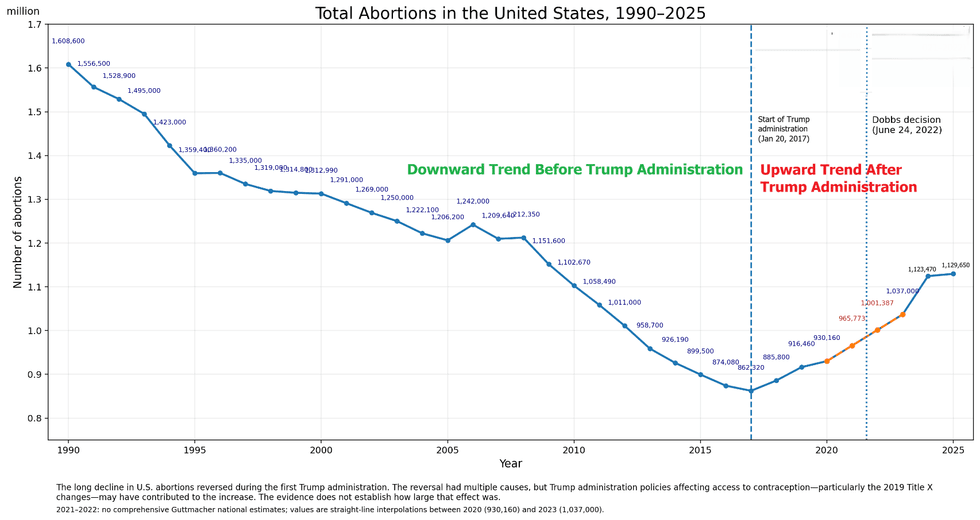
The first graph tells a remarkable story. From 1990 through 2017, the number of abortions in the United States followed a generally downward trend, falling from more than 1.6 million in 1990 to a historic low around 2017. Guttmacher describes this as a nearly three-decade decline.
Then the direction changed.
Beginning around the start of the Trump administration, the long decline stopped, and abortions began increasing. By 2020, abortions had risen to 930,160, an 8% increase from 2017. Guttmacher reports that the increase continued after that, reaching more than 1 million abortions in 2023 and approximately 1.124 million in 2024. Its latest estimate is approximately 1.126 million in 2025—the highest number since 2009.
The graph also identifies two important changes in the policy environment: the Trump administration's changes to Title X beginning in 2019 and the Supreme Court's Dobbs decision in 2022.
I am not claiming that these policies caused the increase. The data cannot establish that. The increase had already begun before Dobbs, and many factors affect abortion rates.
But the pattern is unmistakable: the decades-long decline in abortions stopped, and the trend reversed.
That should cause us to ask whether the policies we have adopted are accomplishing what we intended.
Texas provides an even more striking example
The second graph tells a similar story, but with an even more dramatic policy change.
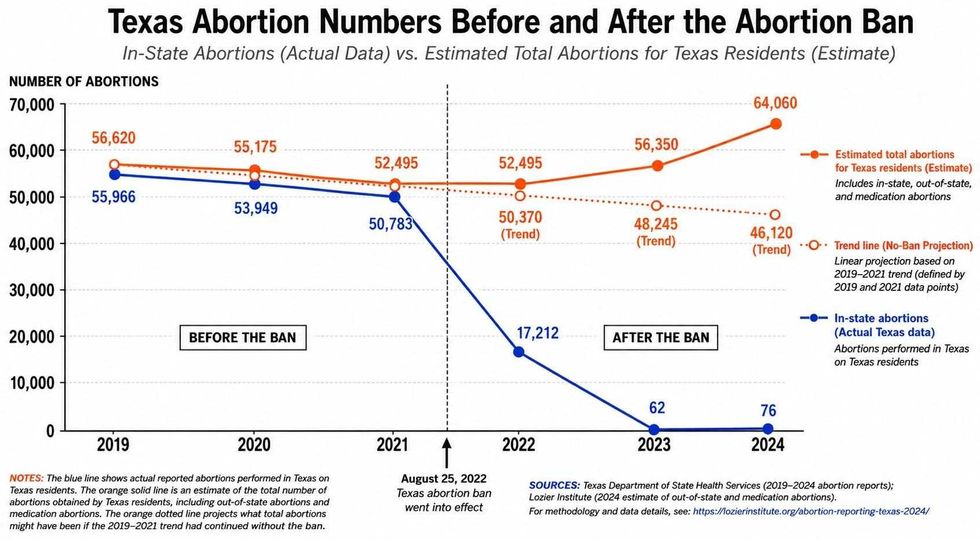
Texas abortions had been declining for years. The total fell from 56,620 in 2019 to 55,175 in 2020 and 52,495 in 2021.
Then Texas banned abortion.
The effect on abortions performed inside Texas was immediate and dramatic. The number fell from 50,783 in 2021 to 17,212 in 2022 and essentially zero thereafter.
But that is not the same thing as reducing abortions among Texas residents.
As the orange line in the graph shows, the estimated total number of abortions obtained by Texas residents went from 52,495 in 2021 to 56,350 in 2023 and 64,060 in 2024. In other words, despite the ban, the estimated number of abortions obtained by Texas residents increased by approximately 22% between 2021 and 2024.
The abortions did not simply disappear. They moved—to other states and increasingly to medication abortion and telehealth. Guttmacher has documented the enormous increase in interstate travel and telehealth provision following Dobbs.
Again, I am not claiming that the Texas ban caused the increase. There are undoubtedly multiple explanations, and the available data cannot establish a single cause.
But we should at least acknowledge the obvious: the Texas ban has not produced the result its supporters presumably wanted if that result was fewer abortions among Texas residents.
What might explain this?
Here I want to make a suggestion, and I want to be clear that it is my hypothesis, not a proven conclusion.
Before Texas eliminated abortion providers, Texas law required a woman seeking an abortion to receive information that included alternatives to abortion and to wait at least 24 hours before the procedure, subject to limited exceptions.
Whatever one's opinion of those requirements, they created an opportunity for a woman considering an abortion to have an in-person encounter with healthcare professionals, learn about her options, consider alternatives, and have additional time before making the final decision.
That entire environment disappeared when Texas eliminated legal abortion providers.
A woman seeking an abortion in Texas now has to find another pathway. She may travel to another state, or she may obtain medication through telehealth. Those pathways can be extraordinarily valuable for someone who has already made a firm decision. But they may provide fewer opportunities for the kind of personal interaction, counseling, and consideration of alternatives that existed when abortion providers were available locally.
Perhaps that is part of the explanation for the surprising Texas numbers.
I don't claim that it is the whole explanation. It almost certainly isn't. The reasons for the increase are likely much more complicated. But it is a hypothesis worth testing rather than dismissing.
Perhaps we should learn from the data
For almost 30 years, the United States experienced a substantial decline in abortions. Whatever the reasons for that decline, something was working.
Since approximately 2017, that progress has reversed.
Texas provides an even more striking example. A state that had been experiencing a long-term decline eliminated virtually all legal abortion providers, yet the estimated number of abortions obtained by Texas residents subsequently increased.
If our objective is to reduce abortions, we should judge our policies by whether they actually reduce abortions.
That means pro-life and pro-choice Americans have an opportunity to move beyond the argument over who is morally right and work together on the outcome we can share: fewer abortions.
That could mean better access to contraception, better sex education, greater economic support for pregnant women, stronger support for mothers and children, adoption services, healthcare, childcare—and, perhaps, giving women who are considering abortion the information, counseling and time they need to make a truly informed decision.
We don't have to agree on everything about abortion to agree that reducing the number of abortions is a worthwhile goal.
And perhaps the most important lesson of all is this:
If being "pro-life" means wanting fewer abortions, then perhaps being genuinely pro-life means being genuinely pro-choice—giving women the information, support, time, and real alternatives they need to choose life.
Pro-life means pro-choice.
Michael A. Soderstrand is a retired professor of Electrical and Computer Engineering and currently lives in Columbus, Ohio.











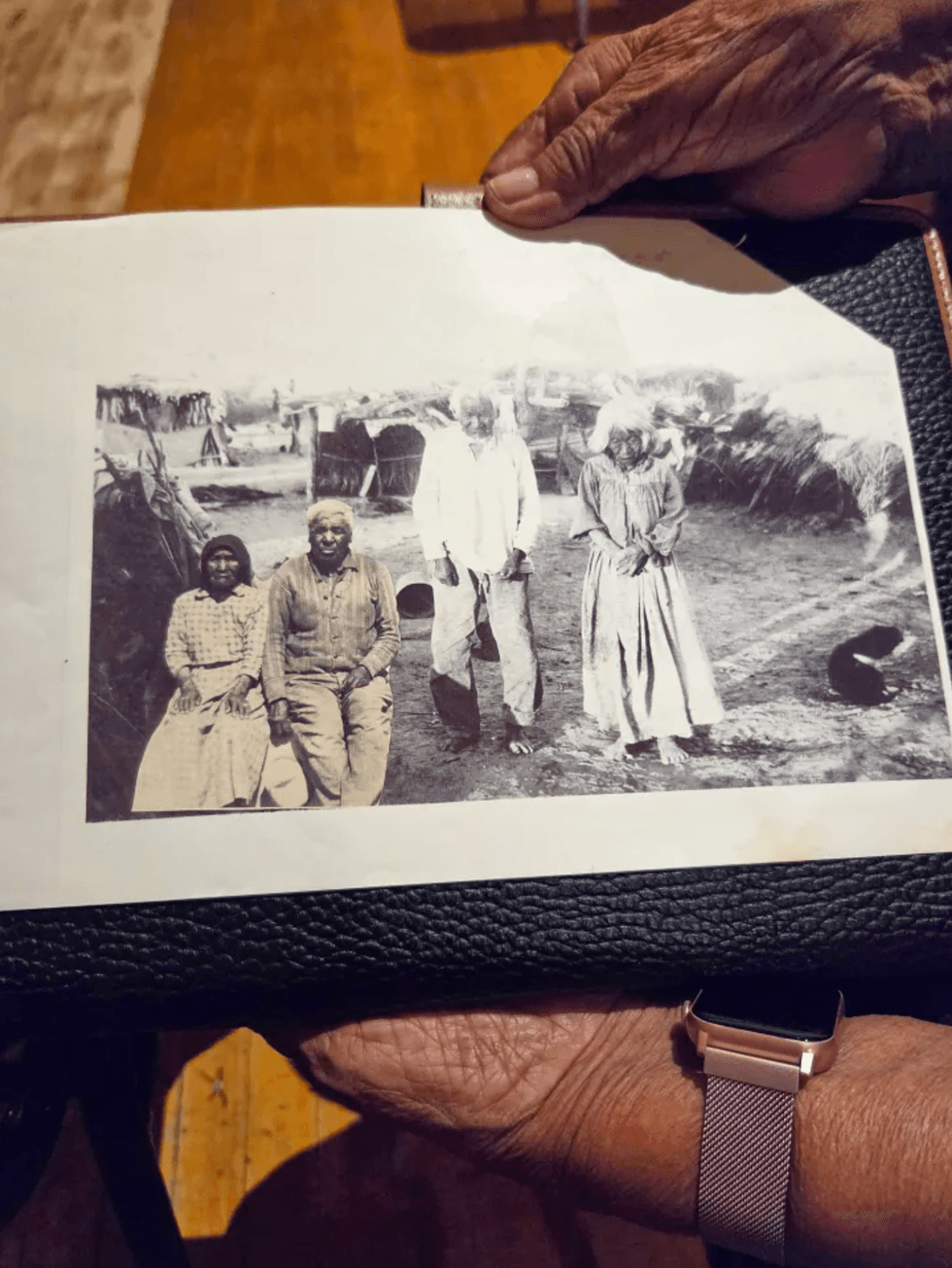 Lorraine Marquez Eiler’s photo of her great-great grandparents and her great-grandparents, who would walk about 50 miles through the Sonoran Desert to the springs.
 The Quitobaquito pond sits near the U.S.-Mexico border just west of the Lukeville port of entry on Monday, Aug. 24, 2026. The Trump administration is attempting to build a second border fence 150-feet from the existing border, which O’odham tribal members and environmentalists say would damage Quitobaquito, a sacred site to the O’odham and other indigenous people. Credit: Stephanie Casanova
 Construction equipment is seen near the U.S.-Mexico border just west of the Lukeville port of entry on Monday, Aug. 24, 2026. Credit: Stephanie Casanova
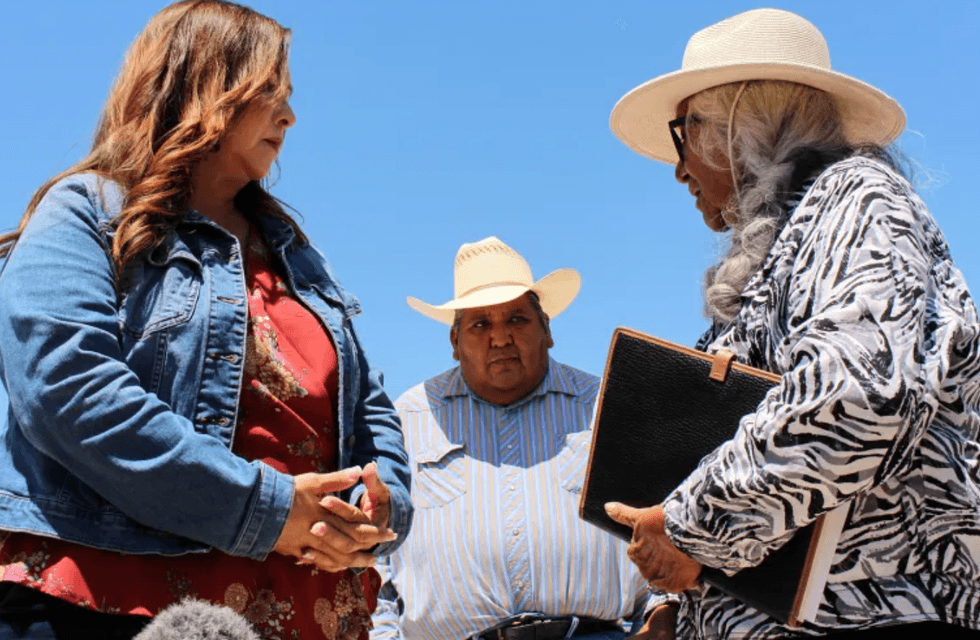 Rep. Adelita Grijalva, left, and Tohono O’odham Chairman Verlon Jose listen as Lorraine Marquez Eiler, a Hia-C’ed O’odham elder, shares how her ancestors would hold ceremonies at Quitobaquito Springs. Grijalva visited the springs with tribal leaders on Monday, Aug. 24, 2026. Credit: Stephanie Casanova
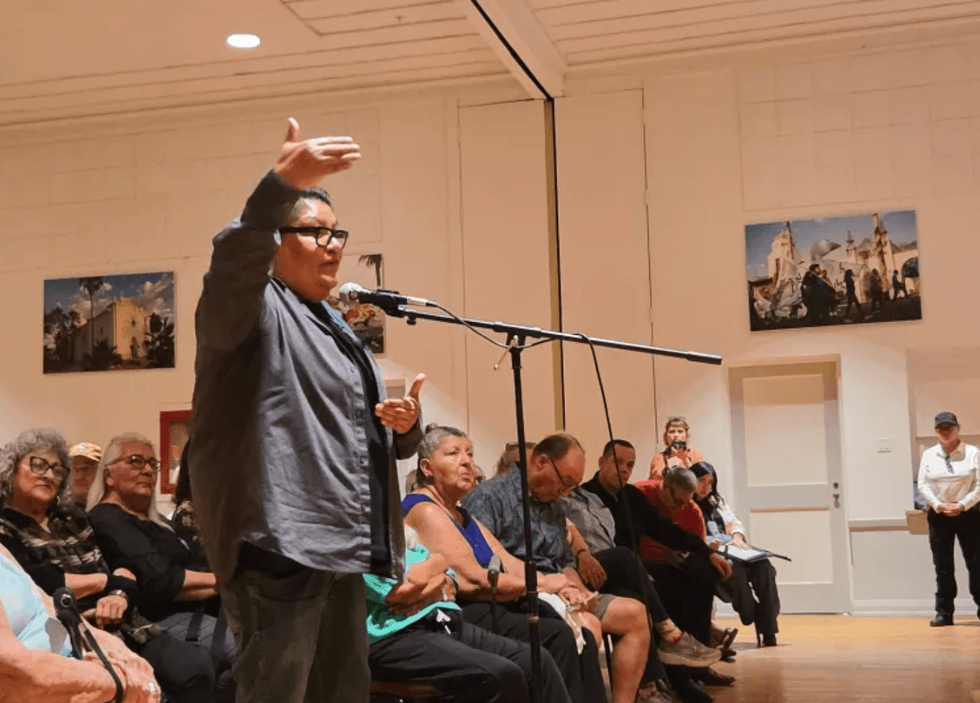 Sara Mae Williams, Justice of the Peace in Ajo and a Tohono O’odham citizen, shares their concerns regarding border wall construction on Tohono O’odham land at a town hall at the Ajo Plaza Rec Hall on Monday, Aug. 24, 2026. Credit: Stephanie Casanova