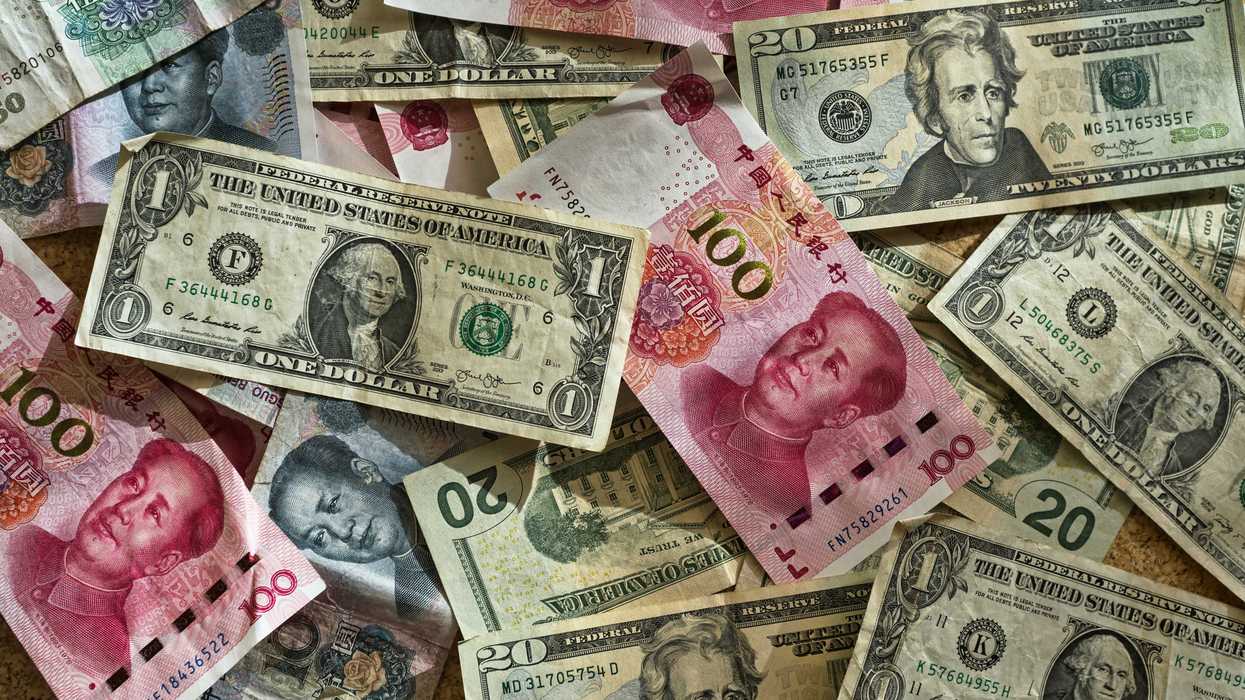





Trickle-down policies facilitated the transition from the mid-20th century "Great Compression “characterized by low-wage inequality and strong labor unions—to the "Great Divide" by shifting the economic focus from mass purchasing power to capital accumulation through massive tax cuts and deregulation.
The Great Compression
Following World War II, the United States experienced an unprecedented period of economic egalitarianism. Propelled by the G.I. Bill, the rise of powerful labor unions, and a heavily progressive tax code, the income gap between the wealthiest Americans and the working class shrank dramatically.
During this era, the economy heavily subsidized upward mobility. A single-income household could comfortably afford a starter home, a vehicle, and higher education without incurring generational debt. The post-war consensus was rooted in the idea that productivity growth and wage increases moved in lockstep.
During the Great Compression (Mid-1940s to the late 1970s), heavy progressive taxation, strong labor unions, and robust minimum wage policies actively reduced inequality. High marginal tax rates (often around 80%) kept executive compensation in check, while strong unions and a surge in demand for moderate-skilled labor allowed the bottom 90% of earners to experience wage growth that kept pace with economic productivity. During this era, homeownership, higher education, and healthcare were widely accessible on a single middle-class income.
However, the stagflation of the 1970s paved the way for supply-side economics. This "trickle-down" philosophy was built on the premise that slashing top marginal tax rates and easing corporate regulations would unleash private investment, ultimately generating widespread job creation and tax revenues.
The Great Divide
The Great Compression reversed in 1980, marking the beginning of the Great Divide (often called the Great Divergence). Policy shifts, including sharply lowered top marginal tax rates and capital gains taxes, financial deregulation, and weakened union protections, led to explosive income and wealth gains for the top 1%, while median wages stagnated. Between 1979 and 2022, the top 1% doubled their share of national income.
This hollowing out of the middle class severely damaged baseline affordability:
The Productivity-Wage Gap: From 1979 to the present, U.S. worker productivity has soared by over 83%, but median wages have increased by only about 29%. Workers are producing vastly more value but receiving a shrinking share of it.
Soaring Essential Costs: Prices for housing, higher education, and childcare have dramatically outpaced wage growth. The burden of essential living expenses has skyrocketed. The cost of living dominates public concern, with items like electricity (up 21% since 2020), healthcare, and groceries stretching family budgets to the breaking point.
Systemic Market Constraints: Modern affordability is heavily exacerbated by corporate consolidation and restrictive zoning laws, which severely limit the supply of housing and healthcare while inflating everyday expenses.
Housing and Real Estate: Home prices have doubled relative to annual household incomes since the 1950s. Over ten million American households, roughly 25% of all renters, spend more than half of their monthly income just on rent. The housing shortage—estimated at up to ten million units—has led to fierce competition, with institutional investors exacerbating the scarcity of entry-level starter homes.
Debt-Driven Lifestyles: As housing prices were bid up by high earners, middle-class Americans took on higher levels of household debt just to maintain a traditional standard of living.
The Wealth Gap: The divide is starkly visible in asset ownership. While the upper tiers of society have built unprecedented net worths through soaring equity and real estate markets, a significant portion of the population lives paycheck to paycheck, relying on debt just to maintain a baseline standard of living.
The erosion of the middle class is traceable to the affluent reshaping political and economic structures in their favor. Addressing this crisis requires shifting the economic paradigm. One such paradigm shift is a corporate tax proposal by Ralph Gomory (American applied mathematician and former IBM executive), developed alongside economist William Baumol. The Gomory- Baumol tax proposal centers on using a sliding-scale corporate income tax to reward companies that create high-value-added jobs within the United States, aimed at realigning corporate profit-seeking motives with national economic health, specifically fighting offshoring and boosting domestic productivity.
Productivity-Indexed Corporate Tax Rates
Rather than charging a flat corporate tax rate, The Gomory- Baumol proposes tying a company's federal income tax rate directly to its value added per full-time equivalent (FTE) domestic employee.
High Value-Add: Corporations that yield high productivity and high-paying jobs in the U.S. would receive a sharply reduced tax rate.
Low Value-Add: Corporations relying heavily on low-productivity work or offshored functions would face a significantly higher corporate tax rate.
Revenue-Neutral Implementation
The proposal is structured to be revenue-neutral for the federal government. It does not intend to raise or lower the overall corporate tax burden on the macro economy. Instead, it shifts the financial burden away from domestically innovative companies and onto companies that fail to invest in the U.S. workforce.
Realigning Corporate Incentives
The foundational objective of this tax plan is structural reform. The authors maintain that modern corporate boards are legally bound to maximize shareholder value, which often mandates offshoring jobs to lower costs. By altering the tax code, their proposal makes it in the direct financial interest of corporate directors to invest heavily in the skills and output of domestic workers.
Hugh J. Campbell, Jr., CPA, is a Governance, Risk & Compliance (GRC) professional and a student of W. Edwards Deming, the American statistician often credited as the catalyst for the Japanese economic miracle after WWII.