

Skip to content
Search

Latest Stories

Follow Us:
Top Stories

Travel Far Enough, You Meet Yourself

"Travel is fatal to prejudice, bigotry, and narrow-mindedness." - Mark Twain

Opinion

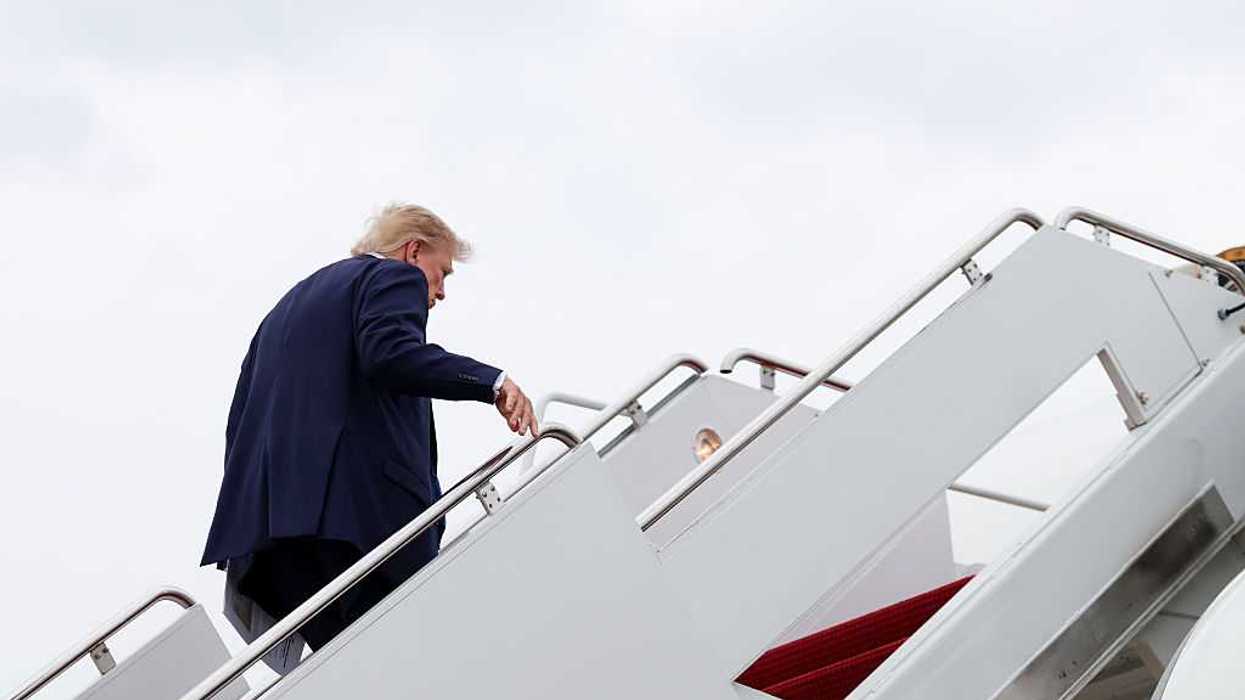
President Trump getting on a plane.

U.S. President Donald Trump boards Air Force One on August 14, 2026 at Joint Base Andrews, Maryland. Trump is traveling to Long Island to tour law enforcement facilities in Nassau County and rally support for local Republican candidates ahead of the upcoming midterm elections

Samuel Corum/Getty Images

Is it possible that our President has simply not traveled enough?

Born and raised in Queens and attending Fordham University in the Bronx, Donald Trump has no record of traveling outside New York until he was over 20, when he transferred to a college in the neighboring state of Pennsylvania. Were his formative years amiss, then, in his learning about other places and other people?


Is his view akin to the famous New Yorker cover by Saul Steinberg, an illustration of the United States with New York City as the epicenter of the country and the Hudson River the border of the known world? We can now at least add Washington, D.C., and Mar-a-Lago to the map of “the realm.”

Our President has now traveled some, but what we recommend is another kind of travel. Not a state-sponsored trip or a venture to scout locations for future Trump Towers. This would be a genuine travel experience, enriching and eye-opening, showcasing other cultures and ways of living.

It will extend far beyond viewing military parades, hobnobbing with such “understanding” world leaders as Kim Jong Un, or taking tea with the King.

WHERE, then, should the President go? As Elon Musk’s Starship spacecraft is not yet ready to take passengers to Mars, perhaps he could explore our own vast country?

Maybe he could travel to “flyover country,” the farming states, where his ying-yanging tariffs and trade restrictions have played havoc with rural economies. Or possibly to California, number one in homeless U. S. citizens, and while there, regale homeless veterans (approximately 32,500 nationwide) with tales of his brave exploits invading and bombing foreign countries.

Or he might tour the Great Lakes, and rename the other four?

WHEN should he go? This will be tough, as he is very busy building his ballroom and renaming bodies of water.

How about a trip in early November, around the midterm elections? Despite the long-discredited accusation of widespread voter fraud, it would be reassuring to know he might be so caught up divvying out ladles of soup in a soup kitchen somewhere that he wouldn’t remember to deploy the military for “election security.”

HOW will he travel? He should definitely not take his Qatari-donated, newly renovated 747, especially after last time, when he had to be smuggled off clandestinely in a catering truck. It’s unlikely any traveling companions, like the Secretary of State or of the Treasury, are going to fall for the ruse a second time. Besides, we may need those people. No more decoys!

Perhaps the President could fly commercially, although this likely would expose him to undue suffering. Without gold bathroom fixtures and maple wood floors, the trip will be no “Luxury Experience.” If only he still had his “Trump Shuttle,” bought with a massive loan he later defaulted on, saying then, “I’m smart. I got out at a good time.”

Considering the potential pitfalls, maybe it’s best the President travel incognito, disguised perhaps as an elderly woman wearing a lot of bronzer.

Wherever, whenever, however: our President needs a vacation.

Moreover, we need a vacation from him.

If the President refuses our travel suggestions, here’s another idea:

Let’s get him a pet! He has never owned a pet. As we know with our children, pets teach essential life lessons: compassion and empathy; they instill a sense of responsibility. There is a well-established connection between those who can care for a pet and those who can care for people.

So, which pet should we choose? A puppy? A kitten? A boa constrictor?

Imagine, the President may even decide he likes having a pet. After all, what is more obedient than a well-trained dog, besides possibly the Cabinet? And what is more docile than a sweet kitten, other than plausibly the Supreme Court?

The President may even become more mellow with a pet afoot and less likely to slap tariffs on our allies, or attempt to annex our neighbors, or bully our Congress. (Realizing, of course, a bully requires active participation from the bullied to maintain his status.)

Maybe we should do both: get the President a pet and devise a travel plan for him. (Do you think we could possibly convince him to leave his phone at home?)

Let’s go for it! After all:

Travel far enough, you meet yourself. (David Mitchell)

And for our President, that would likely be the most profound discovery of all.


Amy Lockard is an Iowa resident who regularly contributes to regional newspapers and periodicals. She is working on the second of a four-book fictional series based on Jane Austen’s “Pride and Prejudice."
Read More

students walking, college campus
a group of people walking on a sidewalk

Safe Spaces vs. Free Speech: Rethinking Campus Safety

“I really want to be able to discuss polarizing topics,” she said. “But as long as it’s a safe space.”

This common sentiment reflects recent data on students’ attitudes toward speech on campus: a 2024 Knight Foundation study found that 91% of students value free speech as “very important” or "important," while 64% of students believe colleges should offer “safe spaces” on campus, with only 15% opposed.

Keep Reading Show less
Children's books on a shelf.
A 17-year-old changemaker from Ohio, Sahana Srikanth founded the Young Learners Foundation to tackle the literacy gap, donating over 18,000 books and empowering youth through mentorship, education, and community-driven impact.
Pexels

Darius Williams Went Viral. Fixing the Literacy Crisis Won’t.

On his second day of teaching at Wheatley High School in Houston, former food influencer Darius Williams faced a problem that has plagued U.S. classrooms for decades: his students couldn’t read or write on grade level. But he didn’t call a colleague or email a district literacy specialist. Instead, he posted a video.

In the clip, Williams sat in front of the camera, crying over the futures his students would be denied. "We have got to do something,” he wrote in the caption. “Something is broken somewhere. It has to be. To see this level of engagement with students who simply don't have literacy skills is completely disheartening. Whew. Yall did not prepare me for this."

Keep Reading Show less
Military education. Student in soldier uniform learning at wooden table indoors, selective focus

Millions join the military to afford college. This essay examines military education benefits, student debt, and why higher education shouldn't depend on military service.

Liudmila Chernetska/Getty Images

You Shouldn't Have to Go To War to Go To College

There are many reasons to join the military, but one of the most enticing is education. Indeed, a 2017 poll conducted by the Department of Defense found that 49% of Army recruits signed up to pay for their education. It makes sense. Military education packages are incredibly attractive, which is quite the recruitment carrot. For a huge number of recruits, joining the military means finding a way to pay for school they couldn’t otherwise afford. That may say less about the luster of military benefits and more about a problem in our public policy. As education scholar William Ayers wrote back in 2006, as recruitment fell short of quotas, “High schools have thus become battlefields for the hearts and minds of young people…recruiters dangle gifts and promises of future benefits before teenagers in an effort to fill the ranks of an all-volunteer military.” Is our country making it hard to get an education on purpose?

Some critics suggest military recruitment strategies have sought to weaponize poverty. By the 1980s, the term "poverty draft" had gained traction, articulating the idea that the enlisted ranks of the military were composed of young people with limited economic opportunities. There is speculation that the Pentagon even embraced programs like No Child Left Behind as part of a broader strategy to improve recruitment by targeting low-income youth. Though these may be cynical perspectives on a simple matter of correlation, it does appear that the military struggles to draw youth to join the ranks whenever more attractive alternative economic pathways emerge. After a long recruitment drought, last year’s numbers finally climbed, but Army officials link it to “a higher unemployment rate among people aged 16 to 24…” In other words, if the economy is depressed enough, as long as the military is one of the few employers still hiring, a recruitment drought won’t be so obvious.

Keep Reading Show less
Children holding hands, walking down a school hallway with backpacks on.

Texas families increasingly rely on after-school programs, but funding cuts and workforce shortages are limiting access.

wera Rodsawang/Getty Images

After School, Before It’s Too Late for Texas Students

Every afternoon in Texas, the end of the school day creates a daily scramble for families. Five out of six parents say they want after-school care, but cannot access it.

The demand for after-school programs is not theoretical.

Keep Reading Show less