
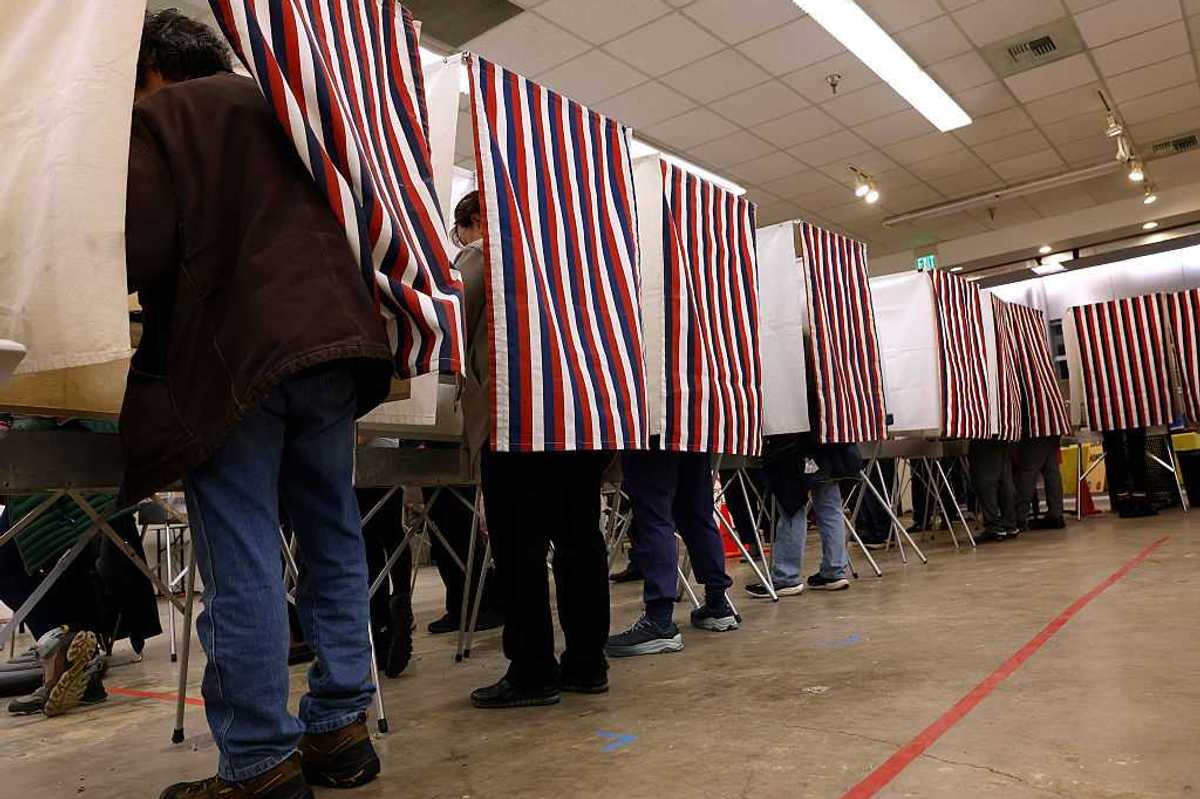



On November 3 Americans vote in the midterm elections, and the most important question may be whether the losers accept the result. A Pew survey this summer found that just 55 percent of Americans are confident the midterms will be run fairly and accurately, down from 64 percent in 2022. The partisan detail is more revealing. Since 2024, Republican confidence has risen and Democratic confidence has fallen from 77 percent to 58 percent. Trust in the referee now depends on who holds power.
Democracy rests on a kind of sportsmanship agreement. The theologian Reinhold Niebuhr put it well: man’s capacity for justice makes democracy possible, but his inclination to injustice makes it necessary. B. R. Ambedkar, the chief architect of India’s constitution, called democracy a method of bringing revolutionary change without bloodshed. Both understood that the system works only if the losing side agrees to try again next time instead of burning down the field. Americans in both parties are forgetting how to do that.
Attacking the Referee
The Supreme Court is democracy’s referee, and this year both sides went after it. When the Court ruled 6-3 in February that a 1977 emergency-powers law gave the president no authority to impose his sweeping global tariffs, President Trump called the justices who ruled against him a “disgrace.” When the same Court narrowed the Voting Rights Act in April, House Democratic leader Hakeem Jeffries denounced “this illegitimate Supreme Court majority.” Different targets, same reflex. Every justice was nominated by an elected president and confirmed by an elected Senate. Calling the Court illegitimate whenever it rules against you rejects the voters who built it.
Rewriting the Rules Mid-Game
The second failure is refusing to accept the score, and now, changing the rules before the game is even played. Al Gore conceded in 2000 after a recount that split the country. In 2017, dozens of House Democrats boycotted Donald Trump’s inauguration; four years later, Trump refused to accept his own defeat, and January 6 followed. Each side nurses a real grievance: Democrats remember a Supreme Court seat held open for most of 2016, and Republicans remember a Russia investigation that shadowed a presidency and ended without a conspiracy charge. Since the summer of 2025, seven Republican-led states have redrawn their congressional maps in the middle of the decade, beginning with Texas at the White House’s urging. California voters answered with a partisan map of their own, and Virginia Democrats tried the same until their state’s Supreme Court struck down the new map. After the Voting Rights Act ruling, Jeffries said “all options are on the table.” Each side calls its move self-defense. Each move becomes the other side’s excuse, like a team that moves the goalposts at halftime and then complains when the other team does the same.
Paralysis follows. Last fall’s 43-day shutdown was the longest full shutdown in American history, and this spring the Department of Homeland Security went unfunded for a record 76 days while airport screeners missed paychecks. In April, Gallup found that just 10 percent of Americans approve of Congress.
Building the Guardrails
It was not always this way. In 1983, with Social Security months from running dry, Ronald Reagan and Tip O’Neill, who disagreed loudly and often, backed a bipartisan commission and shared the political risk of fixing it. Neither man pretended to like the other. That kind of restraint can no longer be assumed, so it has to be built in.
Four reforms would help. The Senate should guarantee every Supreme Court nominee a hearing and a floor vote within 90 days, whichever party holds the gavel. Congress should create a bipartisan commission to settle candidate-eligibility disputes before ballots are printed, a job the Supreme Court said in Trump v. Anderson belongs to Congress. It should also build on the bipartisan Electoral Count Reform Act of 2022 with an independent, staggered-term body to oversee certification, and it should ban mid-decade redistricting outright. And states should adopt open primaries paired with ranked-choice general elections, the system Alaska’s voters narrowly chose to keep in 2024, so candidates must win support beyond their loudest faction.
None of this requires a constitutional amendment, and none of it favors either party. Democracies rarely collapse in a single dramatic moment. They wear down one broken norm at a time. On November 3, one side will lose. The country will be better off if it still remembers how.
Meda Parameswara Reddy, Ph.D., is the Director of the Reddy Center for Critical and Integrated Thinking. A former R&D executive holding 30 U.S. patents, he has published 87 articles, appearing in Proc. Natl. Acad. Sci. (PNAS), RealClear Markets, Science and Defense platforms; Washington Examiner, SpaceNews, The Fulcrum, The Humanist, American Thinker, and South Asia Monitor (on the editorial board, and also hosts the show “SAM Dialogues with Dr. M. P. Reddy.”) Website: mpreddyinsights.com | Contact: mpreddy54@yahoo.com, https://lnkd.in/gn2zQJbs