
“If you want to know what a politician is up to, watch his feet, not his mouth,” historian Marvin Meyers wrote in his magisterial “The Jacksonian Persuasion” in 1957.
It’s still good advice. In private conversations, Republicans are talking a big game about how they’re not worried about November’s midterms, according to several informed sources I’ve talked to. But it’s not just in private. “Today, I don’t think there will be a blue wave at all,” White House Deputy Chief of Staff James Blair told the Free Press earlier this month. Blair is the man tasked with overseeing the midterms for President Trump’s MAGA Inc. super-PAC.
At the National Republican Senatorial Committee’s recent retreat at Sea Island, Georgia, NRSC pollster Erik Iverson insisted that every incumbent GOP senator will be reelected and that Republicans are even on track to pick up a Senate seat.
There is no public polling that agrees with this rosy GOP scenario.
Ah yes, but the polls are “fake” as Trump likes to say, even though, at the end of August he claimed in an interview that if the election were held today, he would win by “25 points.” Meanwhile, Trump’s approval ratings in the polls are at record or near record lows. If they were an EKG, doctors would tell the patient to get his affairs in order.
But let’s ignore the polls. Given the difficulties with polling and its occasionally spotty record in recent years, skepticism is defensible. Which brings me back to Meyer’s advice.
At the Republicans’ faux midterm convention in Dallas a few weeks ago, Trump promised to campaign aggressively for GOP candidates in competitive states and districts around the country, asking voters to “pretend I’m on the ballot.”
Trump said he’d barnstorm the country to help Republicans in competitive races. His feet tell a different story. Since that pledge he’s held just one rally and one tele-rally. But this week he will have two big events — in Oklahoma and Alabama, ruby-red states he won in 2024 by 34 and 30 points, respectively.
There’s not much polling in Oklahoma, but in early August, Kevin Hern, the GOP Senate candidate, was up by more than 20 points against the potential Democratic candidate. Polling in Alabama is even more sparse, but Republican Barry Moore was up 15 points in early July.
These are the only Trump rallies currently scheduled.
I doubt that Hern and Moore are in any trouble, but that’s the point. Trump likes enthusiastic crowds, and there aren’t that many states where he can find them outside of places like Oklahoma and Alabama.
At the time of the midterm “Trumpalooza,” CBS counted 60 “battleground” Republican congressional and gubernatorial candidates. Of them, only about two dozen attended the event. Since then, handicappers have expanded the list of vulnerable Republicans. But that’s based on polling, which we’re supposed to ignore.
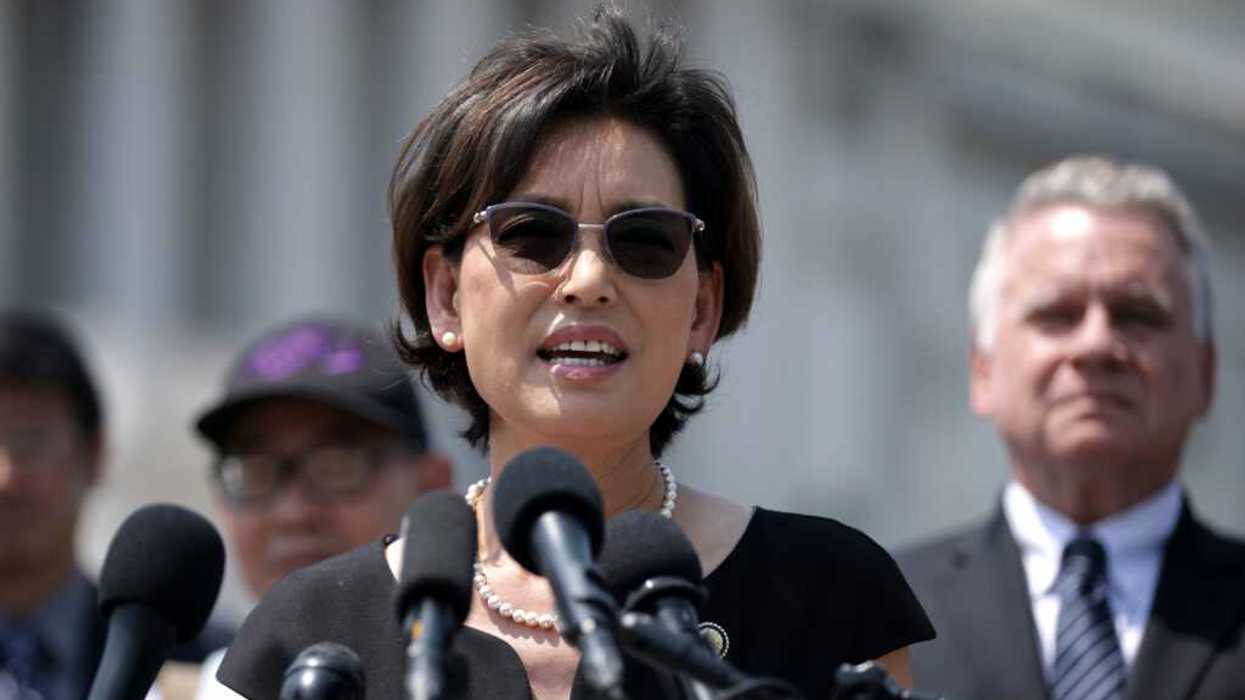
Still, the ever-growing number of GOP candidates who’ve scrubbed or drastically downplayed their ties to Trump must be noticing something. Rep. Young Kim of California replaced her slogan “Stand with President Trump to deliver a bold America First Agenda” with “Taking on Career Politicians to Restore the American Dream.”
Byron Donalds, running for governor in bright-red Florida, has downgraded Trump on his site to a mere afterthought. Texas congressional candidate Carlos De La Cruz changed his self-description from “Trump conservative” to “strong conservative.” And so on.
In Iowa, a state Trump won by 13 points in 2024, Rep. Ashley Hinton is on the ballot for the Senate. She’s started running ads about how she’s eager to work across the aisle with Democrats. She voted with her feet by refusing to appear at a rally with JD Vance, citing unspecified scheduling conflicts.
Rep. Maria Salazar’s south Florida district is 73% Latino. In 2024 she won by 11 points, and Trump carried her district by 15. Earlier this month, she released an ad directly criticizing Trump’s immigration policies. The ad invited Trump’s wrath, but he has not yet withdrawn his endorsement.
A corollary to Meyers’ “watch his feet” advice might be the Watergate era rule, “Follow the money.” So far MAGA Inc. hasn’t spent much of its $400-million war chest. But almost 95% of what it has spent — about $15 million — has been deployed in Texas, which Trump won by almost 14 points in 2024, and which hasn’t elected a Democrat to statewide office in 32 years.
Trump endorsed the biblically corrupt Texas Attorney General Ken Paxton, over the incumbent Sen. John Cornyn, who virtually everyone agrees was a lock to be reelected. The GOP has spent, so far, $140 million on Paxton.
Paxton is trailing Democrat James Talarico by 5 points in the latest polling, with independents supporting him 2 to 1.
But, as we all know, the polls are fake.
Jonah Goldberg is editor-in-chief of The Dispatch and the host of The Remnant podcast. His Twitter handle is @JonahDispatch.