



Texas is in the middle of one of its most contentious and heated elections in modern history. The question that lingers in the national press is, will the state flip to Democrats in the major statewide contests for US Senate and governor?
But the voters who will decide this question aren’t Republicans. They aren’t Democrats. As previously predicted on IVN, it will most likely be independent voters—if they turn out.
- YouTube youtu.be
According to a new poll from the University of Houston Hobby School, 60% of independent voters support Democratic US Senate nominee James Talarico, while 32% support his Republican opponent, state Attorney General Ken Paxton.
Overall, Talarico narrowly leads Paxton, 48% to 46%.
In the governor’s race, Democratic nominee Gina Hinojosa does not poll as high among independents as Talarico, but they still prefer her to Republican Gov. Greg Abbott, 55% to 36%.
Overall, Abbott leads Hinojosa 49% to 46%. Both are tight races.
“High gas and diesel prices, inflation at the grocery store and an unpopular war all have created headwinds for Republicans. More than half of Texans say they have an unfavorable opinion of President Trump, just two years after he carried the state by more than 13 points,” said Renée Cross, executive director of the Hobby School.
“But it has been more than 30 years since a Democrat was elected to statewide office in Texas, and many voters remain loyal to the Republican Party.”
Here’s why this matters.
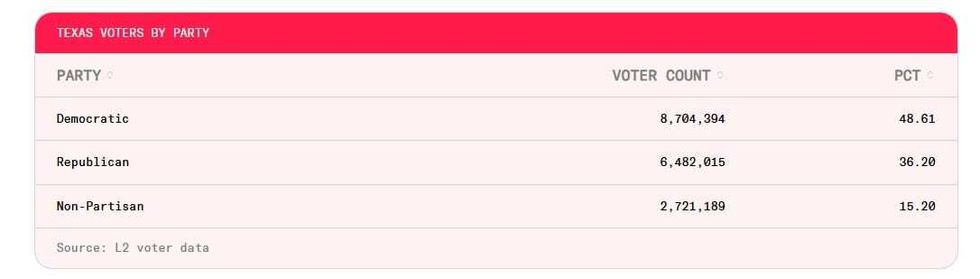
According to VoterCount.ai, which pulls from the L2 Data voter file, there are more than 2.7 million registered voters in Texas (just over 15% of the electorate) that identify as independent, compared to 48.6% that are Democrat and 36.2% that are Republican.
When IVN first reported that L2's figures showed more Democrats in Texas than Republicans in August 2025, the comments and emails stacked up from people accusing L2 and the Independent Voter Project, a co-publisher of IVN, of making up the numbers.
They pointed out—correctly—that Texas does not register voters by party. But L2 explained its methodology (which has set an industry standard for data modeling) and noted that a modeled electorate doesn’t always represent the electorate that shows up to vote.
While people may argue over these numbers, a bigger question was raised in IVN’s original reporting: Has Texas been a purple state this whole time? Or, at least in the last few election cycles.
Look at how close statewide contests have been recently, especially in US Senate contests. US Sen. Ted Cruz won re-election with 53% of the vote in 2024. US Sen. John Cornyn won re-election with the same percentage in 2020.
That is not an overwhelming majority. These races are getting tighter and tighter.
Now, look at the polling from 2024. According to CBS Austin, the same pollster that shows Talarico leading among independents this year found that Ted Cruz had more support from independent voters compared to his opponent in the last cycle, 48% to 42%.
Republican candidates had strong support from independent and Latino voters in 2024. What if it wasn’t Republicans who ensured Cruz kept his seat, but independents?
Now, these voting blocs—independents and Latinos—favor the statewide Democratic candidates, especially Talarico, who already showed what impact courting independents can have in the March primaries.
Talarico received more than 1.2 million votes in the Democratic primary. He beat US Rep. Jasmine Crockett, who received over a million votes. It is the first time since the 90s that turnout in a non-presidential statewide Democratic primary exceeded Republican turnout.
Turnout in the 2020 Democratic presidential primary was higher than the Republican primary, but President Donald Trump still won the state.
In the IVN analysis following the primary, it was noted that the way voters turned out had a few possible implications:
- It could be an indication that there are in fact more Democrats in Texas than the common narrative would have people believe;
- It could be a preview of what may happen in November;
- Independent voters may have driven up the numbers for Democrats; and/or
- Some Republicans may have crossed over to vote in the Democratic primaries
It could also be a combination of some or all of the above.
It is important to note that Talarico didn’t just campaign for Democrats. He reached out to independents as well, which seems to have paid off. The last public survey before the primary election showed his support among these voters at 62% compared to Crockett’s 35%.
Independent voters are allowed to participate in the state’s public primary elections. They can choose between a Republican and Democratic ballot. And Talarico won.
Now the question is, will his continued favorability among independent voters turn into votes in November? Could observers see the same in the governor’s race? Only time will tell. However, one thing is clear:
Independent voters are now impossible to ignore in the Lone Star State.
Are Independent Voters About to Flip Texas? is republished as part of The Fulcrum’s partnership with IVN and the Latino News Network to expand voter‑first journalism and strengthen public‑centered coverage of democracy.