




Almost every week, there seems to be another story about the pay-to-play ethos that is dominant in Donald Trump’s Washington, DC. On July 30, the Wall Street Journal added a new one to the list.
The Journal described the president’s fervent interest in fundraising and how he checks almost nightly with his top fundraiser, Meredith O’Rourke, to find out “which companies and donors have cut checks and which haven’t, and for how much.” The story highlighted the way she channels his interest into making her pitch.
“’This is very important to the president. He’s asked me to call you and ask you for this donation…. The boss wants this money.’”
Nothing subtle there.
Then there is the way the administration has used tariffs as a lever to extract money and other things from businesses seeking relief or exemption from the tariff. For example, on July 31, MS Now reported that the Antwerp World Diamond Center in Belgium had presented the president with a large ring, which he dubbed the Freedom 250 ring, and that they subsequently received favorable treatment in Trump’s tariff regime.
That was no ordinary ring. It is made of eighteen-karat gold and is the size of a wristwatch. It has a hand-carved presidential seal on top, encrusted with 321 diamonds, 56 sapphires, 18 emeralds, and 6 rubies. And it has an engraved inscription to Donald John Trump. A few weeks after the gift was made, the report continues, “Europe’s diamond industry was exempted from Trump’s latest round of tariffs.”
The New York Times is right to caution that “There is no evidence that the gift of the ring directly affected the president’s thinking on the tariff exclusion for the diamond industry. But the new list of exemptions has renewed questions about which industries should be exempt from tariffs, and why.”
If this were a one-off, it would not raise alarms. But it is not. It is part of a pattern in which the president appears to benefit personally from exercising the powers of his office.
As NPR observes, President Trump “has increased his net worth by making investments in companies with business before the government at a level never seen before, as much as $2 billion in the last year. And…he bought stock in Paramount and Warner Bros. while his Justice Department was considering whether or not to approve their merger.”
“He bought stock in Palantir, and then he praised the company publicly, including in a social media post that listed Palantir's stock ticker. He invested in Oracle while he was trying to get that company to buy TikTok, and it goes on and on.”
Ordinary Americans feel the consequences of this focus on personal enrichment and aggrandizement every day, though the connection between the two may not be obvious. For a long time, scholars have documented how government corruption hinders economic performance.
But none of that may be obvious to voters as they consider how to cast their ballots. That is why Democrats running for office this November and groups working to preserve American democracy will need to either work hard to make those connections clear or abandon the effort altogether.
Right now, things are moving in the opposite direction.
Playing the corruption card is fast becoming the orthodoxy among prominent Democrats. James Carville. Carville makes the case that the party is “not meeting the moment” because it is not focusing enough on what he called the MAGA movement’s “staggering corruption.”
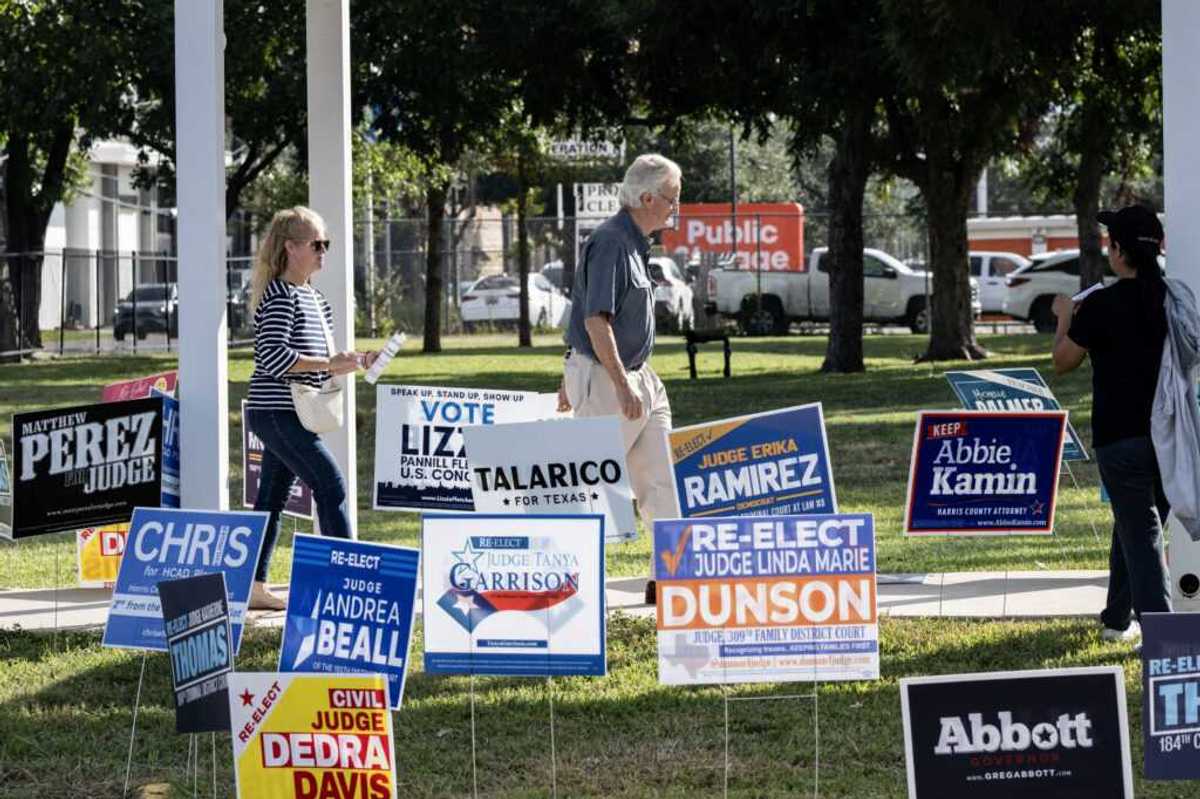
Some Democratic candidates are following Carville’s lead. In Texas, James Talarico, who is running for the Senate, is hitting that theme hard.
He accuses his Republican opponent, Ken Paxton, of being “the most corrupt politician in our state, maybe in our country," but he doesn’t stop there. "We've seen corruption,” he says, “in the judicial branch, just as we've seen it in the legislative and executive branches."
Talarico is also trying to make the case that “politicians… who use their positions of power to enrich themselves and their wealthy friends, is why most Americans, especially the most vulnerable, can't ‘afford anything’ or can't ‘get ahead no matter how hard we work.’"
Senator John Ossoff, running for reelection in Georgia, is saying similar things. “When he’s (President Trump) not posting, he’s been trying to rob us…..All this while you pay more for gas, for groceries, for healthcare.”
But connecting the dots between those things is not easy. Here’s why.
That is because, as Harvard’s Lawrence Lessig argues, “responses to information are inseparable from their interests, desires, resources, cognitive capacities, and social contexts. Because of these and other factors, people may ignore information, misunderstand it, or misuse it. Whether and how,” he adds, “new information is used to further public objectives depends upon its incorporation into complex chains of comprehension, action, and response.”
It also does not help that the public is pretty well inured to accusations of corruption. At this point, NPR says, “People are incredibly cynical, almost numb. They see this as just the way things work in Washington - everybody does it.”
And “Trump has convinced a lot of his voters that he is such a good businessman, he just makes money no matter what he does.” That’s why publicity about how much money he has made in office or about gifts like the Freedom 250 ring may not penetrate with his most loyal supporters.
Beyond his base, voters “have mixed views on whether (allegations of corruption are) a big deal or not, indicating a level of cynicism about many in the political class. Among participants in two online focus groups in Pennsylvania, “Half the participants… were ‘troubled’ by Trump's windfall in office. The other half waved it off.”
One of the members of the latter group indicated that revelations about how much money Trump has made as president “isn't a shock to me or anybody else. He's admitted in the past that he's going to continue running his empire while he's in his president's seat. I was fully aware of that.’”
Moreover, as The New York Times explains. “No American politician, arguably, has understood and exploited this ambient cynicism more successfully than Trump, who has campaigned three times against ‘corrupt’ enemies and a ‘rigged’ system and twice led the most flagrantly self-enriching presidencies this country has seen.”
And, at the end of the day, Democrats need to remember that it is easier to make allegations of corruption during political campaigns than to make them stick and use them to motivate voters. Manoel Gehrke, Nic Cheesemanm, and Licia Cianetti from the Centre for Elections, Democracy, Accountability and Representation in Great Britain attribute that difficulty to “complex media environments…loyalty to one’s ‘group’…(and)pessimism about the likelihood of change….”
In the run-up to November, Democrats should talk about corruption. But it may be easier to break through with voters by delivering a different message.
Whatever his motives, the president and his Republican allies in Congress care more about adding a ballroom at the White House, building a triumphal arch, and having a new, luxurious Air Force One than they do about gas prices, grocery prices, and the cost of health care. No need to connect the dots; just state the facts.
Austin Sarat is the William Nelson Cromwell professor of jurisprudence and political science at Amherst College.