
Skip to content
Search

Latest Stories

Follow Us:
Top Stories

Schmitt’s smoking gun backfires on him

Opinion

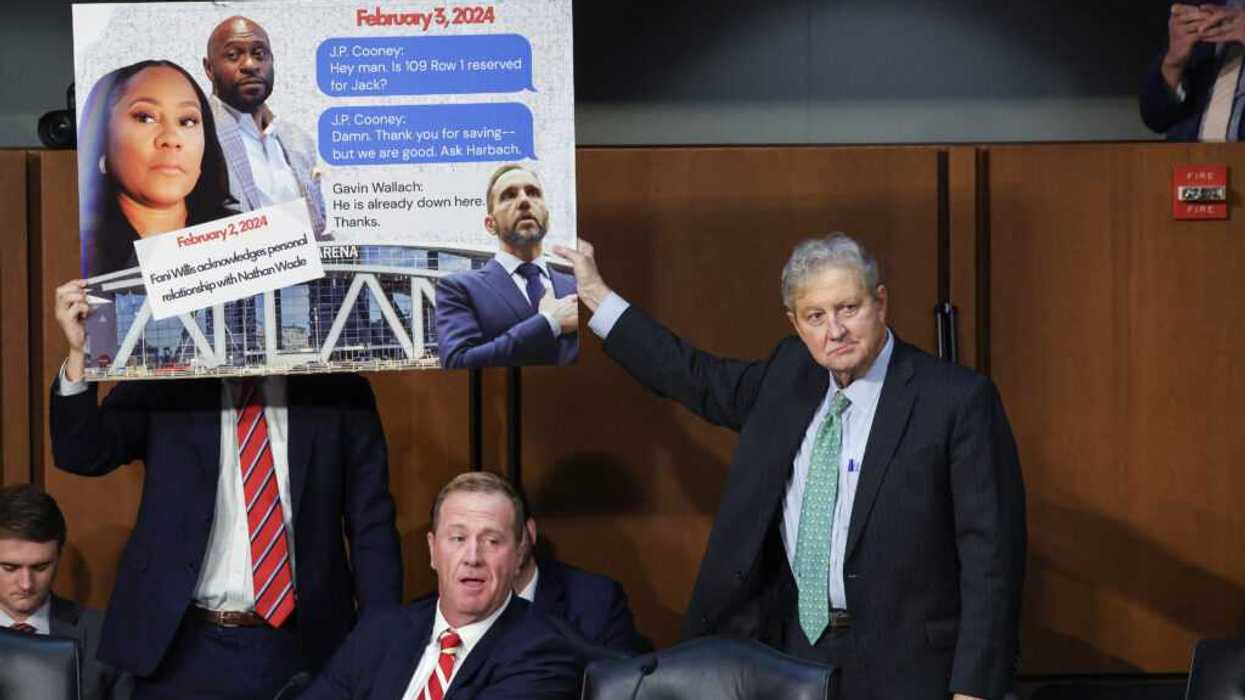
John Kennedy display a sign

John Kennedy display a sign accusing former Special Counsel Jack Smith of meeting with Fulton County, Georgia, District Attorney Fani Willis during a hearing before the Senate Judiciary Committee in the Hart Senate Office Building on Sept. 29, 2026, in Washington, D.C. The committee is holding the hearing to examine Smith’ s probe into Donald Trump.

(Getty Images)

Tuesday was supposed to be a big day for Missouri Sen. Eric Schmitt, a little-known first-term junior Senator whose main claim to fame thus far was the 25 lawsuits he filed against President Joe Biden’s administration in a span of 20 months while Missouri’s attorney general.

But congressional hearings have long been a place not to do actual legislating but to make a name for oneself, and Schmitt was going to take his opportunity on Tuesday, when he got to question former Special Counsel Jack Smith in the Senate Judiciary Committee.


Earlier that morning a short news item — just 80 words — popped up on Axios. The headline:

“Sen. Eric Schmitt Is Drawing Buzz as a Possible Vance VP in 2028.”

The body of the story, in part, read:

“First-term Sen. Eric Schmitt (R-Mo.) — who was a tough-on-crime state attorney general, and now is vice chair of the Joint Economic Committee — has grown close to Vice President Vance and is seen as a top prospect to become a potential 2028 running mate.

We hear the VP views Schmitt, 51, as trustworthy, intelligent, articulate and a deft political operator.”

I’ll let you draw your own conclusions about how that glowing — and unsourced — story ended up where it did on the morning of this hearing, but I think it’s safe to assume it wasn’t a coincidence.

Hours later, Schmitt was in the room where it happened, joining his fellow Republican lawmakers in punishing Smith for pursuing charges around Donald Trump’s 2020 election interference and his handling of classified documents.

And the theatrics were amped up to 11. Sen. John Kennedy had already told Smith “You make me want to throw up in my mouth.” Sen. Ted Cruz proclaimed, “Javert from Les Mis would look at you with astonishment.” Sen. Darline Graham used her time to accuse Smith of bullying her late brother, Lindsey Graham.

Your taxpayer dollars at work, folks.

But anyway, this was all leading up to the big moment, when Schmitt was going to drop the smoking gun — alleged texts from someone in Smith’s office showing he was somewhere he shouldn’t have been, and about to do something he shouldn’t have done.

Except he wasn’t. Smith wasn’t in Atlanta in February 2024 for an Atlanta Hawks game. He wasn’t in Atlanta at all. Instead, he’d been at a women’s college basketball game between the University of Maryland and the University of Iowa. Apparently, Schmitt confused the Hawks with the Hawkeyes.

It was an implosion of delicious proportions for the left, but at a time when Republicans and Trump are drowning in a midterm election hellscape of their own making, it also exposed just how desperate MAGA was for a win — any win.

Before Schmitt could finish imploding, MAGA media had already posted to socials their congratulatory dunks on Smith, unaware that the moment they’d been promised hadn’t gone the way it was supposed to.

Fox’s Sean Hannity deleted his post wherein “Schmitt puts Jack Smith on the spot,” and Benny Johnson deleted his (which misspelled the senator’s name) saying “Schmidt just CAUGHT Jack Smith perjuring himself.”

The whole day, it seemed, from the Axios post in the morning, to the influencer posts in the afternoon, was designed to give the MAGA base some much-needed red meat amid a sea of bad poll numbers.

But it seems Republicans don’t have their priorities straight. They’ve given up on actual policy wins that could have helped stave off what may just be a blue monsoon in November, wins that were promised to voters two years ago. All they’ve got left are parlor tricks and subterfuge — and they can’t deliver on that, either.

It was a moment that was meant to go viral, and it did — but for all the wrong reasons.

S.E. Cupp is the host of "S.E. Cupp Unfiltered" on CNN.


Read More

 U.S. President Donald Trump speaks from the Cross Hall of the White House on April 1, 2026 in Washington, DC.

U.S. President Donald Trump speaks from the Cross Hall of the White House on April 1, 2026 in Washington, DC.

Pool/Getty Images

How Presidential Primetime Addresses Shape Public Trust in Democratic Institutions

A question still being studied is the effects on public trust when the head of the Executive casts doubt on the institutions that run elections, enforce laws, and decide legal disputes. The President of the United States is arguably the most powerful man in the world. He is the commander in chief of a nation #1 in nominal gross domestic product as well as #1 in military power, budget, and spending as of 2026. The actions he takes spew ripple effects across the world and follow many generations. A way you can measure the executive's power can also be measured in how much influence his speeches have on the markets, opinions of the masses, news outlets, lawmakers, social media reactions, etc. His framing of an issue can shape the next day’s political conversation.

These conversations become extremely dangerous/consequential when discussing a principle as embedded in our country as Democracy. In his July primetime speech, Trump continued to pedal the claims about election security and argued for stricter voting rules. He continued to portray the country as facing a moment of corruption and uncertainty, followed by presenting himself as the one prepared to restore order. The address continued with repeated claims about his loss in the 2020 election that have not been supported by the evidence compiled over years of investigation by many parties. Professional reviews, audits, and courts have yet to find significant evidence of foul play substantial enough to influence the outcome of that election.

Keep Reading Show less
unrecognizable businessman giving speech to professional audience

Brain science explains why voters reward charisma over results — and why the leaders who "fix" the most get credit for the least. A behavioral look at elections.

alvaro gonzalez/Getty Images

The Résumé Should Outvote the Smile

There's an old joke about a couple who finally solved years of arguing over decisions. "Since you're the man of the house," the wife said, "you handle the big things -- our stance on foreign wars, who we send to the Senate. I'll take care of the small stuff: groceries, the mortgage, where we live, what we eat." The husband agreed happily, certain he had won the better half of the deal. A few years later he realized the trade had gone entirely the other way. He held forth on geopolitics at dinner parties while his wife quietly ran every detail that actually touched his life: what he ate, where he lived, how his money was spent. What looked like ultimate authority was, in practice, near-total abdication over the things that shaped his days.

Voters make the same trade, and pay for it the same way. We keep hiring leaders for the qualities we would want in a spouse -- warmth, charm, a commanding voice, the sense that they see us -- instead of the qualities we would want in a mechanic: someone who can find what is broken and fix it before the whole system fails. We evaluate candidates the way we choose intimate partners, not the way we hire people to run complex, high-stakes systems.

Keep Reading Show less
US soldier with American flag patch on his arm.
a group of soldiers in uniform
Photo by Oleg Ivanov on Unsplash

Moral Leadership Can Protect Service Members' Psychological Well-Being

It has recently been reported that President Trump and Secretary of War Hegseth disparaged the mental health concerns, including suicide attempts, expressed by the sailors serving aboard the USS Abraham Lincoln during the carrier’s record deployment. Their comments brought back the disquiet I felt several months ago while attending a performance of the US Naval Academy Glee Club at the Church of St. Ignatius Loyola in Manhattan. Usually, when I attend choral concerts in the church’s imposing Baroque sanctuary, my mind quiets, and I find myself immersed in the music. But not on that occasion. Instead, as I enjoyed the exuberant singing, my mind filled with resentment. The Glee Club, handsome midshipmen in formal dress, is a multiethnic group of men and women. The harmonious singing of a chorus composed of individuals of widely varied backgrounds seemed a metaphor for how our country and its military should work.

My upset originated with the realization that during their time at the Naval Academy, these midshipmen had witnessed the firing of the Black Chairman of the Joint Chiefs of Staff, Air Force General C. Q. Brown, Jr., as part of an apparent purge of those supporting diversity in the military. Even uglier was the implication that Brown, a highly decorated officer, had been elevated to his position as a ‘DEI’ hire. They also had seen the firing of trailblazing women leaders in the military, including Admiral Linda Fagan, the first woman Coast Guard Commandant, and Admiral Yvette Davids, the first woman Superintendent of the Naval Academy at Annapolis, the very institution they were attending. I was offended and angered by the message these firings conveyed to the men and women of the Academy’s Glee Club, especially the women and minority midshipmen, who had volunteered to serve their nation and, ultimately, to place themselves in harm’s way for it.

Keep Reading Show less
Donald Trump

U.S. President Donald Trump speaks during a“ Steel Across America” event ahead of the 25th anniversary of the Sept. 11th attacks on the Ellipse near the White House on Sept. 8, 2026 in Washington, D.C. President Trump welcomed 9/ 11 first responders to the Tunnel to Towers Foundation’ s“ Steel Across America” event featuring a 16,900- pound, 21- foot steel beam recovered.

(Getty Images)

For Trump, even 9/11 is an opportunity

There was a reason organizers of the 9/11 ceremony in Manhattan told President Trump he could not speak at this year’s memorial service.

A good one, it turns out.

Keep Reading Show less