


Skip to content
Search

Latest Stories

Follow Us:
Top Stories

Community standards help 'preserve human dignity'

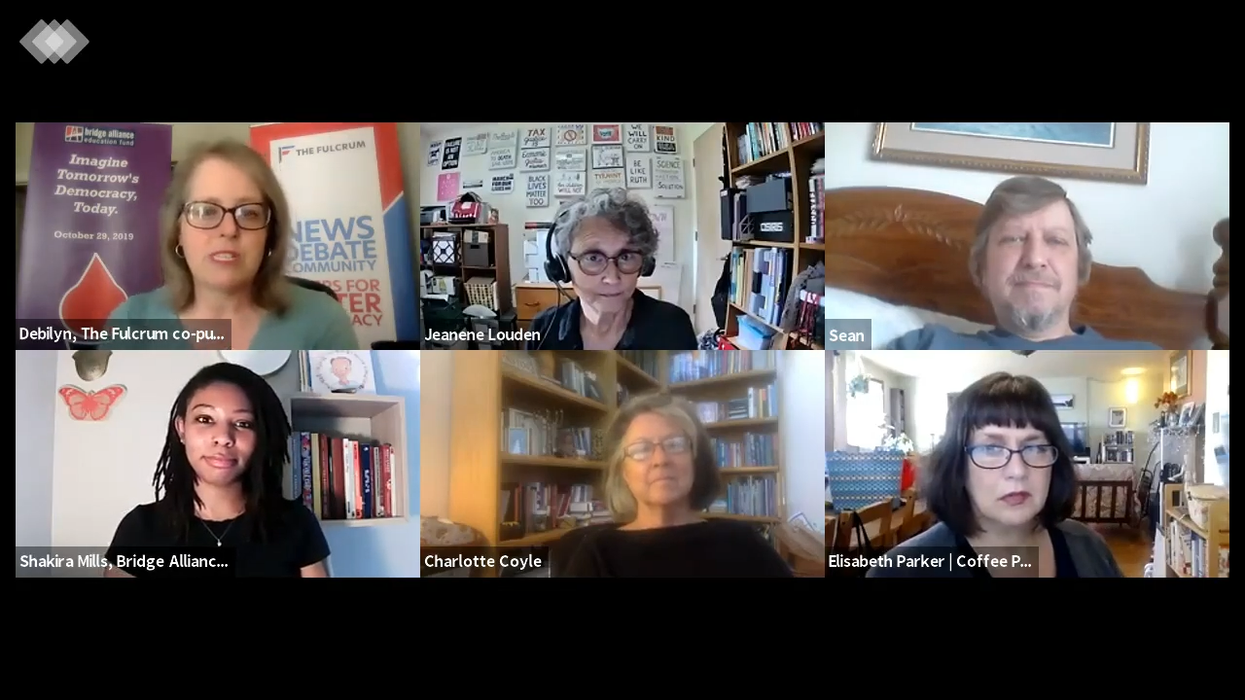
YouTube chat - Bridge Alliance, The Fulcrum, Coffee Party
YouTube

Facebook's Oversight Board upheld the ban on former President Trump on Wednesday, but didn't extend it to a permanent suspension. The Fulcrum's Debilyn Molineaux sat down with the seasoned social media team at Coffee Party USA to ask how they've moderated their Facebook page for more than 10 years. This is the first of two parts.

Community Standards for Healthy Social Media Dialogueyoutu.be


Read More

KY Advocates Continue to Push for Felony Voting Rights Restoration

As of April 2025, people convicted of a felony in Maine, Vermont, and Washington, D.C. retained the right to vote while incarcerated, according to Ballotpedia.

(Adobe Stock)

KY Advocates Continue to Push for Felony Voting Rights Restoration

Kentucky has barred more than 158,000 of its residents from voting.

Most have previous felony convictions and despite a 2019 executive order by Gov. Andy Beshear restoring the voting rights of some Kentuckians with past felonies, the Commonwealth still denies the right to vote to more prior felons than nearly any other state.

Keep ReadingShow less
American flag
American flag
SimpleImages/Getty Images

From the Ashes, What Would A ‘Re-Founding’ of American Democracy Look Like?

Things rarely change unless there is a crisis. The present administration has certainly precipitated unprecedented challenges at all levels of our government. With the likelihood that the crisis will only deepen, the more pertinent question is how far will the destruction go?

A society’s capacity for change is often proportionate to the disaster’s depth. From the ashes of the Civil War, the ratification of the 13th, 14th, and 15th Amendments would go on to play such an important role in the American polity that their passage is considered by some to be a “Second Founding” of American democracy. Amidst the backdrop of decades of political decay and voter cynicism due to gerrymandering, inequities in voter representation, and political gridlock, we do not have the luxury of hoping after the current administration that “things will go back to normal.” Depending on the scale of the mounting assaults challenging our Constitutional system—made even more dire with concerns that future elections may be disrupted or manipulated—we must be prepared to harness a potential groundswell to pass reforms that update our democracy in the most concrete and durable ways.

Keep ReadingShow less
NRF Moves to Defend Utah’s Fair Map Against Gerrymandering Lawsuit

USA Election Collage With The State Map Of Utah.

Getty Images

NRF Moves to Defend Utah’s Fair Map Against Gerrymandering Lawsuit

On Wednesday, February 11, the National Redistricting Foundation (NRF) asked a federal court to join a newly filed lawsuit to protect Utah’s new, fair congressional map and defend our system of checks and balances.

The NRF is a non‑profit foundation whose mission is to dismantle unfair electoral maps and create a redistricting system grounded in democratic values. By helping to create more just and representative electoral districts across the country, the organization aims to restore the public’s faith in a true representative democracy.

Keep ReadingShow less
Maxwell Is the Prosecutable Person
Ghislaine Maxwell, September 20, 2013
(Photo by Paul Zimmerman/WireImage)

Maxwell Is the Prosecutable Person

A story like Jeffrey Epstein’s is easy to treat as an anomaly—one ambitious man, one grotesque circle, one horrific chapter of American life that many would rather seal shut and forget. But I keep coming back to a harder question underneath it: do we actually believe in equal accountability, or only in accountability for the people we can easily punish?

This isn’t a left-right question. It’s a legitimacy question. A democracy can’t function if power purchases are exempted and proximity is treated as guilt. The details change depending on the arena—policing, corruption, finance, exploitation—but a familiar pattern repeats: our institutions tend to prosecute what is simple, visible, and winnable, and struggle to reach what is complex, insulated, and costly.

Keep ReadingShow less