


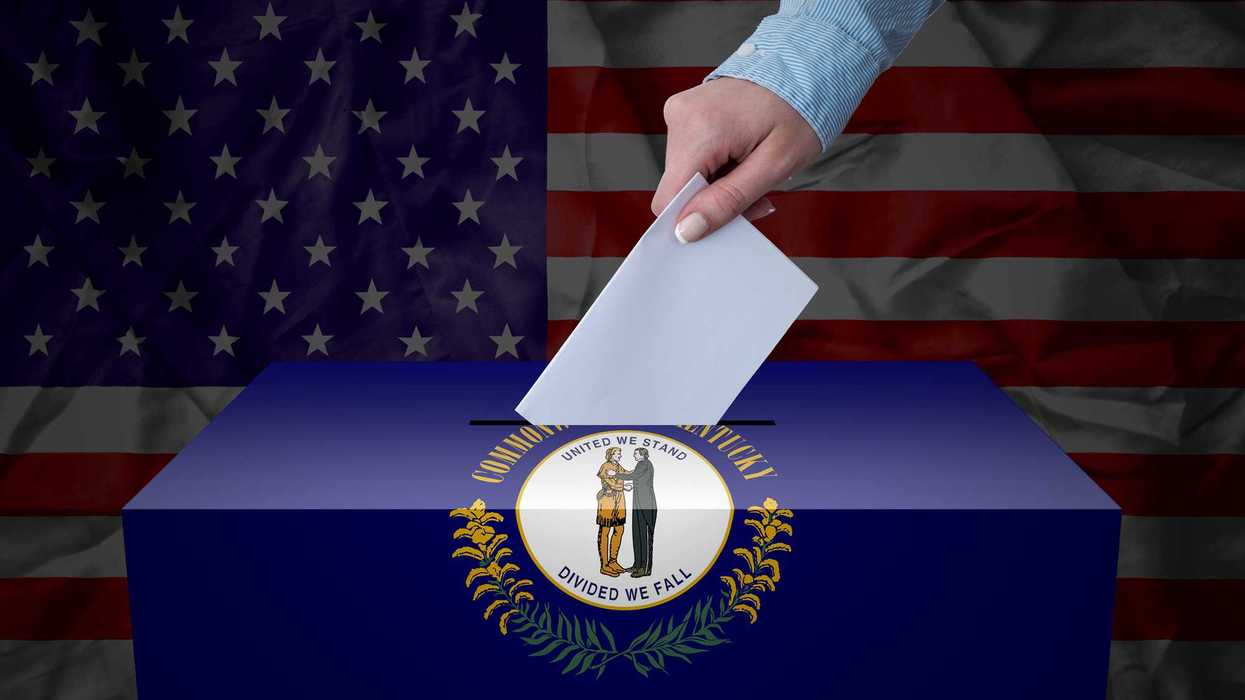

Kentucky’s political establishment has just been handed a number it should not be able to ignore.
In July, more Kentucky voters registered as independent or “other” than registered as Republicans and Democrats combined. More than 8,500 Kentuckians registered to vote, and the “other” category grew by 2,530 voters, compared with 2,483 new Republicans and a decline of 32 Democrats.
Secretary of State Michael Adams put the meaning of those numbers plainly: “Neither party can prevail in a statewide race with only its base; both must reach out to the center.”
He is right. But there is an even bigger problem. Kentucky is the only Southern state with a closed primary system, shutting independent voters out of most primaries. Nearly 384,000 Kentuckians are now registered outside the two major parties, roughly 11 percent of the electorate, and that number is growing faster than either party.
This makes little political sense, particularly for Republicans. The Republican Party’s success across the South has been built in no small part on its ability to forge an alliance with voters who do not see themselves as traditional Republicans. Veterans, young voters, Latinos, and African Americans all showed historically high levels of independent identification.
The lesson should be obvious: neither party can afford to treat independent voters as people who only matter after the candidates have been chosen. Yet that is effectively what Kentucky does.
Kentucky taxpayers pay to administer these elections. They fund the polling places, election workers, ballots, voting machines and the public infrastructure that makes the primary possible. These are publicly administered elections, not private club meetings, and in an increasingly uncompetitive political environment they are often where the real decision is made about who will hold public office. Yet hundreds of thousands of Kentuckians who help pay for that system are excluded because they have chosen not to join a political party.
That is not just a democratic problem. It is a political one for both parties. By shutting independents out until November, Kentucky parties are making it harder to build the broad coalitions they need to win and govern.
And they do not necessarily have to wait for Frankfort to act. Kentucky’s political parties have the power to open their primaries. In Tashjian v. Republican Party of Connecticut, the U.S. Supreme Court recognized that a political party’s First Amendment associational rights can protect its decision to allow independent voters to participate in the primaries. No new law needs to be passed. Either party can choose to welcome these voters.
They should.
The argument that independents have chosen not to join a party and therefore have chosen not to participate gets the problem exactly backward. Independence is not apathy. It is a deliberate political choice. Asking voters to surrender that independence simply to participate in a public election is not inclusion. It is coercion. Imagine if the state of Kentucky asked Republican voters to “just register Democrat” or vice versa in order to vote. The outrage would be immediate and justified.
There is also reason to believe Kentucky’s independent electorate is even larger politically than its registration numbers suggest. An Open Primaries poll in New York City found that 39 percent of registered Democrats described themselves as really independent voters who had registered Democratic specifically to participate in primaries. The same dynamic is likely among the Republican electorate in Kentucky. The point is that voters should join parties because they believe in them, not because outdated election rules force them to.
Thirty-four states already allow independent voters to participate in at least some partisan primaries. These are red states, purple states, and blue states. Kentucky stands alone in the South. It should not be proud of that distinction. With independents now approaching half of the national electorate, the question is no longer whether these voters are a growing political force. It is whether Kentucky’s political parties are prepared to build a political system around the voters they increasingly need to win.
Kentucky’s independents are registering. They are growing. They are paying for these elections.
It is time to let them vote.
Jeremy Gruber is senior vice president of Open Primaries, a national election reform organization, and the author of Let All Voters Vote: Independents and the Expansion of Voting Rights in the United States.









The President Invited Iran to Bomb My Home