

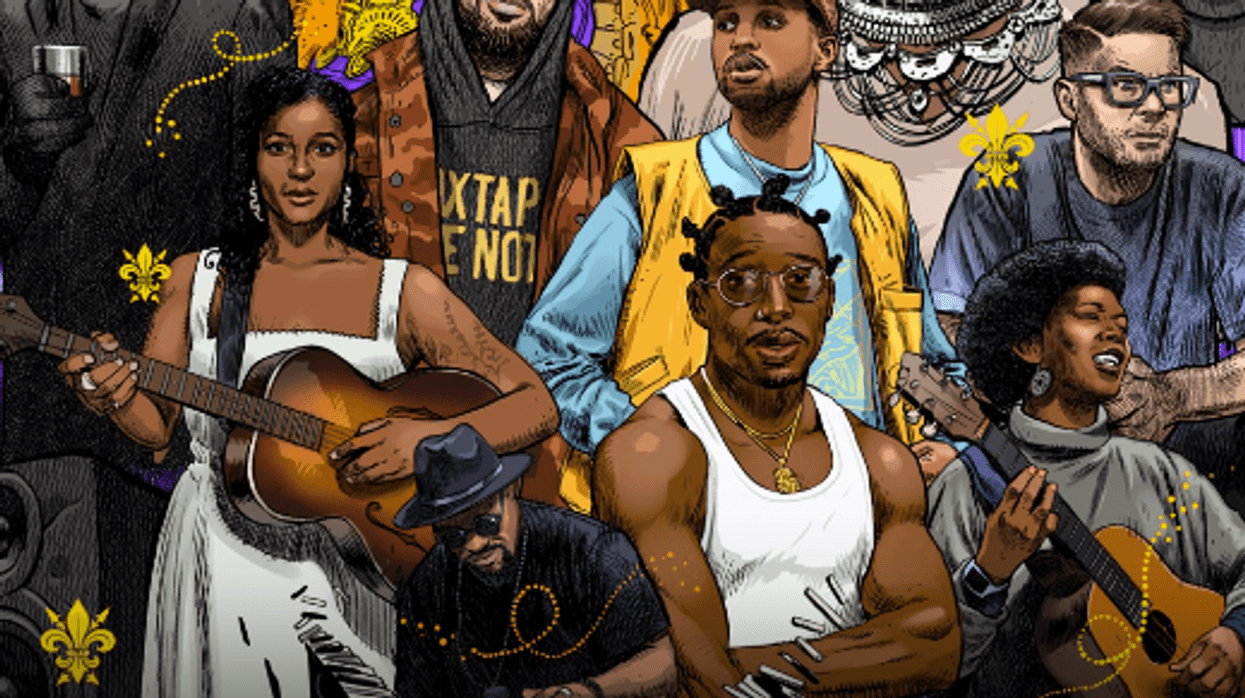
As the United States marks its 250th anniversary, MacArthur Fellow and cultural historian Josh Kun alongside DJ/producer J.PERIOD are asking what the art of DJing teaches us about living with difference.
Their answer is The Art of the Crossfade, a multi-city project that uses the DJ crossfader — the tool that blends two records without either disappearing — as both a musical technique and a metaphor for civic life. Through musical lectures, storytelling, community dialogue and J.PERIOD’s Live Mixtape performances, the series explores how people with different histories, perspectives and identities might find points of connection without erasing their distinctiveness.
After stops in Los Angeles and Phoenix, the project heads to Lincoln, Nebraska, on Oct. 24. The tour will then continue to New Orleans, where Kun and J.PERIOD will take over Music Box Village alongside artists and other special guests.
In a recent conversation with David L. Nevins, publisher of The Fulcrum, Kun explained how an idea he began developing about 15 years ago evolved into a collaboration with J.PERIOD — and why he believes the crossfader feels especially relevant now.
Q: Can you start by explaining where the idea for The Art of the Crossfade came from and how the project developed?
Josh: I started thinking about and developing these ideas around 15 years ago in my academic work and, around that time, met J.PERIOD, whose primary work is as a producer and DJ and was working with similar ideas in his mixtapes. Suddenly, I could see the concepts I was discussing, which come from DJ culture, being put into practice by an actual DJ who completely understood the theory behind them.
We initially started building the project informally. It began as a talk for a TEDx conference, and then we developed it into a multimedia lecture. We kept growing from there. In today's political and cultural climate, I think its core ideas are more important than ever.
The first question is: how do you mix different inputs, whether musical or political? How do you build new stories that respect diversity and difference instead of erasing it?
The second is: what does it mean to spend our days looking for connections?
One of the things DJs do is take two records that might be radically different and find a point of connection. It might be a trumpet, a bassline, or a breakbeat. We’re trying to scale that idea socially, culturally, and politically. What are the shared trumpet lines? What are the shared breakbeats we can isolate and use to build new “mixes” that benefit the future of American culture?
Q: A lot of organizations doing bridging work struggle to engage people across the
political spectrum. How do you think about that challenge with The Art of the Crossfade?
Josh: This remains a key struggle. But part of the reason we use the crossfader [as a metaphor] is that we believe music is a rare language that can put people with radically different viewpoints next to each other without them knowing it. Anytime you go to a festival or get on the dance floor, you don’t know the political beliefs of the people next to you. Sometimes — perhaps all the time — people with radically different political beliefs love the same artists.
In the community talkbacks we’ve been doing around our shows, we’ve had moments when people have conversations they might not otherwise have.
In an earlier iteration, Crossfader was a series of short films. We filmed one episode in Lincoln, Nebraska, pairing a Yazidi refugee musician with a white heavy metal drummer who wasn’t right-wing but was certainly right-of-center. What struck me was how different they were, how much they misunderstood each other, and how music became, at least in that moment, a door opening to a new kind of dialogue.
Q: You and J.PERIOD both came of age with hip-hop. How did that influence the way you think about Crossfader?
Josh: J.PERIOD and I came up at the same time, and hip-hop has been, in different ways, the cultural and philosophical language of our lives.
That horizontal piece on the mixer was a technological tool for so many people of my generation. Even though we didn’t necessarily realize it at the time, it structured how we thought about culture and connection.
Q: Where does the idea of “common ground” fit into this work? Is finding common ground enough?
Josh: I believe in the possibility and power of common ground, and certainly part of The Art of the Crossfade is very much about that: finding that bassline, that breakbeat or that trumpet that becomes the common ground. It’s the point of connection between two different songs, two different generations or two different cultures.
Once you establish what you have in common, you can start a conversation, even if it’s small. You find that initial moment of connection. Without it, there is no conversation. I’m not saying the conversation is guaranteed, but it can only exist once you've established some commonality.
At the same time, I’m always checking myself to avoid overly romanticizing common ground. Sometimes people have to say, “I’m willing to find common ground, but not on this issue,” or “Not on this point,” or “Not if somebody can’t see me as a human being.”
I think everybody must draw certain lines. You can be excited and willing to have dialogue, but it must happen on terms of recognition and respect. So, I don’t know exactly what common ground looks like. These are open questions.
In New Orleans, there’s this interesting tradition of “neutral ground,” which is what they call the medians in the streets. I’m interested in thinking about those spaces as places for new connections and new exchanges.
For us, Crossfade is that opening gesture. It’s about setting the table and creating the common ground — or creating the neutral ground — where hopefully some kind of new mixes and new conversations can happen, grounded in respect, grounded in humanity, and grounded in openness and kindness and compassion that is required for conversation.
Q: You’ve talked about the dance floor itself as a model for bringing people together. What can a DJ teach us about creating that kind of shared space?
Josh: Think about an empty dance floor. A DJ has to figure out how to get a whole group of radically different people onto that dance floor. They have different bodies, different backgrounds, different experiences.
You have to play songs that you think are going to cut across multiple demographics. But then, once you get those people onto the dance floor, you have to sustain them. You have to keep them moving, which means figuring out what comes next.
What’s the next song? Maybe some people know it, and others don’t, but you have to find the right connection that keeps people moving and dancing together.
There are also certain unspoken norms on a dance floor. You maintain space. You respect other people’s bodies. If those rules keep getting established, the dance floor becomes a model for new social formations.
That’s what I’ve always loved about what DJs do. Back when I was a DJ, that's what I loved about it, and for J.PERIOD it’s still a great source of joy: seeing all these different people come together but come together differently.
Q: What do you hope The Art of the Crossfade can ultimately accomplish?
Josh: I don’t think the goal is simply to get everybody to agree or to find some predetermined political center. The possibility is to create the conditions for something new. Music gives us a way to begin with connection. You can find the bassline, the breakbeat, or the shared cultural reference that brings people into the same space. From there, you can potentially create a conversation that otherwise wouldn’t happen.
That doesn’t mean erasing difference. In fact, the whole idea of the crossfader is to bring different inputs together while allowing each to remain distinct.
For me, the hope is that we can create spaces — whether you call them common ground, neutral ground, or something else — where people can encounter one another with recognition, respect, and openness, and where new connections and exchanges become possible.