

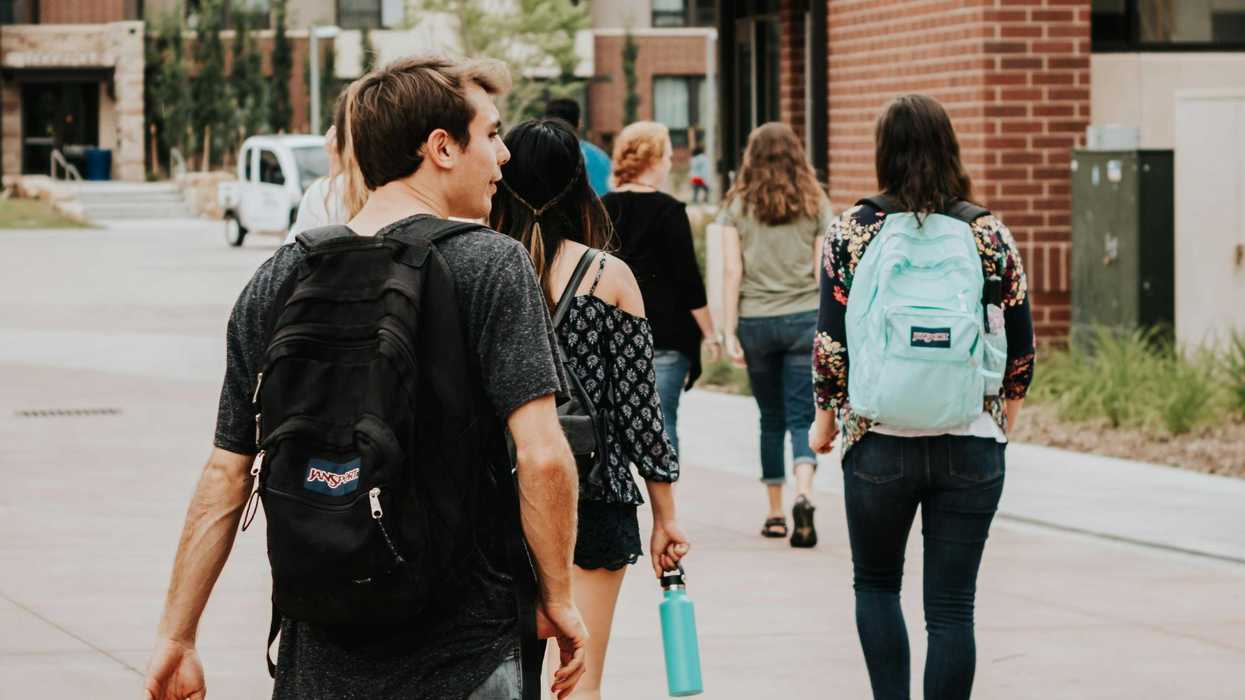
“I really want to be able to discuss polarizing topics,” she said. “But as long as it’s a safe space.”
This common sentiment reflects recent data on students’ attitudes toward speech on campus: a 2024 Knight Foundation study found that 91% of students value free speech as “very important” or "important," while 64% of students believe colleges should offer “safe spaces” on campus, with only 15% opposed.
But what do students really mean by “safe spaces”? Some students use the term to refer to spaces that are physically safe, especially amid growing fears about ICE on campus. Other students use the term to refer to emotional safety, reflecting spaces where authentic conversation on controversial topics is expected, but with rules: no slurs, for example, or no dehumanizing others. Still others feel that, in safe spaces, certain ideas or viewpoints should be forbidden, because of the harm that they cause.
With such a range of definitions, it’s no wonder that the phrase itself has become polarizing. Some view safe spaces as a must, while others view them as a reflection of weakness or lack of resiliency in my generation. Some have proposed “brave spaces” instead, where students are encouraged to speak with courage about controversial issues. As a 2025 college graduate, I often felt intellectual whiplash on Harvard’s campus, between the promotion and decrying of spaces as “safe,” the introduction of new “brave” spaces, and trying to sort out which was which and what meant what.
As someone who spends my new professional career engaged with speech on college campuses, I propose clarifying the term “safety” in this context, with historical precedent.
In 1958, philosopher Isaiah Berlin gave a speech at Oxford entitled “Two Concepts of Liberty.” At the time, Berlin responded to increasingly intense clashes between liberalism, socialism, communism, and other ideologies, each claiming to champion “freedom.” In response, Berlin proposed two frameworks of liberty —negative and positive — aiming to add nuance to the term.
Negative freedom can be described as “freedom from,” as in freedom from restriction. It’s the freedom to do whatever you want, whenever you want, because you are a free person. In contrast, positive freedom is described as “freedom to,” as in, the freedom to have certain entitlements or rights, the retention of which may require some limitations on your negative freedom. For example, because everyone has the right to life, you are not free to murder, and because everyone has the right to free movement, you are not free to evade paying the taxes which fund highways.
This distinction helps resolve conflict between those who view freedom differently. If John were to accuse Sally of being “anti-freedom” for supporting taxes, and Sally in turn called John “anti-freedom” for refusing to contribute to the roads she had the right to travel on, a third party could remind them that in fact they were both “pro-freedom,” but just defined it differently. When someone speaks casually of freedom, they could reasonably be asked, “Do you mean freedom from, or freedom to?”
So how does this all relate to safe spaces? I suggest that the same question, “from, or to?” when applied to the term “safe space,” could have a similarly clarifying and depolarizing effect. When students ask about a safe space, we could ask, “Safe for what?” or “Safe from what?” In doing so, we could better understand their expectations and see how they align with our values. Similarly, when offering “safe spaces,” we could clarify, “This space is safe from non-campus affiliates,” or “This space is safe from slurs.” To step it up a notch, we could even say, “While this space is safe from hateful speech, it is safe for competing viewpoints to be heard and considered.”
Certainly, we cannot 100% control what will be said in a space. But debating whether we should have safe spaces is so ambiguous that it's unproductive. Instead, defining what we mean by them can move the term from a political buzzword to a clarifying statement about what a space is meant to be.
Shira Hoffer is the founding Executive Director of The Viewpoints Project. A 2025 graduate in Social Studies and Religion, she served on Harvard’s Intellectual Vitality Committee for two years, advising and presenting on new strategies for promoting constructive disagreement on campus, and is a practicing mediator in Massachusetts courts. Her senior thesis explored differing campus speech behaviors between religious and secular college students.









U.S. President Donald Trump boards Air Force One on August 14, 2026 at Joint Base Andrews, Maryland. Trump is traveling to Long Island to tour law enforcement facilities in Nassau County and rally support for local Republican candidates ahead of the upcoming midterm elections
Travel Far Enough, You Meet Yourself
Is it possible that our President has simply not traveled enough?
Born and raised in Queens and attending Fordham University in the Bronx, Donald Trump has no record of traveling outside New York until he was over 20, when he transferred to a college in the neighboring state of Pennsylvania. Were his formative years amiss, then, in his learning about other places and other people?
Is his view akin to the famous New Yorker cover by Saul Steinberg, an illustration of the United States with New York City as the epicenter of the country and the Hudson River the border of the known world? We can now at least add Washington, D.C., and Mar-a-Lago to the map of “the realm.”
Our President has now traveled some, but what we recommend is another kind of travel. Not a state-sponsored trip or a venture to scout locations for future Trump Towers. This would be a genuine travel experience, enriching and eye-opening, showcasing other cultures and ways of living.
It will extend far beyond viewing military parades, hobnobbing with such “understanding” world leaders as Kim Jong Un, or taking tea with the King.
WHERE, then, should the President go? As Elon Musk’s Starship spacecraft is not yet ready to take passengers to Mars, perhaps he could explore our own vast country?
Maybe he could travel to “flyover country,” the farming states, where his ying-yanging tariffs and trade restrictions have played havoc with rural economies. Or possibly to California, number one in homeless U. S. citizens, and while there, regale homeless veterans (approximately 32,500 nationwide) with tales of his brave exploits invading and bombing foreign countries.
Or he might tour the Great Lakes, and rename the other four?
WHEN should he go? This will be tough, as he is very busy building his ballroom and renaming bodies of water.
How about a trip in early November, around the midterm elections? Despite the long-discredited accusation of widespread voter fraud, it would be reassuring to know he might be so caught up divvying out ladles of soup in a soup kitchen somewhere that he wouldn’t remember to deploy the military for “election security.”
HOW will he travel? He should definitely not take his Qatari-donated, newly renovated 747, especially after last time, when he had to be smuggled off clandestinely in a catering truck. It’s unlikely any traveling companions, like the Secretary of State or of the Treasury, are going to fall for the ruse a second time. Besides, we may need those people. No more decoys!
Perhaps the President could fly commercially, although this likely would expose him to undue suffering. Without gold bathroom fixtures and maple wood floors, the trip will be no “Luxury Experience.” If only he still had his “Trump Shuttle,” bought with a massive loan he later defaulted on, saying then, “I’m smart. I got out at a good time.”
Considering the potential pitfalls, maybe it’s best the President travel incognito, disguised perhaps as an elderly woman wearing a lot of bronzer.
Wherever, whenever, however: our President needs a vacation.
Moreover, we need a vacation from him.
If the President refuses our travel suggestions, here’s another idea:
Let’s get him a pet! He has never owned a pet. As we know with our children, pets teach essential life lessons: compassion and empathy; they instill a sense of responsibility. There is a well-established connection between those who can care for a pet and those who can care for people.
So, which pet should we choose? A puppy? A kitten? A boa constrictor?
Imagine, the President may even decide he likes having a pet. After all, what is more obedient than a well-trained dog, besides possibly the Cabinet? And what is more docile than a sweet kitten, other than plausibly the Supreme Court?
The President may even become more mellow with a pet afoot and less likely to slap tariffs on our allies, or attempt to annex our neighbors, or bully our Congress. (Realizing, of course, a bully requires active participation from the bullied to maintain his status.)
Maybe we should do both: get the President a pet and devise a travel plan for him. (Do you think we could possibly convince him to leave his phone at home?)
Let’s go for it! After all:
Travel far enough, you meet yourself. (David Mitchell)
And for our President, that would likely be the most profound discovery of all.
Amy Lockard is an Iowa resident who regularly contributes to regional newspapers and periodicals. She is working on the second of a four-book fictional series based on Jane Austen’s “Pride and Prejudice."